Silicones in skincare: what they do on your skin and why silicone-free isn’t proof of quality
NATURAL SKINCARE
Silicones in skincare are synthetic polymers built from silicon–oxygen chains, used mainly for slip, a smooth feel on the skin and a thin, water-repellent film. Common silicones such as dimethicone are considered well tolerated by the skin: because of their molecular size, they barely penetrate and rarely cause reactions. The justified criticism concerns the environment – more precisely, three cyclic silicones that the EU is restricting step by step. So ‘silicone-free’ says little about whether a cream is any good.
What do silicones do in skincare?
In skincare, silicones mainly do one thing: they change how a product spreads and feels on the skin. Chemically, they are chains of silicon and oxygen with methyl groups, and they are entirely synthetic. Depending on chain length and shape, the results are very different. Short, ring-shaped silicones such as cyclopentasiloxane evaporate after application and act as a light carrier that lets a cream ‘sink in’ quickly. Linear silicones such as dimethicone stay on the skin as a thin, smooth film and create the velvety feel that many people associate with a high-quality texture. Cross-linked silicones, known as crosspolymers, give primers and creams a powdery, matte finish. The Cosmetic Ingredient Review expert panel assessed 62 of these dimethicone crosspolymers and describes their roles as including film formers, emollient skin-conditioning agents, slip modifiers and thickeners for water-free products.
What silicones are not is an active skincare ingredient in the strict sense. They provide neither moisture, as hyaluronic acid does, nor lipids, as ceramides do. Their contribution is texture, shine in hair and a degree of protection against water loss thanks to the film. You will also notice that a cream with silicones behaves differently from one without when you layer several products. If your skincare starts pilling into little rolls, the interplay of film formers is often behind it – more on this in why your cream balls up on your face.
Are silicones bad for your skin?
No – according to the available data, the silicones commonly used in skincare are not harmful to the skin. The most thorough assessment comes from the Cosmetic Ingredient Review, a US expert panel that systematically evaluates cosmetic ingredients. Its final report on dimethicone and related silicones, published in the International Journal of Toxicology, states that dimethicone was not absorbed after application to the skin in clinical and animal studies. In most irritation tests it was classed as a minimal irritant, and in a repeated patch test with 83 people it did not cause sensitisation at a concentration of 5.0 per cent. Because of the large molecular weight, the panel considered it unlikely that these polymers penetrate the skin to any significant extent, and it rated them as safe at the usual use concentrations of up to 15 per cent.
That does not mean every silicone cream suits every skin. If your skin does react to a product, however, fragrances, essential oils or individual preservatives are far more often the cause than the silicone. Which of these substances genuinely matter for sensitive skin is covered in the article on skincare without additives. If you avoid silicones anyway because you do not like how they feel on your skin, that is a perfectly legitimate reason. It just is not a health reason.
Do silicones clog pores?
There is no evidence that silicones clog pores, and dimethicone itself is not considered a typical trigger of blackheads. The myth comes from the way it feels: a silicone film feels smooth and sealed, so it is tempting to imagine that the skin underneath can no longer ‘breathe’. But a thin film on the surface is not the same as a plug in the follicle. Whether a product encourages breakouts for you depends more on the formula as a whole – on heavy oils and waxes, on the amount you apply and on how thoroughly you cleanse in the evening. With primers and make-up that contain a lot of silicone in particular, it pays to use a cleanser that genuinely dissolves the film. Why a list of individual raw materials tells you less than the finished formulation is explained in detail in the article on comedogenic ingredients. The honest test remains the same: use a new product for a few weeks as the only change and watch what happens, rather than judging by an ingredient list.
How do you spot silicones on an ingredient list?
You can spot silicones on the INCI list by typical name components, above all ‘-cone’ as in dimethicone, ‘-siloxane’, and ‘silicone’ or ‘siloxy’. Ingredients are generally listed in descending order of quantity, so the further up a silicone appears, the more of it the product contains. These are the names you will come across most often:
| INCI name | Type | Typical job |
|---|---|---|
| Dimethicone, Dimethiconol | Linear, stays on the skin | Smooth feel, light film |
| Cyclotetrasiloxane (D4), Cyclopentasiloxane (D5), Cyclohexasiloxane (D6), Cyclomethicone | Cyclic, volatile | Carrier, evaporates after application |
| Dimethicone Crosspolymer, Polysilicone-11 | Cross-linked | Matte, powdery finish |
| Phenyl Trimethicone, Amodimethicone | Modified | Shine, mainly in hair care |
| Trimethylsiloxysilicate | Silicone resin | Adhesion in long-wear make-up |
A common mix-up: silica is not a silicone. It is silicon dioxide, a mineral powder used in creams and powders to reduce shine, for example, or to help powders flow freely. The only thing it shares with silicones is the element silicon. The same goes for clay minerals such as Magnesium Aluminum Silicate. So if you simply scan the list for ‘sili’, you can easily end up with a false alarm.
How valid is the environmental criticism of silicones?
The environmental criticism has substance, but it mainly concerns three cyclic silicones rather than silicones across the board. In 2018, a committee of the European Chemicals Agency identified D4, D5 and D6 as substances of very high concern because they are very persistent and accumulate very strongly in living organisms; D4 is also considered persistent, bioaccumulative and toxic. According to EU Regulation 2024/1328, widespread use in cosmetics is the main route by which these substances reach the environment. The result is a restriction in two stages:
- D4 and D5 in wash-off products such as shampoo or shower gel: only permitted below 0.1 per cent since 31 January 2020.
- All other cosmetic products, including creams, serums and make-up, as well as D6 in any kind of cosmetic: likewise below 0.1 per cent after 6 June 2027.
- Linear silicones such as dimethicone are not restricted themselves. If they contain residues of D4, D5 or D6, however, the same limit applies to the finished cosmetic product.
That is EU law. In Switzerland, chemical restrictions of this kind are governed by a separate ordinance, but many products on Swiss shelves are formulated for the European market anyway.
That leaves the question of microplastics. The EU microplastics restriction (Regulation 2023/2055) explicitly covers only polymers that are solid. Liquid silicones such as dimethicone therefore do not fall under the legal definition. Things may look different for solid, cross-linked silicone particles, such as powdery crosspolymers, depending on the shape and size of the particles. Some shopping guides nevertheless count liquid synthetic polymers as ‘liquid microplastics’ – that is a matter of definition, not a measured finding. Conversely, the fact that a substance is not a microplastic in the legal sense does not mean it disappears quickly from the environment. The criteria that really count ecologically when choosing a cream are covered in the article on sustainable face cream.
Is silicone-free skincare automatically better?
No, silicone-free skincare is not automatically better – it is simply formulated differently. ‘Silicone-free’ tells you what is missing, but not what has taken its place or whether the formula suits your skin. Something has to take over the silicones’ jobs: plant oils, squalane, esters, waxes or polysaccharides. That can work very well, but on some skin types it can also feel richer or turn shiny faster than a silicone cream. You will know the same pattern from parabens: ‘paraben-free’ only means preserved differently, not safer. And swapping silicones for paraffin gains you little – that is a topic of its own, covered in mineral oil in skincare.
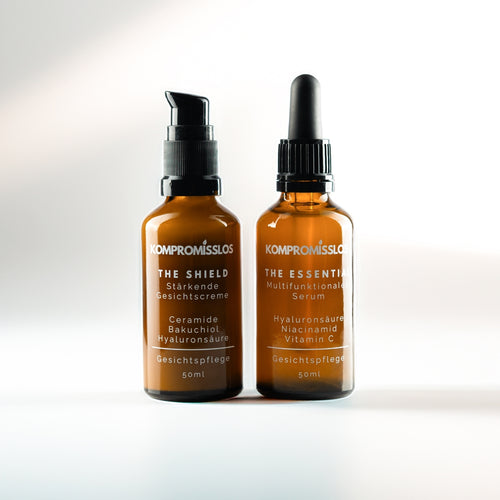
Other questions matter more when you are deciding what to buy. Which active ingredients does it contain, and at what concentration? Does the product contain fragrance? Does the texture suit your skin and the time of year? The Duo also does without silicones, but for us that is not proof of quality, simply a property of the formula. How that feels on the skin is subjective. In her review on Judge.me, Iris S. writes: ‘The cream absorbs quickly. Together, the two give a very smooth feel on the skin.’ (review translated from German)
If you want to avoid a product, decide according to your reason. If it is the feel on your skin that bothers you, look out for ‘-cone’ and ‘-siloxane’. If the environment is your concern, D4, D5, D6 and cyclomethicone are the names that matter.
The Duo contains no silicones, neither in the serum nor in the cream. I deliberately do not turn that into a health argument, because the data on dimethicone on the skin does not support one, and it would be dishonest to make you afraid of a substance we simply do not use. What I can tell you openly instead is this: the cream may feel different from many silicone creams because of it. In our formula, the smooth glide comes from squalane, jojoba oil and plant lipids, and that can feel unfamiliar at first. If you look for the word silica in our list, you will find it: that is silicon dioxide, not a silicone. Everything that goes into it is listed in full on the page with all our ingredients from A to Z.
Frequently asked questions
Is dimethicone harmful?
No, according to the Cosmetic Ingredient Review assessment, dimethicone is considered safe at the usual concentrations. It was not absorbed through the skin after application, was classed as a minimal irritant in most irritation tests and did not cause sensitisation in a test on 83 people. If you avoid it, that is more likely to be because of how it feels on your skin than for health reasons.
Why does silicone-free cream feel different?
Because it lacks the smooth, velvety film that silicones leave on the skin. Silicone-free creams rely on oils, squalane or esters, which need to be worked in a little more and can initially feel slightly richer or less ‘slippy’. That is not a sign of poorer skincare, just of a different texture.
Are cyclic silicones banned?
Partly. In the EU, D4 and D5 have only been allowed below 0.1 per cent in wash-off products since 31 January 2020. For all other cosmetic products, including creams and make-up, this limit applies to D4, D5 and D6 after 6 June 2027. Until then, they are still permitted in leave-on products.
Are silicones microplastics?
Under the EU definition, liquid silicones such as dimethicone are not microplastics. The EU microplastics restriction only covers solid synthetic polymer particles, which may include solid silicone crosspolymers depending on particle size. Some guides still speak of ‘liquid microplastics’. That is a question of terminology; the environmental issue mainly concerns the volatile cyclic silicones D4, D5 and D6.
Do silicones stop active ingredients from getting through?
There is no good evidence for that. In many serums, silicones are themselves part of the base in which the active ingredients are dispersed, and the product still works. What matters more is the order: a light serum first, then a cream with film-forming ingredients. A thick silicone primer belongs at the end, not under your serum.
Are silicones allowed in natural skincare?
Not in certified natural cosmetics, because silicones are entirely synthetic and the well-known natural cosmetics labels exclude them. Conversely, not every silicone-free product is natural skincare. Many conventional brands now also do without silicones without changing anything else in their formulas. What counts is still the full ingredient list.
Is The Duo silicone-free?
Yes, according to the ingredient list, The Duo contains no silicones. The silica on the list is silicon dioxide, not a silicone. We do not see this as proof of quality but as a property of the formula: the feel on the skin comes from squalane, jojoba oil and plant lipids. You can see what goes into the serum and the cream on the page for The Duo in detail.
Sources
- Nair B; Cosmetic Ingredient Review Expert Panel. Final report on the safety assessment of stearoxy dimethicone, dimethicone, methicone, amino bispropyl dimethicone, aminopropyl dimethicone, amodimethicone et al. International Journal of Toxicology, 2003. Source
- Becker LC, Bergfeld WF, Belsito DV, Hill RA, Klaassen CD, Liebler DC et al. Safety Assessment of Dimethicone Crosspolymers as Used in Cosmetics. International Journal of Toxicology, 2014. Source
- European Commission. Commission Regulation (EU) 2024/1328 of 16 May 2024 amending Annex XVII to the REACH Regulation as regards D4, D5 and D6. Official Journal of the European Union, 2024. Source
- European Commission. Commission Regulation (EU) 2023/2055 of 25 September 2023 amending Annex XVII to the REACH Regulation as regards synthetic polymer microparticles. Official Journal of the European Union, 2023. Source