Alcohol effects on skin: what a glass of wine does to your face
SKIN CONCERNS
Alcohol affects the skin on your face mainly through the blood vessels: they widen, your face turns warm and red, and the next morning it often looks puffy and tired. On top of that comes more restless sleep and a small, short-lived diuretic effect. In studies, people who drink heavily on a regular basis report more visible signs of ageing. Skincare cannot undo a glass of wine. This article is about drinking alcohol; for alcohol as an ingredient, see alcohol in skincare.
What does alcohol do to the skin on your face?
Alcohol changes the skin on your face on three timescales: within minutes through blood flow, overnight through sleep and fluid balance, and over the years if you drink heavily on a regular basis. You see the first straight away, because the fine blood vessels in your cheeks, nose and neck widen and more blood flows through the skin. The second shows up in the mirror the next morning: swollen eyelids, a dull complexion, skin that feels tight. The third is quiet and can only be observed in larger studies, not after a single evening. To put this in perspective: almost everything you see the next morning is temporary. One glass of wine does not give you a wrinkle. An evening with little sleep, salty food and several glasses, on the other hand, certainly shows – but usually only for a day. Factors with similar effects, such as too little sleep, smoking or constant stress, often occur together and are rarely easy to separate from alcohol in everyday life.
| What you see | What is behind it | What skincare can do | When to see a professional |
|---|---|---|---|
| Redness, warmth, flushing | Widened blood vessels, the breakdown product acetaldehyde | Cannot prevent it; just avoid adding irritation | If you flush strongly after just a few sips or the redness does not go away |
| Swollen eyelids, puffy face | Shifts in fluid, lying down, salty food | Very little; cold feels pleasant | If the swelling lasts for days even without alcohol |
| Tightness, rougher patches | Restless sleep, a skipped evening routine, dry indoor air | Provide moisture, support the skin barrier | If there is itching, flaking or eczema |
| Tired, dull complexion | A disturbed second half of the night | The skin looks better cared for, but it cannot make up for lost sleep | Rarely necessary |
| More blemishes | Unclear, weak evidence | Avoid applying anything extra that clogs pores | If you have inflammatory acne |
Why does your face go red after a glass of wine?
Your face goes red after a glass of wine because alcohol and its breakdown product acetaldehyde widen the blood vessels in the skin. The face has a particularly large number of fine blood vessels close to the surface, which is why the effect shows there first. How strongly it shows varies a great deal from person to person. A paper in PLOS Medicine describes what is known as the alcohol flushing response: it is caused by an inherited deficiency of the enzyme aldehyde dehydrogenase 2 (ALDH2), which breaks down acetaldehyde. According to the authors, around 36 per cent of people from Japan, China and Korea show this reaction. They estimate the number of people worldwide with this enzyme deficiency at no fewer than 540 million, roughly 8 per cent of the world’s population. Besides redness, the response includes nausea and a racing heart, partly driven by a release of histamine. Whether histamine or sulphites in the wine itself play a major role is often debated, but the evidence for it is thin.
If you flush strongly after just a few sips, or the redness has still not faded by the next day, have it checked by a dermatologist. Other possible triggers are covered in the article on facial redness and what skincare can do. Persistent redness with small bumps or a burning sensation can also point to rosacea; there is more on this in rosacea skincare and when to see a dermatologist.
Why does your face look puffy and dull the morning after?
Your face looks puffy and dull the morning after because several things come together: fluid shifts into the tissue, the blood vessels are still widened, and the night was less restful than it felt. When you lie down, fluid tends to collect in the loose tissue around the eyes, and salty food late in the evening makes this worse. A large survey in the Journal of Clinical and Aesthetic Dermatology involving 3,267 women found that even moderate drinking was linked to more pronounced puffiness under the eyes. The participants rated their own faces, so this is not proof of cause and effect, but it is a pointer that matches everyday experience.
The dull, tired complexion has a lot to do with sleep. A review in Alcoholism: Clinical and Experimental Research states that, at all doses studied, alcohol helps you fall asleep faster, makes the first half of the night more settled and disturbs the second half more. So you fall asleep quickly but still wake up less rested. Puffiness and dullness usually fade over the course of the day, and no cream measurably speeds that up.
Swollen eyelids have many triggers, and alcohol is only one of them. If your eyelids are regularly swollen on alcohol-free days too, it is worth having a doctor take a look rather than buying yet another eye cream.
Does alcohol dry out your skin?
Drinking alcohol dries out your skin less than is often claimed. It does have a diuretic effect, but at normal amounts the effect is small and short-lived. In a randomised study in the journal Nutrients, 20 older men each drank 30 grams of alcohol as beer, wine or spirits, or the same amount of the alcohol-free version. Wine and spirits increased urine output in the first four hours, but over 24 hours there was no longer any measurable difference. Beer made no difference at all. The authors describe the diuretic effect as small and short-lived. If your skin still feels tight the next morning, there are usually other reasons: dry indoor air, too little or restless sleep, and an evening routine that simply got skipped after a long night. The tight feeling is then more a sign of water loss in the outermost layer of skin than of dry skin in the true sense. The difference between the two is explained in the article on dehydrated skin and how it differs from dry skin. You do not need any extra skincare products because of it.
Does drinking alcohol regularly make your skin age faster?
In studies, regular and especially heavy drinking is linked to more visible signs of ageing, but nothing can be concluded from this about the occasional glass. In the survey of 3,267 women from the US, Canada, the UK and Australia mentioned above, heavy drinking, defined as eight or more drinks a week, was associated with more pronounced lines in the upper face, puffiness under the eyes, downturned corners of the mouth, loss of volume in the mid-face and visible thread veins. Moderate drinking was only linked to puffiness under the eyes and loss of volume in the mid-face. The women reported both their faces and how much they drank themselves, so the study shows associations, not causes.
A second example concerns the blood vessels. In a cohort study in the Journal of the American Academy of Dermatology involving 82,737 women from the Nurses’ Health Study II, the risk of rosacea diagnosed by a doctor rose with the amount of alcohol. At 30 grams of alcohol a day or more, the risk was a good half higher than in women who never drank (hazard ratio 1.53). This, too, is an observed association. For context: UV light remains the biggest external influence on skin ageing; you can read more in how to slow down skin ageing. Smoking and a lot of sugar are also discussed, but they are topics of their own.
How should you care for your skin the night and morning after one glass too many?
After one glass too many, you care for your skin exactly as you would on any other day – you just do not skip the routine. That evening, your skin does not need a rescue mask, an exfoliant or an extra active ingredient, but a short routine you can still manage when you are tired. Reddened skin tends to react more sensitively to fragrance, rubbing and too many products, so the rule is: less, and more gently.
- In the evening, remove your make-up if you are wearing any, then cleanse your face with lukewarm water, not hot.
- Gently massage in a serum with humectants, from the centre of your face outwards, without rubbing.
- Apply a cream on top that supports the skin barrier. If your skin is dry, you can use a little more.
- In the morning, follow the same routine, then apply sunscreen separately, because neither serum nor cream contains any.
- For the puffy feeling, cool water helps as a home remedy, without really making the swelling go down any faster.
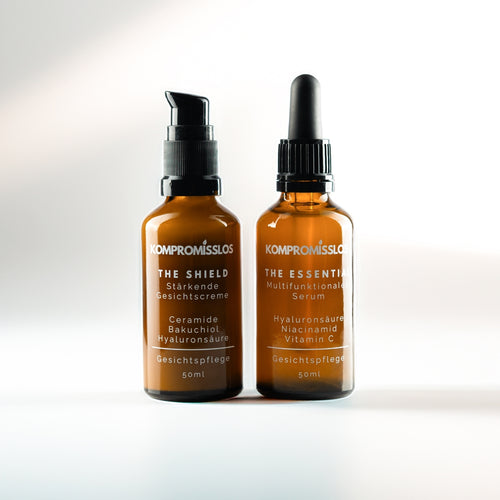
That is exactly how The Duo of The Essential and The Shield is meant to be used: The Essential, with niacinamide and hyaluronic acid in three molecular sizes, provides moisture, and The Shield, with ceramide NP and squalane, supports the skin barrier. Both are fragrance-free and contain no ethanol or Alcohol Denat.; they do contain the skin-conditioning fatty alcohol Cetearyl Alcohol. This will not help with flushing, swelling or redness caused by alcohol, but it can help your skin look calmer and suppler in the morning.
I reduced Kompromisslos to two products instead of eight, and the evening after a party shows why. When you get home at midnight, you do not need five steps or a rescue mask, just the same short routine as always: cleanse your face with water, serum, cream, done. Both products are fragrance-free, because reddened skin in particular does not need the extra irritation of fragrance. One thing I want to say openly: no skincare can prevent redness caused by alcohol, ours included. Anyone who promises you otherwise is selling you a clear conscience rather than a result. What the routine can provide is a reliable foundation, even on days when everything else did not quite go to plan. You can see exactly what the two steps look like in how to apply the serum and cream.
Frequently asked questions
Is red wine worse for your skin than white wine or beer?
There is no good evidence that red wine is especially bad for your skin. In a large cohort study, a higher risk of rosacea was linked mainly to white wine and spirits. In a small study on the diuretic effect, beer made no difference, while wine and spirits only did so in the first few hours. For your skin, the amount matters far more than the type of drink.
How quickly does your skin recover when you stop drinking?
The short-term effects pass quickly: flushing usually fades after a few hours, and puffiness and a dull complexion over the course of the following day. There are no reliable studies with a timeline for longer-term changes after a longer break from alcohol. Promises with fixed timeframes are based on personal accounts, not data.
Can alcohol cause spots?
A direct link between alcohol and spots is poorly supported by evidence. Indirectly, an evening with little sleep and a skipped cleanse can contribute to a more uneven-looking complexion. If you have recurring inflamed blemishes or acne, have it looked at by a dermatologist rather than blaming the wine.
Why do I go red after just a few sips?
Flushing quickly and strongly after just a few sips is often caused by an inherited deficiency of the enzyme ALDH2, which breaks down acetaldehyde. It is common in people of East Asian descent, but it is not limited to them. If this applies to you, or if you are worried about your drinking, your GP is the right person to talk to.
Does alcohol make rosacea or couperose worse?
Alcohol is one of the most commonly cited triggers for rosacea flare-ups, and in a large cohort study, more alcohol was linked to a higher risk of rosacea. With couperose and broken capillaries, it also temporarily widens thread veins that are already visible. In both cases, diagnosis and treatment belong with a dermatologist.
Should I take off my make-up after a night of drinking, even if I am tired?
Yes, if you are wearing make-up, it is worth removing it even when you are tired. Make-up and sunscreen left on overnight on irritated, warm skin are not a good combination. After that, the short routine of cleansing with water, serum and cream is enough. You can skip extra steps such as an exfoliant or a mask that evening.
Do I need anything different after an evening of wine if I use The Duo?
No. As always, you use 3 to 6 drops of serum and 3 to 6 pumps of cream, a little more if your skin is dry. You do not need an extra product, and The Duo does not prevent redness or swelling caused by alcohol either. It provides moisture and supports the skin barrier, so your skin looks calmer in the morning.
Sources
- Brooks PJ, Enoch MA, Goldman D, Li TK, Yokoyama A. The alcohol flushing response: an unrecognized risk factor for esophageal cancer from alcohol consumption. PLoS Medicine, 2009. Source
- Goodman GD, Kaufman J, Day D, Weiss R, Kawata AK, Garcia JK et al. Impact of Smoking and Alcohol Use on Facial Aging in Women: Results of a Large Multinational, Multiracial, Cross-sectional Survey. The Journal of Clinical and Aesthetic Dermatology, 2019. Source
- Ebrahim IO, Shapiro CM, Williams AJ, Fenwick PB. Alcohol and sleep I: effects on normal sleep. Alcoholism: Clinical and Experimental Research, 2013. Source
- Polhuis KCMM, Wijnen AHC, Sierksma A, Calame W, Tieland M. The Diuretic Action of Weak and Strong Alcoholic Beverages in Elderly Men: A Randomized Diet-Controlled Crossover Trial. Nutrients, 2017. Source
- Li S, Cho E, Drucker AM, Qureshi AA, Li WQ. Alcohol intake and risk of rosacea in US women. Journal of the American Academy of Dermatology, 2017. Source