Snail mucin cream: what it actually does and the vegan alternatives
NATURAL SKINCARE
A snail mucin cream contains the filtered secretion of farmed snails, usually listed in the INCI as Snail Secretion Filtrate. The secretion contains sugar-rich proteins, allantoin and glycolic acid, and can help keep the skin hydrated. The evidence is thin: a handful of small studies, several of them funded by manufacturers. Snail mucin is not vegan. Hydration, soothing and barrier support can all be covered by vegan ingredients, some of which have been studied more thoroughly.
What is snail mucin in creams, and where does it come from?
Snail mucin in creams is the secretion of land snails, which is collected, filtered and worked into skincare products as a raw material. It usually comes from the common garden snail, which appears in studies under the Latin names Helix aspersa or Cryptomphalus aspersa. The snail produces the mucus to move around, keep its body moist and protect its own skin. That observation gave rise to the idea of using the secretion on human skin as well. A Spanish manufacturer developed a standardised filtrate from it, and several of the clinical studies are based on this filtrate. Snail mucin became widely known, however, through Korean skincare, where it is a staple in the form of essences, serums and creams.
In that context, snail mucin is usually one step among many. Whether you need that many steps at all is covered in the article on what the Korean 10-step routine actually does and doesn’t do. This article is about the one ingredient: what is in it, what the evidence supports and which of its jobs other ingredients can take over.
What is in snail mucin, and which parts of it actually work on the skin?
Snail mucin is mainly water with dissolved mucins – large, sugar-rich proteins – plus smaller molecules such as allantoin and glycolic acid. On the skin, the mucins form a fine, moisture-binding film, much like other polysaccharides and humectants. In cosmetics, allantoin is considered soothing and smoothing, while glycolic acid is a fruit acid that loosens dead skin cells. That both substances are present in the mucus has been confirmed analytically: a paper in the Journal of Chromatography A developed a method for measuring allantoin and glycolic acid simultaneously in snail mucus and in creams containing it, and applied it to several batches.
The crucial point is the amount. In a finished cream, the filtrate is diluted, and no packaging tells you how much allantoin or glycolic acid ends up on your skin. The composition also varies with the snail species, its feed and the collection method. For glycolic acid, this means you cannot count on an exfoliating effect: a snail cream is no substitute for a properly dosed exfoliant. What mainly shapes how your skin feels are the moisture-binding components – and that is exactly the job other ingredients can do too.
What do studies on snail mucin cream really show?
Studies on snail mucin cream show measurable effects on fine lines, skin texture and water loss, but in only a few trials with few participants. The best-known paper appeared in the Journal of Drugs in Dermatology in 2013: for twelve weeks, 25 people with moderate to severe photoageing applied an emulsion with 8% and a serum with 40% snail secretion to one side of their face and a placebo to the other. The fine lines around the eyes improved significantly on the side with the active product. The participants themselves noticed an improvement in fine lines after eight weeks, but reported no significant difference in the quality of their skin.
A 2020 study in the Journal of Clinical and Aesthetic Dermatology compared a regimen with snail secretion and snail egg extract against a placebo regimen in 50 women aged 45 to 65. In the active group, the skin’s water loss decreased, and roughness, firmness and elasticity improved. Fine lines, however, improved in both groups. The study was funded by the manufacturer of the extracts, and the authors themselves call for larger studies. A review in the Journal of Cosmetic Dermatology reached the same conclusion in 2024: most of the research is preclinical or consists of small clinical studies.
Research on wound healing and scars consists mainly of laboratory and animal studies. If you want scars, broken skin or acne treated, a dermatologist is the right person to see, not a cream off the shelf.
Who is snail mucin suitable for, and when should you be careful?
Snail mucin is best suited to skin that needs moisture and responds well to light, gel-like textures – in other words, normal to dry or mildly dehydrated skin. It is not an active ingredient with a clearly defined job, like niacinamide or a retinoid, but rather a hydrating building block. You should be careful if you are allergic to shellfish, molluscs or house dust mites. A review of snail allergy in Current Issues in Molecular Biology describes several allergens in snails, including tropomyosin, and reports cross-reactions with house dust mites. The paper deals with eating snails, not with cosmetics. How often snail mucin causes skin reactions has barely been studied – and that is precisely the gap the review in the Journal of Cosmetic Dermatology points out as well.
- If you have a known allergy to seafood, snails or mites, get it checked by a doctor or allergist first.
- Test a new product on a small area for a few days first, for example on the side of your neck.
- If you get itching, hives or swelling, stop using the product and see a doctor.
- If your skin is sensitive, check the rest of the formula too, as fragrances are among the common triggers of contact allergies.
How is snail mucin collected, and is it vegan?
Snail mucin is obtained from farmed snails and is therefore never vegan, however gentle the method is said to be. The animals produce the secretion in response to movement or other stimuli. Manufacturers describe their processes in very different ways, and how stressful the collection is for the animals is hard to verify from the outside. The review in the Journal of Cosmetic Dermatology explicitly lists the ethics of how the snails are kept during collection among the open questions. A ‘cruelty-free’ label on a snail cream usually refers to animal testing, not to the absence of animals from the process.
For a vegan routine, snail mucin is therefore ruled out, just like other animal-derived raw materials. Which ones those are, and how to tell that a vegan face cream really contains nothing animal-derived, is covered in a separate article.
Which vegan ingredients do the same jobs?
The jobs snail mucin promises to do – hydration, soothing and barrier support – can be taken over by vegan humectants, lipids and active ingredients such as niacinamide. Instead of mucins, plant humectants such as tamarind seed and biotechnologically produced polysaccharides bind water on the skin. In cosmetics, hyaluronic acid is mostly produced by fermentation today, in which case it is vegan. You can read more about what hyaluronic acid really does for skin in the dedicated ingredient article. Allantoin itself is available in synthetic form – no snail required. If your main aim is to calm irritated skin, panthenol as a soothing humectant is a good choice.
| What snail mucin promises | Component in the mucus | Vegan alternative | In the Duo |
|---|---|---|---|
| Moisture film | Mucins (sugar-rich proteins) | Polysaccharides from plants or fermentation | Tamarind seed polysaccharide, Biosaccharide Gum-1 |
| Binding water | Mucins, water | Hyaluronic acid, glycerin, aloe vera | Hyaluronic acid in three molecular sizes, aloe vera as the base of both products |
| Soothing | Allantoin | Synthetic allantoin, panthenol | Panthenol, no allantoin |
| Supporting the barrier | Not specific | Ceramides, squalane, niacinamide | Ceramide NP and squalane in The Shield, 5% niacinamide |
| Gentle smoothing | Small amounts of glycolic acid | A separate exfoliant, if needed at all | Not included |
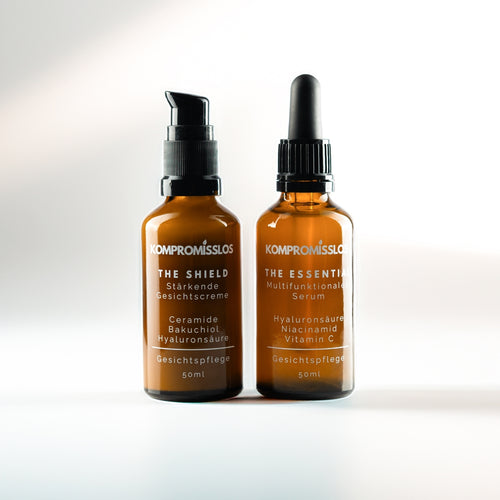
In the Duo of serum and cream, these jobs are split across two products: The Essential serum provides hyaluronic acid in three molecular sizes and niacinamide, while The Shield cream provides ceramide NP and squalane. The Duo also contains panthenol, tamarind seed polysaccharide and Biosaccharide Gum-1. You do not need a snail mucin essence underneath. In her review on Judge.me, Barbara F. writes that she followed a Korean 7-step routine for years, and sums up the switch like this: ‘Two products, clear ingredients, no frills’ (review translated from German).
For me, vegan is a firm decision: nothing in our products comes from animals. So no snail mucin and no animal collagen. Instead, I rely on humectants and barrier-supporting ingredients that I can disclose, with concentrations where they exist, such as 5% niacinamide. And on two products rather than layering an essence, an ampoule and a cream. But being honest also means saying this: what applies to snail mucin applies to our vegan alternatives too. They support hydration and the skin barrier; they do not treat scars or wounds. I have set out what each individual ingredient does in our detailed guide to the active ingredients.
Frequently asked questions
Is snail mucin cream vegan?
No, a snail mucin cream is never vegan, because the raw material comes from living snails. A gentle collection method does not change that. A cruelty-free label only means that the product was not tested on animals, not that it is free from animal-derived raw materials. If you want a vegan routine, choose plant-based or synthetic humectants.
How can I recognise snail mucin on an INCI list?
Snail mucin usually appears in the INCI as Snail Secretion Filtrate. Some manufacturers also declare it using the snail’s Latin name, for example with Helix Aspersa in the ingredient name. How far up the list it appears gives a rough idea of how much is in the product. Our separate guide explains how to read an ingredient list and see what’s really in your cream.
How long does snail mucin cream take to work?
Your skin feels different straight away, because the mucus binds moisture. The studies assessed visible changes in fine lines after eight to twelve weeks and after three months respectively. So give a new cream around three months before you judge it.
Does snail mucin help with acne marks or scars?
There is no solid evidence for this. Research on scars and pigmentation consists mainly of laboratory and animal studies, plus a few small trials. Scars belong in the hands of a dermatologist. For red and brown marks left behind by breakouts, it is worth looking at what actually fades acne marks.
Can I combine snail mucin with retinol or vitamin C?
Yes, snail mucin is considered a mild hydrating ingredient and can generally be combined with retinol or vitamin C. The order follows the texture, so the lighter product goes on first. If your skin becomes irritated, retinol or an acidic form of vitamin C is the more likely trigger. If in doubt, introduce new products one at a time.
Can I be allergic to snail mucin?
Yes, that is possible, even though there is hardly any data on cosmetics. Snails contain allergens such as tropomyosin, which is also found in other molluscs, and cross-reactions with house dust mites have been described. If you have one of these allergies, test a new product on a small area first or talk to your doctor beforehand.
Do I need snail mucin if I use The Duo?
No. The jobs snail mucin promises are covered in the Duo by vegan ingredients: hyaluronic acid in three molecular sizes and niacinamide in the serum, ceramide NP and squalane in the cream, plus aloe vera, panthenol and tamarind seed polysaccharide. An extra snail essence makes your routine longer without taking on any job that The Duo isn’t already designed for.
Sources
- Fabi SG, Cohen JL, Peterson JD, Kiripolsky MG, Goldman MP. The effects of filtrate of the secretion of the Cryptomphalus aspersa on photoaged skin. Journal of Drugs in Dermatology, 2013. Source
- Lim VZ, Yong AA, Tan WPM, Zhao X, Vitale M, Goh CL. Efficacy and safety of a new cosmeceutical regimen based on the combination of snail secretion filtrate and snail egg extract to improve signs of skin aging. Journal of Clinical and Aesthetic Dermatology, 2020. Source
- Singh N, Brown AN, Gold MH. Snail extract for skin: a review of uses, projections, and limitations. Journal of Cosmetic Dermatology, 2024. Source
- El Mubarak MA, Lamari FN, Kontoyannis C. Simultaneous determination of allantoin and glycolic acid in snail mucus and cosmetic creams with high performance liquid chromatography and ultraviolet detection. Journal of Chromatography A, 2013. Source
- Mederos-Luis E, Poza-Guedes P, Pineda F, Sánchez-Machín I, González-Pérez R. Gastropod allergy: a comprehensive narrative review. Current Issues in Molecular Biology, 2024. Source