PDRN cream (salmon DNA): what the K-beauty trend can really do for your skin
ACTIVE INGREDIENTS
A PDRN cream contains purified fragments of DNA, traditionally taken from the sperm cells of salmon or trout, and is sold on the K-beauty shelf as a regenerating ingredient. The solid data on PDRN, however, comes almost entirely from injections and wound care. For creams there are only a few small studies, and the large DNA molecules struggle to get through the skin’s outermost layer. Realistically, a PDRN cream looks after the skin’s surface, just as other well-formulated creams do.
What is PDRN, and why is there salmon DNA in creams?
PDRN stands for polydeoxyribonucleotide – purified fragments of DNA that are traditionally extracted from the sperm cells of salmonid fish. A review in the journal Biomolecules names rainbow trout and chum salmon as the main sources. That is where the buzzword “salmon DNA” comes from, along with the rather misleading “salmon sperm” of social media videos: the cream does not contain sperm cells, but DNA that has been isolated from them, purified and broken down into fragments. Medically, the substance is nothing new. According to the same review, the first medicine with PDRN as its active ingredient was approved in 1994, for tissue damage with impaired regeneration, up to and including ulcers. Since then, PDRN has been studied in wound care and later in aesthetic medicine as well. In cosmetics, it took off mainly through Korea, where polynucleotide injections are common in clinics and the cream is readily marketed as a way to get clinic results at home. How such creams fit into a routine there is covered in our article on what the Korean 10-step routine does and doesn’t do.
PDRN and polynucleotides (PN) are the same basic material in different chain lengths. The review describes a typical molecular mass of 50 to 1,500 kilodaltons and proposes calling anything from 1,500 kilodaltons upwards a polynucleotide and anything below it PDRN. On packaging, however, both terms are used freely, often simply as “salmon DNA”.
What is the evidence for PDRN: injections, wound gels or creams?
The evidence for PDRN is strongest where it is injected into the skin or applied to damaged tissue in a medical setting, and there is hardly any for creams on intact skin. A systematic review in the Journal of Cosmetic Dermatology found nine studies with a total of 219 patients who had received polynucleotides by injection. The results for wrinkles, skin texture and elasticity were promising, but the studies themselves were of low to moderate quality, and the authors explicitly call for higher-quality research. Skin booster injections like these are a medical procedure in the dermis, not skincare. If you are considering them, that is a conversation to have at a dermatology practice. Wound care is the second area with data. There, PDRN is studied in impaired wound healing – that is, on tissue that lacks the protective outer layer of the skin, the stratum corneum. These results cannot be transferred to a face cream sitting on healthy, intact skin.
| How it is used | What has been studied | Where the limit lies |
|---|---|---|
| Injection (skin booster with PDRN or polynucleotides) | Small clinical studies on wrinkles, skin texture and elasticity | Studies of low to moderate quality; a medical procedure, not skincare |
| Medical preparations | Tissue repair in impaired wound healing | Open tissue is not an intact skin barrier; no cosmetic promise |
| Cream or serum with salmon PDRN | Individual studies with specially processed fractions | Little independent data; uptake through the stratum corneum unclear |
| Vegan PDRN from plants, algae or microorganisms | Mainly laboratory and cell studies | No proven clinical equivalence with salmon PDRN |
For creams, the first clinical data are now available. A study published in PLoS One in 2026 compared an eye cream containing 0.1% PDRN from salmon sperm with a cream containing 0.1% retinol, in a randomised split-face study of 31 women aged 35 to 55 over 28 days. The PDRN side performed better on fine lines and skin density. The study is small and short, however, it uses a specially processed PDRN fraction, and several of the authors work for biotechnology companies. That does not make the result wrong, but it is an early indication for one particular formulation, not proof for every PDRN cream on the shelf.
Does PDRN from a cream actually get into the skin?
PDRN from a cream gets into the skin only to a very limited extent, because the molecules are many times larger than what the intact stratum corneum normally lets through. In the journal Experimental Dermatology, the Amsterdam dermatologists Bos and Meinardi set out what is known as the 500 Dalton rule: according to it, a substance must be under 500 daltons for the skin to absorb it, and larger molecules do not pass through the stratum corneum. Typical PDRN measures 50 to 1,500 kilodaltons, or 50,000 to 1,500,000 daltons, which puts it 100 to 3,000 times above this threshold. A recent review in the Journal of Functional Biomaterials also notes that the intact stratum corneum lets large, water-loving macromolecules through only to a limited degree, and that it contains a DNA-degrading enzyme of its own. The 500 Dalton rule is a rule of thumb, not a law of nature, and manufacturers work with shorter fragments or carrier systems. In the PLoS One study, a signal typical of PDRN could be measured as deep as the living epidermis after application. The authors themselves point out, however, that their measuring method cannot reliably tell foreign DNA apart from the skin’s own.
You will recognise this pattern from other large molecules. It is the same reason why collagen from a cream doesn’t get into your skin, and a similar debate to the one about peptides in skincare, which are smaller but also struggle to be absorbed.
What can a PDRN cream realistically do for the skin’s surface?
Realistically, a PDRN cream can look after the surface: it holds in moisture, makes the skin feel more supple and helps it look calmer. Most of that, however, comes from the formula around it, not from the DNA alone. Large, water-loving molecules mostly stay on and in the uppermost layers of the skin, where they can bind water and form a light film. That feels pleasant, but it is nothing unique, because hyaluronic acid, glycerin or plant polysaccharides do the same. Many PDRN creams contain these humectants as well, often alongside niacinamide, ceramides or peptides. If your skin feels better after two weeks, it is hard to say which ingredient is responsible. For the surface, what matters most is whether the cream binds water, replenishes lipids and does not irritate. There is a separate article on what a damaged skin barrier really needs. What a cream cannot do: remodel scars, replace aftercare following a procedure or work in the dermis the way an injection does. For scars, after laser treatment or microneedling, and for skin conditions, a dermatologist is the right person to see.
If you want to test a PDRN cream, use it to replace your current cream rather than adding it on top, and change nothing else for four weeks. That is the only way to see whether it does more than what you already had.
What is vegan PDRN, and is it the same as salmon DNA?
Vegan PDRN is DNA from plants, algae or microorganisms instead of fish, and while it is related to salmon PDRN, it is not the same thing. The review in Biomolecules names red algae and ginseng as alternatives that have been studied, and more recent papers describe DNA from plant cell cultures and root cultures. The review in the Journal of Functional Biomaterials cited above, which deals specifically with plant-derived PDRN, is clear on this: the evidence is predominantly preclinical, meaning it comes from cell and laboratory studies, and must not be read as proof of clinical equivalence with animal-derived PDRN. Direct comparisons at the same dose, the same molecular size and the same purity are rare. That is not an argument against vegan PDRN; it simply means that “vegan” and “salmon” are two different raw materials with different amounts of evidence behind them. So compare them by criteria rather than by advertising claims: origin, INCI name, stated concentration and evidence for that exact raw material. And bear in mind that vegan PDRN on its own does not make a cream vegan. How to check the rest of the list is explained in the article on how to tell whether a face cream is really vegan.
How can you tell from the INCI list how much PDRN is really in it?
You cannot tell the exact amount from the INCI list; you can only see the name under which PDRN is declared and roughly how far up the list it appears. Salmon PDRN is usually listed as “Sodium DNA”. Plant-based versions often appear as an extract of a plant cell culture, so the word DNA does not appear at all and only the marketing talks about PDRN. The list is sorted in descending order of quantity, but ingredients present in tiny amounts at the end may be listed in any order. So the position is only a rough guide. These points give you more clarity:
- Name: is “Sodium DNA” or a clearly named extract on the list, or does PDRN only appear on the packaging?
- Position: if the ingredient comes after preservatives or fragrance, the amount is very small.
- Concentration: does the manufacturer state a percentage, or only use terms such as “highly concentrated”?
- Origin: salmon, plant, alga or microorganism – “Sodium DNA” alone does not tell you.
- Evidence: is there data on this exact raw material, or is it advertised with studies on injections?
Without a percentage, you do not know whether the cream is in the region of the 0.1% used in the PLoS One study or far below it. That is not a criticism of individual brands; it is often the case with trending ingredients.
Who is a PDRN cream worth it for, and when can you skip it?
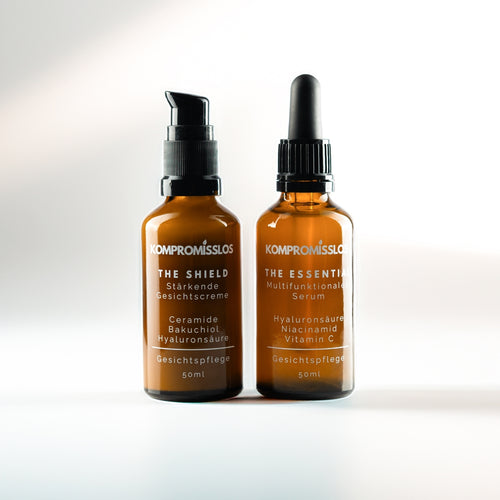
A PDRN cream is worth it if you like its texture and the way it feels on your skin, and you have no problem with salmon DNA. You can skip it if you are hoping for the effect of an injection. For what a PDRN cream can demonstrably do at the surface – moisture, barrier care and a calmer-looking complexion – you do not need salmon DNA. The Duo of serum and cream covers this layer with vegan ingredients: The Essential with hyaluronic acid in three molecular sizes and niacinamide, followed by The Shield with Ceramide NP, squalane and bakuchiol. In her review on Judge.me, Barbara writes: “My skin feels calm, well nourished and gently protected. I like being able to achieve that with just 2 little bottles.” (review translated from German). If you want to try PDRN anyway, the simplest option is to buy it in Switzerland. What to look out for is covered in the article on buying Korean skincare in Switzerland. And if your concern is scars or deeper wrinkles, seeing a dermatologist is more honest than any cream.
Vegan is non-negotiable at Kompromisslos, so salmon DNA does not go into the Duo. According to the INCI list, The Duo contains no PDRN, and therefore no Sodium DNA, and no peptides or collagen either. I decided against a trending ingredient with an unclear concentration and in favour of two products with disclosed figures: 5% niacinamide, 2% vitamin C as 3-O-Ethyl Ascorbic Acid and 1% zinc PCA, calculated for The Duo as a whole. I am just as open about the limit: what an injection into the dermis can achieve, The Duo cannot achieve either. It looks after the surface and supports the skin barrier, and I do not promise more than that. You can see exactly what it contains in our full ingredient list.
Frequently asked questions
Is PDRN really salmon sperm?
No, not literally. Traditional PDRN is extracted from the sperm cells of salmonid fish such as trout or chum salmon; the DNA is then isolated, purified and broken down into fragments. So the cream contains DNA from this raw material, not sperm cells. Salmon PDRN is still not vegan, though.
Is PDRN cream vegan?
Only if the PDRN comes from plants, algae or microorganisms and the rest of the formula also contains no animal-derived raw materials. Salmon PDRN is of animal origin. The INCI name “Sodium DNA” does not reveal the source, because DNA from salmon can be listed under this name just as well as DNA from other sources. If in doubt, ask the manufacturer.
Is PDRN the same as Rejuran or polynucleotides?
Not quite. PDRN and polynucleotides are both DNA fragments, but polynucleotides have longer chains. Rejuran is the brand name of an injectable product from this group, which is injected at a doctor’s practice. A PDRN cream is not an alternative to an injection like this, because it does not reach the dermis in the same way.
Can PDRN in a cream build collagen?
That has not been shown. Cell studies and laboratory tests on skin samples have pointed to more collagen, and one small study with a special PDRN fraction also measured a thicker dermis. No independent study shows that a standard PDRN cream from the shelf measurably builds collagen in the dermis. Realistically, it looks after the surface and makes the skin look plumper.
Is PDRN suitable for sensitive skin or if you have a fish allergy?
Purified DNA from salmonid fish is considered well tolerated in studies, but there are no guarantees. Fish allergies are generally a reaction to proteins, and as a customer you cannot tell how thoroughly a raw material has been purified. If you have a known fish allergy, check with your allergist or dermatologist before you buy.
Can I combine PDRN with retinol, niacinamide or vitamin C?
There are no known combinations to avoid with PDRN; it is neither acidic nor typically irritating. The risk lies more in the sheer amount: if you layer a PDRN cream on top of retinol, vitamin C and niacinamide, you can no longer tell what is working and what is irritating. So introduce new products one at a time.
Do I need a PDRN cream if I use The Duo?
No. The Duo covers the layer a PDRN cream can realistically reach: moisture, barrier care and a calmer-looking complexion. It contains no PDRN and does not work like PDRN either. If you want to try PDRN, use it instead of the cream, not as a third step on top of The Duo.
Sources
- Marques C, Porcello A, Cerrano M, Hadjab F, Chemali M, Lourenço K, et al. From Polydeoxyribonucleotides (PDRNs) to Polynucleotides (PNs): Bridging the Gap Between Scientific Definitions, Molecular Insights, and Clinical Applications of Multifunctional Biomolecules. Biomolecules, 2025. Source
- Lampridou S, Bassett S, Cavallini M, Christopoulos G. The Effectiveness of Polynucleotides in Esthetic Medicine: A Systematic Review. Journal of Cosmetic Dermatology, 2025. Source
- Bos JD, Meinardi MM. The 500 Dalton rule for the skin penetration of chemical compounds and drugs. Experimental Dermatology, 2000. Source
- Ye R, Wang Q, Du L, Li L, Hu F. Topical medium-length PDRN enhances dermal extracellular matrix repair in photodamaged skin via PI3K-Akt/TGF-β-regulated pathways. PLoS One, 2026. Source
- Kim HJ, Lee JW, Kim S, Son KH. Plant-Derived Polynucleotides/Polydeoxyribonucleotides in Skin Biomaterials: Delivery Platforms and Bioactivity Attribution. Journal of Functional Biomaterials, 2026. Source