Glass skin routine: what’s behind the trend and what’s realistic for real skin
ROUTINE
A glass skin routine can make your skin look smoother, plumper and more evenly luminous, but it will not turn it into glass. The look you see in K-beauty images comes from a well-hydrated outer layer of skin, an even surface and a calm skin tone, enhanced by lighting, make-up and often filters. You can cover the skincare part with just a few building blocks: a mild cleanser, a humectant, lipids and sunscreen during the day. Over 40, a plump, calm glow is realistic; a surface with no visible pores is not.
What is glass skin, and where does the trend come from?
Glass skin describes a complexion that looks so smooth, translucent and evenly glossy that it is reminiscent of a pane of glass. The term comes from the Korean beauty world and spread around the globe via Instagram, YouTube and later TikTok. It does not refer to a particular product but to a result: skin on which light sits as a calm, continuous reflection rather than breaking up into patches, flakes or shadows. The term is vague, though. Some people mean a dewy sheen across the whole face, others an almost porcelain-like complexion with a single highlight on the cheekbones. And this is where the first misunderstanding lies: many guides sell a long sequence of products as the way to get there, even though the look depends mainly on properties of your skin, some of which you can influence and some of which you cannot. Whether the well-known sequence of steps makes sense in itself is covered in the article on what the Korean 10-step routine does and doesn’t do. This article is about the goal: what does your skin need in order to look glassy, and how much of that is realistic for real skin?
What makes skin look as smooth and glossy as glass?
Skin looks glassy when four things come together: enough water in the stratum corneum, a smooth surface, an even skin tone and light that is reflected partly from the surface and partly from deeper layers. In a consensus published in the journal Clinical, Cosmetic and Investigational Dermatology, an international panel of ten dermatologists and aesthetic physicians described four categories by which skin quality is perceived: even skin tone, even skin surface, firmness and glow. Glass skin is essentially an attempt to push three of them to the maximum at the same time. Physically, this makes good sense. A smooth surface reflects light in one direction, while a rough one scatters it in all directions and looks matt or dull. When the stratum corneum, the skin’s outermost layer, is well hydrated, its cells lie together more smoothly, and fine flakes or dryness lines are less noticeable. How a lack of water shows in your skin and how to test for it is explained in the article on how to recognise dehydrated skin.
- Water in the stratum corneum: makes the surface supple and the skin look plumper.
- A smooth surface: ensures that light is reflected evenly rather than patchily.
- An even skin tone: without redness and pigmentation marks, the reflection looks calmer and more continuous.
- Light from deeper layers: some of the light penetrates the skin and comes back scattered, which creates the impression of a glow from within.
How much skin tone matters is shown by a study in the Journal of the American Academy of Dermatology. Images of the cheeks of 170 girls and women aged between 11 and 76 were rated by 353 people. The more even the colour distribution, driven mainly by melanin and haemoglobin, the younger, healthier and more attractive the skin was judged to be. What you can do for a more even complexion is covered in a separate article.
How much of the glass skin look is lighting, make-up and filters?
A large part of what shines in glass skin images is created not in the skin but in front of it: in the lighting, the make-up and the photo editing. Ring lights and large softboxes light the face evenly from the front, so the shadows in pores and fine lines disappear. Glow primers, liquid highlighters and dewy setting sprays add an extra reflective film that can be placed precisely on the cheekbones, the bridge of the nose and the forehead. Many smartphone cameras already smooth out skin automatically, and beauty filters go further, editing out pores, redness and texture altogether. What is left is an image that no skin can match in normal bathroom lighting, not even very well cared-for skin. That is not a criticism of the trend, but it is an important benchmark. If you compare your skin with an edited image, you will always lose, however good your routine is. It is better to compare it with itself, in the same light and over several weeks. That is less spectacular, but it shows you honestly what your skincare actually changes.
The most honest test of your own glow: photograph your face without make-up and without filters by a window in daylight, always in the same spot and at the same time of day. After four to six weeks, you will see what has really changed in your skin’s surface and tone.
Which building blocks of a glass skin routine actually make a difference?
In a glass skin routine, four building blocks genuinely contribute to the glass effect: a mild cleanser, a humectant, a layer containing lipids and sunscreen during the day. Humectants such as hyaluronic acid, glycerin or polysaccharides bind water in the stratum corneum. Lipids such as ceramides and squalane sit on top, supplement the skin’s own fats and slow down evaporation. Only this interplay keeps the surface supple over time and lets light reflect back more calmly. Sunscreen protects, in the long term, precisely the skin tone and texture that the whole look depends on. The skincare part needs nothing more, even though many guides recommend seven layers or more. Extra toners, essences and masks usually just deliver similar humectants all over again. How many products make sense in the end is covered in the article on how many products your skin really needs.
| Building block | What it contributes to the glass effect | Do you need it? |
|---|---|---|
| Mild cleanser | Removes sunscreen, make-up and sebum without drying out the skin | Yes, in the evening; in the morning, water is often enough |
| Humectant, for example in a serum | Binds water in the stratum corneum, so the skin looks plumper | Yes |
| Lipids, for example in a cream | Keep the water in the skin, so the surface becomes more supple | Yes |
| Sunscreen | Protects skin tone and texture in the long term | Yes, during the day |
| Several layers of toner or essence | Extra moisture if your serum and cream are very light | Usually not |
| Acid exfoliant | Loosens flakes, so the surface looks smoother in the short term | Occasionally at most |
| Highlighter or glow primer | Adds a visible sheen to the skin | Only if you want the look for a photo or an occasion |
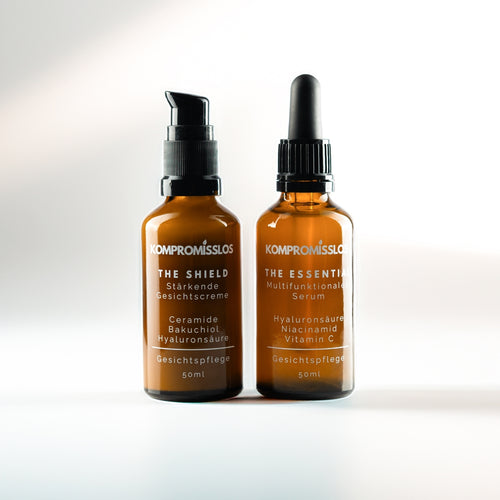
If you want to cover humectants and lipids in two steps, that is exactly how The Duo of serum and cream is built: first the light serum with hyaluronic acid in three molecular sizes and niacinamide, then the cream with ceramide NP, squalane and jojoba oil on top. Neither of the two contains an SPF, so in the morning you add a separate sunscreen for your face. The Duo does not promise the shine of advertising images. It takes care of the part that skincare can actually influence.
Is glass skin realistic for mature skin over 40?
For mature skin over 40, a plump, even glow is realistic, but the smooth, glass-like reflection of very young skin is not – and that is not down to a lack of skincare. A study in Skin Research and Technology compared light reflection from the faces of 83 Japanese women aged between 20 and 49. Younger skin reflected more light from the deeper layers and reflected light more evenly at the surface. The study suggests that this is why younger skin is perceived as glowing from within, while older skin tends to be perceived as shiny. For mature skin, this means that the goal is not more shine on the surface but a more even one. When it comes to water, the picture is more encouraging. According to a study in the International Journal of Dermatology, the water content of the stratum corneum gradually decreases with age, but the change was only statistically significant at one environmentally exposed site on the arm. On the face, it remained higher than on the arms in all age groups, and the authors describe the effect as mild. So moisture remains a realistic starting point at 50 or 60, too.
What skincare cannot achieve in mature skin is firmness from deep within. The consensus mentioned above notes that skin quality can also depend on deeper tissue layers and that skincare applied purely to the surface may not be sufficient for this. Retinol or acids can play a role for the surface, but they are a separate decision, not a mandatory part of a glow goal. In mature skin, a glow tends to come from moisture and an intact barrier rather than from pushing harder with exfoliation. In her review on Judge.me, Nicole B. writes: “The fine lines don’t go away, which isn’t really the idea anyway […], but the overall look becomes softer!” (review translated from German). That sums up pretty accurately what you can realistically expect for mature skin.
When does chasing a glow tip over into skincare overload?
Chasing a glow tips over into skincare overload when the shine no longer comes from moisture but from irritated, over-exfoliated skin or a film left by too many layers. There is a typical pattern: an acid toner every evening, plus an exfoliant, several serums with active ingredients and finally a rich layer to make everything shine. In the short term, the skin then looks very smooth and reflective, but it feels tight, stings when you apply products or turns red. A shine like this is not a sign of health; it can be a sign that the outermost layer of your skin is under stress. Small blemishes that suddenly appear are another warning sign. How to recognise this reliably and how your skin recovers is explained in the article on skincare overload. A rule of thumb for the glass skin goal: if a new step increases the shine but makes your skin feel worse, leave it out. If redness, burning or flaking persist for weeks despite a pared-back routine, have it checked by a dermatologist.
I don’t want to promise you a filter look with The Duo, because no cream can create one. What skincare can influence when it comes to the glass effect is moisture in the stratum corneum and an intact barrier. That is why I made two products instead of eight: a light serum with humectants and a cream with ceramide NP, squalane and jojoba oil. I disclose the concentrations: 5% niacinamide, 2% vitamin C in the stable 3-O-ethyl form and 1% zinc PCA in The Duo, all fragrance-free. We deliberately don’t offer a toner, essence or exfoliant, because for this part they would deliver nothing that the two products don’t already cover. The cream has no SPF, so a separate sunscreen belongs in your daytime routine. How the serum and cream follow each other morning and evening is deliberately kept simple.
Frequently asked questions
How long does it take to get glass skin?
You will often see more hydration within a few days, because a well-hydrated stratum corneum quickly looks plumper. For skin tone and surface, allow several weeks to three months before you judge. Even after months, you will not achieve the glass look of edited images, because it is partly made up of lighting, make-up and filters.
Do I need to double cleanse for glass skin?
No, you don’t need to double cleanse for a glow. It can make sense in the evening if you wear waterproof sunscreen or a lot of make-up that a single mild cleanse does not fully remove. Otherwise, one thorough but gentle cleansing step that doesn’t dry out your skin is enough.
What is the difference between glass skin and dewy skin?
Dewy skin describes a fresh, dew-kissed sheen that looks softer and less perfect. Glass skin also implies a very smooth, almost translucent surface with an even tone. That makes dewy skin the more realistic everyday goal: it needs the same basics of moisture and barrier, but does not demand a surface on which pores are no longer visible.
Does glass skin work for oily or combination skin?
Yes, but the approach is different. Oily skin often already shines, just with an oily sheen in the T-zone rather than an even one. Light hydration without heavy layers helps here, so you don’t add even more shine. If you want a targeted glow, it is better to apply highlighter just where you want it. Layering lots of products on combination skin is more likely to encourage clogged pores than a glow.
Can you get glass skin without exfoliating?
Yes, you can achieve the skincare part of the look without exfoliating. Moisture and lipids already make the surface look smoother. A mild exfoliant can loosen flakes now and then, but it is not a mandatory step. Exfoliating every day to get more shine is more likely to lead to irritation and to a shine that comes from stressed skin.
Are pores really invisible with glass skin?
No, even with glass skin, pores are there and visible in normal light. In photos, they disappear thanks to frontal lighting, make-up, soft-focus effects or filters. Skincare can make pores look finer when the skin is well hydrated and less sebum and fewer flakes accentuate the openings. But no amount of skincare will make them disappear.
How close can I get to the glass skin effect with The Duo?
As close as skincare can get. The Duo provides humectants and lipids in two steps, which is the part of the look that comes from moisture and a supple surface. It can make your skin look plumper and more even. The Duo does not replace shine from lighting, make-up or filters, and you will also need sunscreen during the day.
Sources
- Goldie K, Kerscher M, Fabi SG, Hirano C, Landau M, Lim TS, et al. Skin Quality – A Holistic 360° View: Consensus Results. Clinical, Cosmetic and Investigational Dermatology, 2021. Source
- Matts PJ, Fink B, Grammer K, Burquest M. Color homogeneity and visual perception of age, health, and attractiveness of female facial skin. Journal of the American Academy of Dermatology, 2007. Source
- Matsubara A. Differences in the surface and subsurface reflection characteristics of facial skin by age group. Skin Research and Technology, 2012. Source
- Boireau-Adamezyk E, Baillet-Guffroy A, Stamatas GN. The stratum corneum water content and natural moisturization factor composition evolve with age and depend on body site. International Journal of Dermatology, 2021. Source