Natural Swiss cosmetics: how to tell what’s really inside
SWISS NATURAL SKINCARE
Natural Swiss cosmetics is not a protected term. Neither the word natural nor the Swiss indication of origin tells you anything about what a formula actually contains. Only three things are reliable: the full ingredient list, openly stated concentrations, and where a product is developed and made.
What are natural Swiss cosmetics?
Natural Swiss cosmetics are skincare products whose formula is based mainly on plant, mineral or biotechnologically obtained raw materials and which are offered by a company based in Switzerland. Nothing in this description is legally binding. There is no regulation that specifies the proportion of plant-based raw materials above which a product may be called natural. What does apply is the ban on misleading claims: according to the Federal Food Safety and Veterinary Office (FSVO), advertising claims for cosmetic products must not be misleading and must meet six defined criteria. A technical definition is also provided by the international ISO 16128 standard, which sets out which ingredients count as natural. By its own account, however, this standard explicitly does not regulate advertising claims or labelling. For you, this means: the front of a pack is marketing; the back, with the full ingredient list, is the information.
Natural, nature-derived or synthetic: what’s the difference?
The difference lies in how much a raw material is changed after it has been obtained. A natural ingredient comes directly from a plant, a mineral or a microorganism and is only processed physically – pressed, dried, filtered. A nature-derived ingredient also starts out as a natural raw material but is then processed further by chemical or biotechnological means to make it more stable, purer or better tolerated. A synthetic ingredient is built up in the laboratory, without a plant-based starting material as its basis. This third group has the worst reputation in the debate and only partly deserves it, because many well-researched active ingredients fall into exactly this category. The distinction still matters, though, because many products advertise a high proportion of natural origin, and that figure can vary widely depending on how it is calculated. Water, after all, counts in that calculation.
| Category | What it means | Typical example |
|---|---|---|
| Natural | Comes from a plant, mineral or microorganism and is only processed physically. | Jojoba oil, aloe vera, plant extracts |
| Nature-derived | Starts out as a natural raw material and is processed further by chemical or biotechnological means. | Squalane, fermented hyaluronic acid |
| Synthetic | Built up in the laboratory, without a plant-based starting material as its basis. | Niacinamide, stabilised forms of vitamin C |
Are natural cosmetics automatically better tolerated?
No – natural origin and good tolerance are two different things. The most common triggers of contact allergies in skincare are fragrances, and many of them are found in essential oils, one of the most natural groups of ingredients there is. Citrus oils, lavender or tea tree are entirely plant-based and yet often the most difficult components of a formula for sensitive skin. Conversely, some of the mildest substances in cosmetics belong to the nature-derived or synthetic group, because they were designed specifically to cause hardly any irritation. So tolerance comes down to the individual substance and its concentration, not its origin. A more useful question than whether something is natural is therefore how short and how well thought out a list is. The fewer ingredients a formula contains, the easier it is to find out what your skin doesn’t like. That applies especially if you are prone to blemishes and redness.
What does “Swiss” tell you about a product?
The word Swiss tells you something about the company and the manufacturing, not about the formula. A Swiss head office doesn’t automatically mean the raw materials come from Switzerland, because hyaluronic acid, ceramides or vitamin C are produced worldwide by a small number of specialised manufacturers. Indications of origin such as Swiss Made are tied to specific conditions that relate to manufacturing steps and costs, not to the origin of every single ingredient. What Switzerland does contribute are a few plant raw materials from the Alpine region, above all edelweiss and gentian root extract. Both grow under intense UV radiation and cold, and that is precisely why they are used in skincare. For you, the Swiss label is mainly useful for two other reasons: short delivery routes and a contact who is subject to the same law as you. As a promise of quality for the formulation, it doesn’t hold up.
If origin matters to you, ask specifically: where is the product filled, and where does quality control take place? Reputable brands will answer that without beating about the bush.
How can you tell how much of an active ingredient a product really contains?
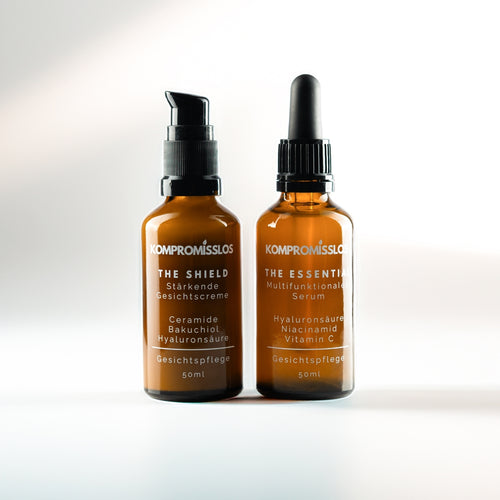
From the order of the ingredient list and from openly stated percentages – from nothing else. Ingredients are listed in descending order of quantity, but only down to a level of one per cent. Anything below that may appear in any order. That is exactly where many of the active ingredients advertised on the front end up. A plant extract that is displayed prominently on the pack but appears in the list after the preservative is present in an amount that does very little. Percentages are voluntary, and that is exactly why it means something when a brand states them. Ours relate to the serum and cream together and are: 5% niacinamide, 2% hyaluronic acid, 2% vitamin C as 3-O-Ethyl Ascorbic Acid, 1% zinc, 0.3% bakuchiol and 2% each of edelweiss and gentian root extract. You can read about what sets these active ingredients apart in our comparison of vitamin C and niacinamide.
What does a natural routine you can stick to look like?
Short, consistent and without constantly switching products. A routine doesn’t get better because it contains more plant extracts, but because you actually use it morning and evening. Two steps are enough for most skin types: something watery that binds moisture, and something richer that holds it in and supports the skin barrier. Everything else is an addition, not the foundation. If you introduce something new as well, do it one product at a time, two to three weeks apart; otherwise, if your skin reacts, you won’t know which product triggered it. Visible changes take weeks anyway, because the horny layer renews itself slowly. How much serum and cream to apply, and in which order, is explained in detail on our how-to-use page. That is exactly why our range consists of two products rather than eight, deliberately put together as a two-step Duo.
When is a professional the better person to ask?
Whenever your skin isn’t just dry or unsettled but is persistently painful, weeping, bleeding or changing a lot in a short time. Cosmetics care for healthy skin and help it maintain its barrier. They don’t replace a diagnosis. If you have had patches for weeks that are getting worse despite gentle care, if itching keeps you awake at night, or if a mole changes in colour, shape or size, that needs to be examined by a dermatologist, not treated with a new cream. The same applies to known skin conditions for which prescription treatments exist. Good skincare can accompany such treatment and calm the skin in between, but it doesn’t take its place. Anyone who sells you a cosmetic product as the solution to a medical problem is crossing a line that exists for good reason.
For the Duo, I deliberately didn’t build the most natural formula imaginable, but the most stable one. One example: pure vitamin C in its classic form oxidises quickly as soon as it is exposed to light and air. That is why I chose 3-O-Ethyl Ascorbic Acid, a stabilised form that stays true to what it says on the pack for longer on the shelf. The name sounds less natural, and I accept that. In the same way, I chose bakuchiol rather than retinol, because it is plant-derived and milder. Not every decision goes in favour of the more natural raw material. It goes in favour of what you’ll still be using after eight weeks.
Frequently asked questions
Are natural cosmetics the same as certified natural cosmetics?
No. Natural is an unregulated term that any brand may use. Certified natural cosmetics, by contrast, follow the rules of a private seal with fixed criteria and external inspection. So a product can contain mainly natural raw materials and still carry no seal – and vice versa.
Is there a law on natural cosmetics in Switzerland?
No, there is no specific legal definition of the term natural. However, cosmetic products are subject to Swiss food law and, since 2017, to the ban on misleading claims. Advertising claims must not be misleading, must meet six defined criteria and must not promise any medical or therapeutic properties. Compliance is monitored by the cantonal enforcement authorities.
What does nature-derived mean for an ingredient?
Nature-derived means the raw material comes from a natural source but has then been processed further by chemical or biotechnological means. Squalane from plant oils is one example, as is fermented hyaluronic acid. These steps are usually aimed at greater purity, a longer shelf life or better tolerance on the skin.
Are vegan cosmetics automatically natural cosmetics?
No. Vegan simply means that no animal-derived ingredients are included, such as beeswax, honey or lanolin. It says nothing about the natural origin of the other raw materials. A purely synthetic product can be vegan, whereas a plant-based product containing beeswax cannot.
How can I tell whether a product really comes from Switzerland?
A Swiss head office on the pack only tells you who is selling it. What’s informative is the information about manufacturing and filling, as well as the responsible person that every product must have. If in doubt, ask directly where it is made and tested. If a brand gives an evasive answer, that is an answer in itself.
Are natural preservatives the better choice?
Not as a rule. Every water-based skincare product needs protection against microbes; otherwise it becomes a risk. What matters is whether the preservative system works reliably and is well tolerated at the amount used. Natural origin alone doesn’t make a preservative any milder or safer.
How many products do I need for a natural routine?
For most skin types, two skincare steps after cleansing are enough: something watery for moisture and something richer to hold it in. More products mean more variables and make it harder to tell what is working. It is better to add products one at a time, a few weeks apart.
Sources
- Federal Food Safety and Veterinary Office (FSVO), Spezifische gesetzliche Anforderungen für kosmetische Mittel. Source
- International Organization for Standardization, ISO 16128-1:2016 Guidelines on technical definitions and criteria for natural and organic cosmetic ingredients and products, 2016. Source