Switching to natural skincare: how to change step by step and what to watch out for
NATURAL SKINCARE
Switching to natural skincare works best one product at a time rather than swapping everything overnight. Start by replacing the products that stay on your skin longest – serum and cream – and wait one to two weeks each time before the next new product comes in. That way, you can trace any reaction back to a single product. There is no detox phase along the way: breakouts after the switch have a trigger you can track down, and they are not a sign that your skin is getting used to something new.
What changes in texture, scent and preservation when you switch to natural skincare?
When you switch to natural skincare, three things change above all: textures feel different, products smell of their raw materials rather than of perfume, and preservation has to make do with a smaller choice of substances. The different feel on your skin starts with the formula. Many conventional creams contain silicones, which leave a smooth, silky film and make the product easier to spread. Natural skincare does without them and works with plant-based emulsifiers, oils and waxes. These sometimes glide less during application, absorb differently or feel a little less silky at first. That is a difference in texture, not a process taking place in your skin. Why that smoothing effect says nothing about the quality of a product is explained in the article on silicones in skincare. Just as important: natural skincare is not a protected term. What a product has to meet is only defined by private standards, and the overview of natural skincare certifications shows which of them are worth anything.
Scent is often where the difference is most noticeable. Many natural skincare products are scented with essential oils. Fragrance-free products, on the other hand, smell of what is in them: plant extracts and oils, sometimes slightly earthy. In her review on Judge.me, Joh. L. writes about our products: “At first the smell took some getting used to, as I had imagined (or hoped for) a slightly fresher, floral scent” (review translated from German). That very moment is part of moving away from perfumed skincare.
When it comes to preservation, natural skincare standards generally allow a shorter list of substances. A review in the journal Molecules notes that natural antimicrobials such as essential oils reach their limits as preservatives: they lose effectiveness when diluted, depend on pH and have a strong smell. In practical terms, this means closing jars and bottles properly after every use and only dipping in with clean fingers.
How fast should you switch: everything at once or one product at a time?
Switch one product at a time rather than everything at once. The reason is not that your skin has to get used to natural skincare slowly, but that this is the only way to see which product triggers what. If you change your cleanser, serum, cream and make-up on the same weekend and get redness or breakouts ten days later, all you can do is guess. There is also a point many people underestimate: natural does not automatically mean less irritating. An analysis in the journal JAMA Dermatology examined 1,651 skincare products from US retailers that were marketed as natural or “clean”. Of these, 94.2 per cent contained at least one known contact allergen, with fragrance mixes among the most common. Only a test on your own skin can therefore show whether you react to a new ingredient. Dermatology has a method for this, the repeated open application test: the product is applied twice a day to the same small area on the inside of the forearm for at least one week, as described in a paper in Advances in Dermatology and Allergology. It is easy to adapt at home:
- Test: apply the new product twice a day for one week to a small area on the inside of your forearm.
- Introduce: if the area stays calm, the product moves to your face. Every other step of your routine stays the same.
- Observe: give the product one to two weeks before the next new one comes in.
- Note it down: record the date and the product so that you can reliably trace any later reaction.
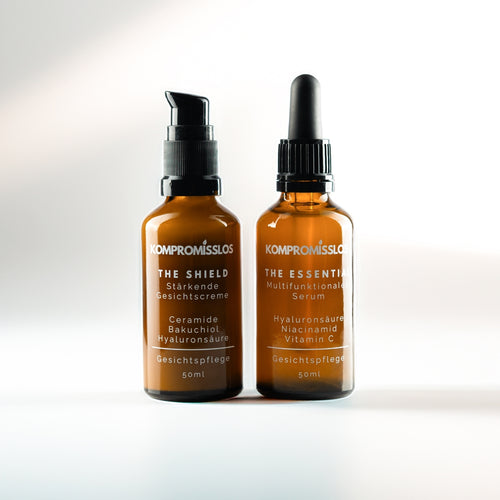
With four products to replace, a careful switch therefore takes around one to two months. It goes faster if you have fewer products to replace. That is exactly the idea behind The Duo of serum and face cream: two products take care of everything after cleansing – vegan, and free from fragrance, silicones and microplastics. If it does not suit you, you have a 100-day right of return.
Do not introduce a new product at a time when your skin is already irritated, for example after sunburn or a strong exfoliation. Otherwise you cannot tell whether the redness comes from the product or was already there.
In what order should you replace your products?
Replace the products that stay on your skin longest first, and the ones you wash off anyway last. Serum and cream sit on your face for many hours, which is where you notice most clearly whether a formula suits you. Cleanser is rinsed off again after a minute. If it is mild and well tolerated, it can easily stay a while longer. Active products such as retinol or acid exfoliants are not swapped out in the same move; instead, check separately whether your new routine covers them at all. This is particularly worth looking at for mature skin, because certified standards exclude some well-researched active ingredients, as the article on natural skincare for mature skin shows. Only ever replace your sunscreen with an equivalent one, and never drop it without a replacement.
| Order | Product | Why at this point | What to look for |
|---|---|---|---|
| 1 | Face cream | Longest contact time, shapes how your skin feels the most | Perfume and essential oils in the ingredient list |
| 2 | Serum | Delivers active ingredients directly to the skin | Concentrations stated in a way you can check |
| 3 | Cleanser | Short contact, least urgent | Mild, no tightness after washing |
| 4 | Sunscreen | Your protection must not have a gap | Only swap for one with an equivalent SPF |
| 5 | Make-up | A separate project, comes last | Test it the same way as your skincare |
Are breakouts normal after switching to natural skincare?
Breakouts after switching to natural skincare do happen, but they are not a fixed part of the switch and not a sign of detoxing. The idea that skin first has to expel residues after conventional skincare, or has to readjust, has no scientific basis. If you get breakouts after the switch, it is worth looking for the trigger: a richer texture with oils and butters that is too much for your skin, for example, an ingredient you react to, or something that has nothing to do with the switch at all, such as stress or hormonal fluctuations. The ingredient list alone will not tell you which. A study in the Journal of the American Academy of Dermatology tested finished cosmetic products on the backs of six volunteers three times a week for four weeks. The authors concluded that finished products containing ingredients classed as comedogenic are not necessarily comedogenic themselves. What counts, then, is the formula as a whole and how your skin responds to it.
A realistic timeline looks like this: redness, itching or stinging within hours to a few days points more towards irritation or an allergic reaction. Where that comes from and when to stop using a product is explained in the article Face cream stinging. Clogged pores and breakouts, by contrast, tend to show up over weeks – it is no coincidence that the test method mentioned above runs for four weeks. Because you introduced one product at a time, you can trace the reaction back to its source. Whether a product with acids or retinoids is temporarily bringing breakouts to the surface or simply does not suit you is covered in the article Skin purging or a reaction. If inflammation is severe, painful or persistent, have it checked by a dermatologist.
What should you do with your old products?
Opened products that your skin tolerates well can be used up at your own pace. The only important thing is that nothing else in your routine changes while you are testing a new product on your face. A conventional face cream can carry on as a hand or foot cream, and a mild cleanser can be used until it runs out before you replace it. Unopened products can be given away. For anything already opened, check the PAO symbol: the number with the M tells you how many months the product keeps after opening. If something smells rancid or its colour or consistency has changed, it no longer belongs on your face. Leftovers go in the household rubbish, not down the drain, and empty packaging is sorted by material. You do not have to throw anything away on principle. The switch is not a clear-out but a decision about your next purchases. Which criteria count here, from a complete ingredient list to clear return conditions, is explained in the guide to natural skincare in Switzerland.
I deliberately limited Kompromisslos to two products, because hardly anyone sees a switch through properly with eight new jars. With a serum and a cream, you replace the skincare that follows cleansing, and you can see clearly what each product does. Both are vegan and free from fragrance, silicones and microplastics, with edelweiss and gentian root from Switzerland. What I will not promise you is that everything in them comes straight from nature. They are preserved with Sodium Levulinate and Sodium Benzoate, and the second one is synthetic. That is stated openly in our list of all ingredients. The cream does not contain sun protection, so keep using a separate sunscreen during the day. And we do not sell a cleanser. If yours is mild, you do not need a new one.
Frequently asked questions
Do I need to change my cleanser when I switch?
No, not necessarily. Cleanser only stays on your skin briefly. If it is mild and leaves no feeling of tightness, it can stay, even if it is not natural skincare. Only swap it once your serum and cream have settled in, or sooner if it dries out your skin. Changing it just because of the label does nothing for your skin.
Can I keep using retinol or acids while I switch?
Yes, and ideally without changing anything while you switch your other products. Never change an active ingredient and your skincare at the same time, otherwise you cannot tell what caused any irritation. Certified natural skincare generally does without synthetic retinol. Whether you want to replace it is a separate decision, once your new skincare has settled in.
Can I mix natural skincare and conventional products?
Yes, without any problem. Your skin does not care whether a product carries a certification; it reacts to the individual ingredients and the texture. Many people keep their sunscreen or a tried-and-tested active product, for example. Where the two approaches really differ is shown in the comparison Natural vs conventional skincare.
Is it enough to look for vegan products when I switch?
No, because vegan is not the same as natural skincare. Vegan means free from animal-derived ingredients, whereas natural skincare is about where raw materials come from and how they are processed. A vegan product can contain synthetic substances, and natural skincare can contain beeswax or honey. If both matter to you, check each one separately. Whether vegan facial skincare really is vegan is something the ingredient list tells you, not the label.
Is there natural skincare with no scent at all?
Yes, but far from all of it. Many natural skincare products are scented with essential oils, which also count as fragrance. Check the ingredient list for Parfum, essential oils and Limonene or Linalool. What the claim fragrance-free actually guarantees is explained in the article on fragrance-free moisturisers.
Can I keep my make-up when I switch?
Yes, you can keep your make-up and switch it last. New skincare and new make-up at the same time make reactions hard to read. How long your skincare should sink in before you put on make-up is covered in the article on skincare before make-up.
How do I switch to a simple routine with The Duo?
Replace your current serum and cream with The Duo and leave your cleanser and sunscreen as they are for now. Test both products on your forearm as described above and introduce them one after the other, one to two weeks apart. After that, morning and evening after cleansing: 3 to 6 drops of serum, then 3 to 6 pumps of cream, each massaged in from the centre of your face outwards and over your neck. That way, your routine with The Duo is in place within three to four weeks.
Sources
- Young PA, Gui H, Bae GH. Prevalence of Contact Allergens in Natural Skin Care Products From US Commercial Retailers. JAMA Dermatology, 2022. Source
- Kaliyadan F, Jayasree P, Ashique KT. Practical suggestions to improve standardization of repeated open application testing (ROAT) for daily use products. Advances in Dermatology and Allergology, 2022. Source
- Draelos ZD, DiNardo JC. A re-evaluation of the comedogenicity concept. Journal of the American Academy of Dermatology, 2006. Source
- Halla N, Fernandes IP, Heleno SA, Costa P, Boucherit-Otmani Z, Boucherit K, et al. Cosmetics Preservation: A Review on Present Strategies. Molecules, 2018. Source