Vegan facial skincare: how to tell whether it really is vegan
VEGAN SKINCARE SWITZERLAND
Vegan facial skincare contains no animal-derived ingredients: no lanolin, no beeswax, no honey, no collagen, no carmine. The term is not legally protected, but it can still be checked. In Switzerland, the ingredients list on the pack is mandatory, and if you know the usual animal-derived raw materials, you can reliably spot them there.
What exactly is vegan facial skincare?
Vegan facial skincare is skincare in which no ingredient comes from an animal – neither from the animal itself nor from anything an animal produces. That rules out lanolin from sheep’s wool, beeswax, honey, propolis, collagen, elastin, carmine from scale insects and silk protein. The rest of a formula is unaffected: water, plant oils, emulsifiers, preservatives and active ingredients such as niacinamide or hyaluronic acid are not of animal origin anyway, whether they come from plants, from fermentation or from the laboratory. So vegan tells you something about where the raw materials come from, and nothing about efficacy, tolerability or natural content. A purely synthetic serum can be vegan; a certified natural skincare cream with beeswax is not. Confusing the two is the most common mistake on this subject, and it explains why the term vegan on a moisturising cream calls for more scrutiny than a glance at the front of the pack.
How can you tell whether facial skincare is really vegan?
You can tell from the ingredients list, not from the advertising on the front. In Switzerland, cosmetics must list all ingredients under the heading Ingredients, in descending order of quantity, although anything below one per cent by mass of the finished product may appear at the end in any order. This has two practical consequences. First, every animal-derived raw material has to appear there; there is no legal way to leave it out. Second, once an ingredient is in the lower part of the list, you can’t infer its concentration from its position. For the vegan question this doesn’t matter, because all that counts is whether a name appears, not how much of it is in there. Around a dozen raw materials are critical, and one of them has the same name whether it is of plant or animal origin. The overview below shows the most common ones and the plant-based alternatives used in their place.
| Raw material in the ingredients list | Where it usually comes from | Plant-based alternative |
|---|---|---|
| Lanolin | From the wool grease of sheep. | Squalane, shea butter or jojoba oil. |
| Cera Alba, Beeswax | From the honeycomb built by bees. | Candelilla wax or carnauba wax. |
| Mel, Honey | Honey produced by bees. | Glycerin or aloe vera as a humectant. |
| Collagen, Elastin | Mostly from skin, bones or fish. | Hyaluronic acid or plant peptides. |
| Carmine, CI 75470 | Red pigment from dried scale insects. | Mineral or plant pigments. |
| Keratin | From feathers, horns or wool. | Wheat or rice proteins. |
| Squalane | Historically from shark liver, today mostly plant-based. | Squalane from olives or sugar cane. |
Squalane is the special case: the name on the list is the same, wherever the raw material comes from. The only thing that helps here is a brand that discloses its source, as we do in the full overview of our active ingredients.
Is vegan the same as cruelty-free or natural skincare?
No – these are three different things, and they only partly overlap. Vegan refers to the raw materials: nothing in the product comes from an animal. No animal testing refers to testing: neither the finished product nor its ingredients were tested on animals for cosmetic purposes. Natural skincare refers to the proportion of natural raw materials and to excluded groups of substances such as silicones or paraffins. A product can involve no animal testing and still not be vegan, because it contains beeswax. It can be vegan and still not be natural skincare, because it consists mainly of synthetic raw materials. And natural skincare is particularly often not vegan, because honey, propolis and beeswax are among the classic natural raw materials. What the law in Switzerland actually says about animal testing is clarified in a separate article, because the answer has more nuance than any label can show.
Is vegan facial skincare automatically gentler on the skin?
No – and anyone who promises that is selling you a story. Where a raw material comes from says nothing about how well it is tolerated. Essential oils are plant-based and among the most common triggers of contact reactions. Fragrances from citrus peel are vegan and still often unsuitable for sensitive skin. Conversely, many people tolerate lanolin without any problem. What determines tolerability is the specific formula: how many fragrances it contains, how high the active ingredients are dosed, how the barrier care is built. Vegan is an ethical decision, not a dermatological one. It still makes sense if it fits your values, and it doesn’t rule out good tolerability at all. You should just assess the two separately and not assume that a vegan label will prevent a reaction. The more honest approach: check the list for animal-derived ingredients first, then, separately, for anything that you know from experience irritates your skin.
What does a complete vegan facial skincare routine look like?
A complete vegan facial skincare routine needs three functions, not seven products: cleansing, supplying moisture and active ingredients, and sealing the barrier. Anything beyond that is comfort, not a prerequisite for a good result. The most common mistake is not a missing product but too many products at once, which overlap in their active ingredients and overwhelm the skin. If you are switching from a conventional routine to a vegan one, it is best not to replace everything at once but step by step, as each product runs out. That way you notice what your skin reacts to, and you don’t throw away anything useful. The same sequence makes sense morning and evening, with a single difference: during the day, sun protection goes on last; in the evening, it doesn’t. The question of whether you really need a serum and a cream is answered in detail in a separate article. The short version as a sequence:
- Gentle cleansing, morning and evening, with no tightness afterwards.
- Serum on skin that is still slightly damp – with ours, 3 to 6 drops.
- Cream on top, 3 to 6 pumps, up to the hairline and down over the neck.
- In the morning, sun protection last if you are outdoors during the day.
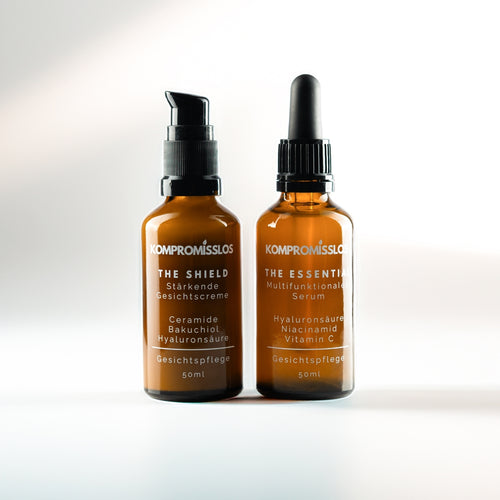
That is exactly what The Duo of The Essential serum and The Shield cream is built for: two products that together provide 5% niacinamide, 2% hyaluronic acid, 2% vitamin C as 3-O-Ethyl Ascorbic Acid and 0.3% bakuchiol. How the steps work together day to day is explained in the step-by-step how-to-use guide.
When facial skincare is no longer enough
Facial skincare is a cosmetic product, and under the Swiss Ordinance on Foodstuffs and Utility Articles (LGV) it may not claim to cure, alleviate or prevent disease. This is not a legal formality but a limit that makes sense in substance. If your skin weeps, bleeds or flakes over large areas, if redness persists for weeks, if itching keeps you awake at night or a mole changes, that is a matter for a dermatology practice, not for a serum. The same applies if you have reacted to several products in a row with stinging or swelling. A vegan formula changes nothing here; in this question, it is simply not the relevant category. Good skincare can soften the look of dryness, redness and unevenness and support the skin barrier. It is no substitute for a diagnosis, and any brand that suggests otherwise crosses a line that the law draws for good reason.
When I finalised the formula for The Duo, leaving out lanolin was the decision I thought about longest. Lanolin is a very good occlusive – inexpensive and tried and tested for decades. I still opted for plant-derived squalane, because I didn’t want to give a vegan brand a raw material from sheep’s wool, and because some people with sensitive skin react to lanolin. The price of that is real: squalane costs many times more. That is one of the reasons why The Duo costs CHF 109.90 and not CHF 39. I think it is fairer to lay that calculation open than to let it disappear behind a label.
Frequently asked questions
Is vegan facial skincare automatically cruelty-free?
No. Vegan describes the raw materials; no animal testing describes how the product was tested. A product with no animal-derived ingredients could, in theory, still have been tested on animals, for example for a market outside Switzerland. Conversely, there are products with no animal testing that contain beeswax. You have to check the two terms separately.
How do I spot lanolin on the pack?
Lanolin appears in the ingredients list as Lanolin, Lanolin Alcohol, Hydrogenated Lanolin or Lanolin Acid. It turns up mainly in rich creams, lip care and hand care. If none of these names appears, there is no lanolin in the product, because full declaration is mandatory.
Is squalane animal-derived or plant-based?
Both are possible, and the name Squalane in the ingredients list doesn’t distinguish between them. Historically, squalane came from shark liver; today it is mostly obtained from olives or sugar cane. You can’t tell the source from the list alone. The only reliable option is a brand that openly names the source.
Do I need a certification label for vegan facial skincare?
No. A label is a shortcut, not proof, and the term vegan is not legally protected. The ingredients list, on the other hand, is mandatory and complete. If you know the usual animal-derived raw materials, you don’t need a label to classify a product with confidence.
How many products does a vegan facial skincare routine need?
Three functions are enough: cleanse, nourish, seal. In practice, that means a gentle cleanser, a serum, a cream and sun protection during the day. More products rarely bring better results, just more overlap between active ingredients. Cutting back also makes it quicker to see what your skin is actually reacting to.
Is vegan facial skincare better for sensitive skin?
Not in itself. Tolerability depends on the specific formula, not on where the raw materials come from. Essential oils and citrus fragrances are plant-based and often irritate sensitive skin. So check first for animal-derived ingredients, and then separately for fragrances, alcohol and high-dose active ingredients.
How much does vegan facial skincare cost in Switzerland?
The range runs from around CHF 15 for a simple drugstore cream to over CHF 200 for luxury brands. Where you can buy vegan cosmetics in Switzerland is broken down separately. Our Duo costs CHF 109.90 and lasts 2 to 4 months, depending on how often you use it.
Sources
- Cantonal Laboratory of Bern (Kantonales Laboratorium Bern), Merkblatt Kennzeichnung von Kosmetika (fact sheet on the labelling of cosmetics), Version 2, 2021. Source