Migros, Coop or dm face cream: when own brands are enough and when they aren’t
SWISS BUYING GUIDE
A face cream from Migros, Coop or dm is often enough if your skin is uncomplicated and mainly needs moisture. Independent tests show that own brands can come out on top, but also that two creams from the same retailer can perform very differently. What matters, then, is not the logo but the individual product: little or no fragrance, a formula suited to your skin’s condition and information you can actually check. An own brand reaches its limits mainly with sensitive, dry or mature skin that needs targeted active ingredients in known amounts.
Is a face cream from Migros, Coop or dm good enough?
Yes, for many people a face cream from Migros, Coop or dm is good enough, as long as their skin is calm and the cream mainly needs to keep it hydrated. That basic job is done by humectants such as glycerin, a few oils or fats and an emulsifier, and none of these raw materials is rare or expensive. An inexpensive cream can combine them just as well as an expensive one. If you are wondering more generally what you are really paying for when you buy a face cream, you will find the general answer there. This article looks at the specific case on Swiss shelves: the own brands of supermarkets and drugstore chains.
The honest caveat has nothing to do with price. Own brands are made for the mass market. They are meant to appeal to lots of people, often to smell pleasant and to sell well. That works as long as your skin has no special needs. As soon as it reacts with irritation, feels tight, shows visible signs of ageing or you want specific active ingredients in known amounts, the choice on the shelf narrows. At that point it pays to look more closely at the individual product rather than the brand behind it.
Who makes own-brand skincare, and are Migros, Coop and dm really any different?
Own-brand skincare frequently comes from large contract manufacturers that produce for several retailers, so the difference often lies less in the factory than in the formula and the price. The best-known Swiss example is Mibelle: according to a Blick report from December 2025, the company makes the products for I am, the Migros brand, in Buchs AG and Frenkendorf BL. Mibelle was a Migros subsidiary until March 2025 and was then sold to the Spanish group Persán. The same report states that Mibelle also produces the goods for Balea, a brand of the German drugstore chain dm.
Blick illustrates the price gap with one example: the I am Q10+ anti-ageing day cream costs CHF 4.95, while a similar Balea cream costs CHF 1.82 in Germany. Migros attributes this to higher wages and rents than dm’s and to the fact that the German drugstore chain buys in larger volumes. For you, this means two things. First, sharing a manufacturer says nothing about whether two creams have the same formula. Second, none of the chains can be rated better or worse across the board: each retailer carries several lines, from basic skincare to natural cosmetics such as Coop Naturaline or alverde and facial skincare brands such as Zoé. So you have to compare product by product.
How do own-brand face creams perform in tests?
Own-brand face creams sometimes do very well in Swiss tests and sometimes poorly, and both results often come from the same retailer. One example is a saldo test of twelve face creams from December 2023. The best performer was a product from the Migros brand I am, which increased skin hydration by 36 per cent. Two other own-brand creams from Coop and Migros, by contrast, increased skin hydration by only 2 and 7 per cent respectively after six hours. According to saldo, half of the creams tested hydrated the skin only moderately or poorly.
What follows from this is not a ranking but a rule: a good test result applies to exactly one product, not to the whole brand and certainly not to the whole retailer. And no laboratory can tell you how your skin will feel after a few weeks, whether it becomes calmer or whether a fragrance irritates it. Before you take a test winner off the shelf, it is worth looking at what the K-Tipp face cream test measures and what it does not.
When is an inexpensive own-brand cream enough for your skin?
An inexpensive own-brand cream is enough if your skin is normal to slightly dry, rarely reacts and what you mainly want from the cream is moisture and a comfortable feel. In that case the formula matters more than the price, and good formulas exist at every price point. What counts most is that the cream suits the way your skin feels: not too greasy, not too light, with no stinging or tightness. You can only check that on your own skin; no price tag will do this test for you.
Nor do you necessarily have to pay more for good tolerability. An analysis of 174 best-selling body moisturisers from US online shops, published in JAMA Dermatology, found that products entirely free of common contact allergens were not statistically more expensive per ounce than products containing at least one such substance. If an own-brand cream is fragrance-free, your skin has tolerated it without problems for months and nothing feels tight, there is no objective reason to switch. Whether your skin needs a light or a rich texture is covered in the article on how to choose a moisturiser.
When does an own brand reach its limits?
An own brand reaches its limits wherever you need more than basic care: with sensitive skin that reacts to fragrance, with dry or mature skin that needs targeted active ingredients in known amounts, and with skin conditions. Fragrance is a common stumbling block. In the JAMA Dermatology analysis mentioned above, only 12 per cent of the best-sellers were free of the contact allergens studied, and fragrance mix was the most common allergen, found in 87 products. For reactive skin, a fragrance-free moisturiser is therefore worth choosing, whichever shelf it comes from.
| Your situation | An own brand is usually enough | Worth a closer look |
|---|---|---|
| Skin is calm and mainly needs moisture | Yes, if fragrance-free or well tolerated | Rarely necessary |
| Skin reacts to fragrance or new products | Fragrance-free lines only | Check the INCI list, test one product at a time |
| Dry or mature skin with specific goals | Possible as a base cream | Active ingredients with disclosed concentrations |
| Rosacea, atopic eczema, acne | Not as a solution | Have it assessed by a dermatologist |
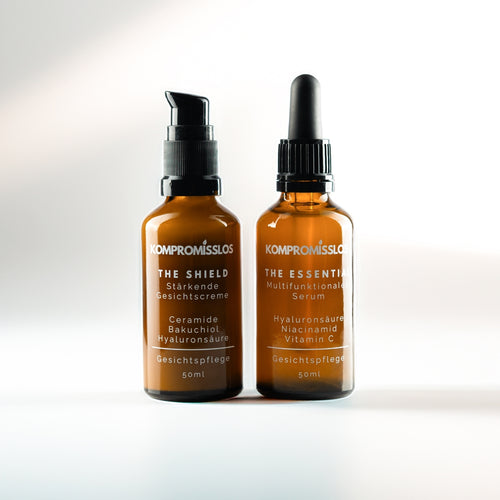
The second limit is disclosure. Own brands rarely state how much niacinamide, vitamin C or ceramides a product actually contains. For a base cream, that is not a problem, but if you want to use active ingredients in a targeted way, you are missing the most important piece of information. This is exactly where The Duo with serum and cream comes in: disclosed concentrations, fragrance-free, a serum with hyaluronic acid in three molecular sizes and a cream with Ceramide NP, bakuchiol and squalane for sensitive, dry or mature skin. Whether that is worth the extra cost to you is your call. With a 100-day return policy, you can take your time and judge it on your own skin. If you are looking for a solution for rosacea, atopic eczema or acne, you will not find it on a supermarket shelf or with us, but with a dermatologist. Switching to pharmacy or drugstore skincare does not replace that assessment either.
How can you spot a good own-brand cream on the shelf?
You can spot a good own-brand cream on the shelf by five points that are printed on every pack and that need no test result. They apply to I am, Zoé, Naturaline, Balea or alverde just as much as to any other brand. The order matters: tolerability first, then everything else.
- Parfum in the INCI list: if ‘Parfum’ appears anywhere in the list, or fragrance allergens such as Linalool and Limonene follow, the cream is a gamble for sensitive skin.
- Disclosed concentration: if the pack gives a percentage for the advertised active ingredient, you can compare. If it does not, ‘with hyaluronic acid’ or ‘with Q10’ is just a name.
- Packaging: a tube or pump dispenser protects the contents from air and fingers better than an open jar.
- Certification: for natural cosmetics, independent labels such as NATRUE, COSMOS or BDIH help, because the term on its own is not protected.
- Target skin type: if the pack names a skin condition that matches yours, such as dry or sensitive, that is a useful first filter.
For the details, it is worth learning how to read an ingredient list properly once. After that, checking the label on the shelf only takes a moment.
On our active ingredients page, I list the disclosed concentrations in The Duo: 5% niacinamide, 2% vitamin C as 3-O-Ethyl Ascorbic Acid and 1% zinc PCA. Not because figures look good, but so that you can compare The Duo with any cream on the shelf, including an inexpensive one. If an own brand gives the same information and your skin stays calm with it, you do not need us. What I decided to do differently: two products instead of eight, both fragrance-free, developed and made in Switzerland. That will never be as cheap as a supermarket own brand. I cannot promise you that the difference is worth it for your skin. All I can do is tell you openly what you are comparing.
Frequently asked questions
Does own-brand natural skincare count as real natural cosmetics?
That depends on the individual product, because the term ‘natural cosmetics’ is not legally protected in Switzerland. Independent labels such as NATRUE, COSMOS or BDIH, which check raw materials and manufacturing against fixed criteria, are more reliable. If an own-brand cream carries one of these labels, the same rules apply to it as to any other certified natural cosmetic. If it does not, the only way to judge it is to look at the INCI list.
Why is dm skincare more expensive in Switzerland than in Germany?
Because of the extra costs of importing, customs clearance and storage – that was the explanation Galaxus gave in October 2021, when the online retailer started selling dm own brands such as Balea and alverde in Switzerland. Until then, dm had no shops of its own in Switzerland. The higher price does not change what is in the cream.
Why do own brands rarely state the concentration of active ingredients?
Because stating it is voluntary. What is mandatory is the ingredient list in descending order of quantity, with substances below 1 per cent allowed to appear in any order – but not the percentage of individual active ingredients. Many brands, expensive and inexpensive alike, leave it out. That does not mean there is too little in the product. You just cannot check.
Are cheap face creams worse for mature skin?
Not as a rule. An inexpensive cream can keep mature skin well moisturised. When Öko-Test examined 53 face creams, 22 of them with anti-wrinkle claims, none of the manufacturers, according to Kassensturz, had provided sufficient evidence that their product could smooth wrinkles. So a higher price is no proof of a stronger effect on wrinkles. The difference lies more in whether targeted active ingredients are present in known amounts.
Can I combine an own-brand cream with a serum containing active ingredients?
Yes, that is often a sensible solution. The serum goes onto cleansed skin first, followed by the cream. Make sure the cream is fragrance-free and does not contain the same active ingredient again in an unknown amount. Introduce new products one at a time so that, if your skin reacts, you know what caused it.
How do I find out whether a drugstore cream is enough for me?
By using it on its own for several weeks without changing anything else in your routine. You will usually notice within the first few days whether your skin tolerates it. Whether it is enough becomes clear after that: if your skin no longer feels tight, nothing flakes and it still feels supple in the evening, you do not need a more expensive cream. If something is missing, you now know more precisely what it is.
Is The Duo worth it if an own-brand cream is basically enough for me?
If your skin is calm with an own-brand cream and you are not missing anything, probably not. The Duo becomes interesting if you want targeted active ingredients with disclosed concentrations: 5% niacinamide, 2% vitamin C and 1% zinc PCA, fragrance-free, with serum and cream designed to work together. That is a choice in favour of more transparency, not a must.
Sources
- Kälin M. Migros verlangt Schweiz-Zuschlag auf eigene Kosmetikprodukte. Blick, 7 December 2025. Source
- Schildknecht A. Test: Eine günstige Gesichtscreme pflegt am besten. saldo 20/2023, 5 December 2023. Source
- Xu S, Kwa M, Lohman ME, Evers-Meltzer R, Silverberg JI. Consumer Preferences, Product Characteristics, and Potentially Allergenic Ingredients in Best-selling Moisturizers. JAMA Dermatology, 2017. Source
- Kurmann S. Galaxus bringt dm in die Schweiz. Galaxus, 27 October 2021. Source
- Kempf P. Gesichtscremes im Test: Keine Beweise für Faltenglättung. SRF Kassensturz, 13 December 2019. Source