How to choose a moisturiser: five questions that lead you to the right one
SWISS BUYING GUIDE
The best way to choose a moisturiser is not a skin type test but five questions: what should it solve, which texture does your skin tolerate, do you react to fragrance, do you need a serum underneath, and how much of a routine will you really keep up? Answer them honestly and you end up with two or three criteria that fit, rather than a ranking. And sometimes the result is that your current moisturiser already suits you.
How do you find the moisturiser that suits you?
You find the right moisturiser by first working out what it needs to do, and only then comparing products. Bad buys often happen the other way round: a cream gets bought because it has good reviews, and only at home does it turn out to be too heavy, to smell of perfume or to do a job that did not need doing. Online quizzes are of limited help here, because they usually sort you into one of four skin types and then recommend the matching product from the brand’s own range. The five questions below work differently. They are about properties you can check in any cream, whatever the brand. Answer them in order, because each answer narrows down the next. If, after the last question, you realise that your current cream ticks every box, that is not an interim result – it is the result.
- What the cream should solve for you: tightness, redness, shine or something else.
- Which texture your skin tolerates throughout the day.
- Whether you react to fragrance or to new products in general.
- Whether you need a serum under the cream or the cream on its own is enough.
- How many steps you will really take morning and evening.
Question 1: What should the moisturiser solve for you?
A moisturiser suits you if it addresses a specific issue with your skin that you can feel or see today. How to assess your skin for this is explained in the article Skin condition, not skin type. Here, the only aim is to turn that into a goal for the cream, and to make it as precise as possible. “My skin feels tight in the afternoon” leads to different criteria from “my T-zone gets shiny” or “I would like a smoother complexion”. If your skin feels tight, lipids and humectants matter, and you will find the details in the guide to choosing a moisturiser for dry skin. If your forehead is shiny while your cheeks are dry, you are dealing with combination skin and need a texture that works everywhere. And if the changes from your forties onwards are what concern you most, the criteria for mature skin will get you further than any best-of list. A cream that promises everything at once rarely does any one thing well. One or two goals are enough.
Question 2: Which texture does your skin tolerate?
The right texture is the one that still leaves your skin feeling comfortable six hours later, neither tight nor shiny. That is not a matter of taste; it depends on how a cream is formulated. A review in Clinical Medicine & Research describes three groups of ingredients: humectants, which draw water into the outermost layer of the skin; occlusives such as oils and waxes, which form a layer on the skin and slow down evaporation; and emollients, which fill the gaps between the cells of the outer skin layer, support the barrier function and leave the skin smoother and more supple. A light cream relies more heavily on humectants, a rich one more on oils and lipids. The same review notes that people use a moisturiser poorly when they are not happy with it. A texture you do not like is one you will not use regularly, and then even the best list of active ingredients no longer matters.
| What you notice after a few hours | What it usually means | What to try |
|---|---|---|
| Skin feels tight again, especially on the cheeks | Too few lipids, or applied too thinly | A little more product or a richer texture |
| Shine in the T-zone, cheeks feel fine | Texture too heavy for the oily zone | A lighter cream, used more sparingly on the T-zone |
| Cream sits on the skin as a film, make-up slides | Too much product or too occlusive a texture | Use less and give it a moment to sink in |
| Skin feels calm and soft | The texture suits you | Change nothing |
A review of our own cream shows how honestly this question needs to be answered. In her review on Judge.me, Daniela B. writes: “As my skin is on the dry, mature side, I would have liked the face cream to be a little richer, so I add a facial oil from another brand” (review translated from German). That is a good answer to question 2: if a cream is too light for your skin, you can use more of it or add a step, rather than replacing everything.
Question 3: Do you react to fragrance or new products?
If your skin reacts to new products with burning, stinging or redness, your moisturiser should be fragrance-free and contain as few potential irritants as possible. Fragrances are a well-known trigger of contact allergies. A study in the British Journal of Dermatology patch-tested a random sample of 3,119 adults from the general population in five European countries. The conservatively estimated prevalence of fragrance contact allergy was 1.9 per cent, and around twice as high in women as in men. That may sound low, but it only covers proven allergies. If you suspect you are allergic to a substance, a dermatologist can carry out a patch test to find out exactly what you are reacting to. Many people also report sensitive skin that reacts to products without any allergy. An expert group from the International Forum for the Study of Itch defined it in Acta Dermato-Venereologica as a syndrome: unpleasant sensations such as stinging, burning, pain, itching or tingling in response to stimuli that would not normally cause them, in skin that may look normal or red, particularly on the face.
For your choice, this means: if you recognise these reactions in yourself, a fragrance-free moisturiser is not a question of style but a non-negotiable. If you never react, fragrance is simply a matter of preference.
Never introduce two new products at the same time. Otherwise, if your skin reacts, you will not know which one caused it, and you will probably end up ruling out both.
Question 4: Do you need a serum under your moisturiser?
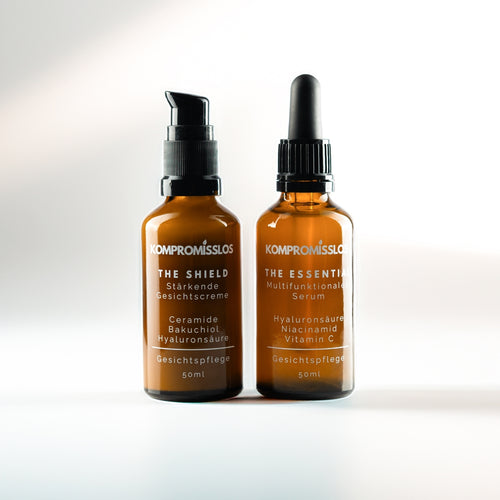
A serum under your moisturiser is worthwhile if your skin needs more moisture or specific active ingredients than a cream alone can provide. When one product is enough and how the two share the work is covered in the article on serum and cream. If you want both without having to combine two products yourself, The Duo of Essential serum and Shield cream is a pair designed to work together.
Question 5: How much skincare will you really use every day?
The right moisturiser is the one you actually apply morning and evening, not the one that looks best in an eight-step routine. The more steps a routine has, the more often one gets skipped, and the harder it becomes to tell which product is having which effect. So ask yourself honestly how much time you really spend in the bathroom. If the answer is two minutes, two products after cleansing are more realistic than five. Think about the morning, too: many moisturisers, ours included, contain no sun protection, so a separate sunscreen belongs in your daytime routine and needs room in it as well. Finally, this question also includes the most honest outcome of all. If your current cream does not leave your skin tight or stinging, you enjoy using it and your skin is calm, you do not need a new one. Switching only makes sense once at least one of the five questions gets a clear no.
I deliberately limited Kompromisslos to two products instead of eight, because I believe a routine only works if you stick to it. The serum and the cream are designed for a particular kind of skin: demanding, sensitive, dry or mature. That is why both are fragrance-free, and that is why I disclose the concentrations, so you can check for yourself what goes on your skin. To be honest, it also means this: if your skin is very oily and resilient and your current skincare works well, you do not necessarily need The Duo. Not every skin needs a serum and a cream. You can see exactly what is in them, and what each ingredient is for, in our active ingredients with disclosed concentrations.
Frequently asked questions
Is an online skin type test reliable?
An online skin type test is only a rough guide, and what matters instead is explained in the article on how to care for your skin by its condition rather than its type.
Does the right moisturiser change with age?
Yes, the answer to question 2 often shifts over the years. Many women notice with time that their skin becomes drier and that a cream with more lipids feels more comfortable. Age alone does not decide, though – what you feel on your skin does. A cream that works well does not need replacing just because of a birthday.
Can I use a moisturiser for combination skin if my cheeks are dry?
Yes, as long as the cream gives your cheeks enough care without making your T-zone shiny. In practice, it often helps to use the same cream and adjust the amount: a little more on the cheeks, less on the T-zone. How else to care for your T-zone and cheeks together is covered in the guide to combination skin.
How long should I give a new moisturiser?
You can tell how a cream feels straight away, whereas visible changes in your complexion take weeks. Which timeframes are realistic is explained in the article on how long skincare takes to work.
Do I need a different moisturiser in winter?
Not necessarily – a little more of the same cream is often enough in winter, and you can read what else mature, dry skin needs in cold weather and heated indoor air in the guide to winter face cream.
What matters more: ingredients or texture?
Both matter, but texture decides first, because you will not use a cream with an unpleasant texture regularly. Ingredients are the second filter: they should match your goal from question 1 and, for sensitive skin, be free of fragrance. A long list of active ingredients is no substitute for a texture you feel comfortable with.
Who is The Duo right for, and who is it not right for?
The Duo is mainly suited to demanding, sensitive, dry or mature skin that wants a fragrance-free two-step routine: serum and cream, morning and evening. For very oily, resilient skin that is doing well with its current skincare, it is not essential. If your skin is very dry, use a little more cream. You can see how The Duo with serum and cream is put together on the product page.
Sources
- Purnamawati S, Indrastuti N, Danarti R, Saefudin T. The Role of Moisturizers in Addressing Various Kinds of Dermatitis: A Review. Clinical Medicine & Research, 2017. Source
- Diepgen TL, Ofenloch R, Bruze M, Cazzaniga S, Coenraads PJ, Elsner P et al. Prevalence of fragrance contact allergy in the general population of five European countries: a cross-sectional study. British Journal of Dermatology, 2015. Source
- Misery L, Ständer S, Szepietowski JC, Reich A, Wallengren J, Evers AW et al. Definition of Sensitive Skin: An Expert Position Paper from the Special Interest Group on Sensitive Skin of the International Forum for the Study of Itch. Acta Dermato-Venereologica, 2017. Source