Vitamin C and hyaluronic acid: what you need to know
Yes – vitamin C and hyaluronic acid can be combined without any problem and are among the most sensible pairings of active ingredients there is. As an antioxidant, vitamin C protects against environmental stressors and gives you a more even, fresher-looking skin tone; hyaluronic acid supplies your skin with moisture and visibly plumps up dehydration lines. The only point where the combination can snag is the form of vitamin C: pure ascorbic acid needs a very low pH and can irritate sensitive skin. Stable derivatives such as 3-O-Ethyl Ascorbic Acid get around this problem – they are pH-compatible and can be formulated with hyaluronic acid in one product without conflict. That turns the combination into a question of getting the formulation right, not of tolerance.
What do the two ingredients do – and why do they complement each other?
The division of labour is clear. Vitamin C is the ingredient for protection and radiance. It neutralises free radicals generated by UV radiation and exhaust fumes, supports the skin’s own collagen production and can visibly soften the look of dark spots and age spots. Hyaluronic acid is the moisture ingredient: it can bind many times its own weight in water – up to a thousand times – and so tops up the skin’s moisture reserves, which reduces dehydration lines and makes your skin look smoother. One protects and brightens; the other plumps and soothes. Because their mechanisms do not overlap, there is no reason to choose between them.
The real sticking point: which form of vitamin C?
Almost all the problems people have with vitamin C products – stinging, redness, tingling, a serum that quickly turns brown – come down to pure ascorbic acid. It is the most potent form, but also the most unstable and the most irritating: it needs a pH of around 3.5, which is considerably more acidic than the skin itself (pH ~5). Derivatives such as 3-O-Ethyl Ascorbic Acid solve exactly that problem: they are stable at a skin-friendly pH, oxidise much more slowly and are well absorbed by the skin. For combining with hyaluronic acid, that means that with a derivative the two can exist in the same product without the formulation having to compromise on tolerance. We have set out in detail why we prefer this derivative to all the others.
Order and time of day: what applies with two separate products?
With a combined serum, neither question arises – apply it, put a cream on top, done. With two separate products, the rule is: vitamin C product first (it is usually the lighter one and should be in direct contact with the skin), let it absorb briefly, then the hyaluronic acid serum on skin that is still slightly damp, and finally a cream to seal everything in. As for time of day, vitamin C is most useful in the morning, because antioxidant protection is needed during the day – it does not make your skin sensitive to the sun, but it is no substitute for sun protection either. Time of day makes no difference to hyaluronic acid. So you can use a combined product morning and evening without a second thought.
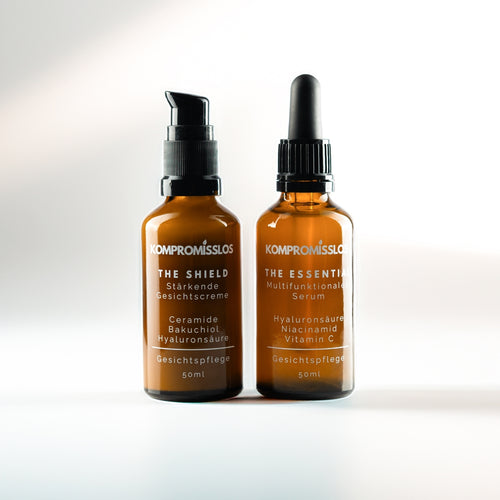
Our serum, The Essential, is built on exactly this logic: 2% vitamin C as 3-O-Ethyl Ascorbic Acid combined with 1.5% hyaluronic acid in three molecular sizes – plus 5% niacinamide as the third building block. We deliberately decided against pure ascorbic acid: for sensitive and mature skin, a stable, low-irritation derivative is simply the smarter choice than the most aggressive ingredient on paper. You can read how the three get along with one another in our articles on niacinamide and vitamin C and niacinamide and hyaluronic acid.
What about sensitive skin?
As a substance the body produces itself, hyaluronic acid is practically non-irritating – so the question of tolerance comes down to vitamin C alone. There are three things to look at. First, the form: derivatives rather than pure ascorbic acid, for the reasons above. Second, the concentration: with stable derivatives, 1–2% is enough for a noticeable effect; the 15–20% ascorbic acid heavyweights of high-dose marketing are almost always counterproductive for sensitive skin. Third, the context: if you stack vitamin C with exfoliating acids and retinol in the same routine, you overwhelm the barrier – and then the problem is not the ingredient but the quantity. A brief fresh sensation on application is normal; persistent stinging is the signal to simplify your routine rather than keep adding to it.
Frequently asked questions about the combination
Vitamin C and hyaluronic acid – which serum goes first?
The vitamin C product first, then the hyaluronic acid serum on slightly damp skin, and the cream last. With a combined serum, the question of order does not arise.
Can I use vitamin C and hyaluronic acid morning and evening?
Yes. Vitamin C is most useful in the morning, because its antioxidant protection works during the day – but it does no harm in the evening. Hyaluronic acid suits any time of day.
Does vitamin C make your skin sensitive to the sun?
No – unlike retinol or fruit acids, vitamin C does not increase sensitivity to the sun. It complements sun protection but does not replace it.
Why is my vitamin C serum turning brown – and is it still any good?
Browning indicates oxidation, a typical problem with pure ascorbic acid. A noticeably discoloured serum has lost much of its effect. Stable derivatives such as 3-O-Ethyl Ascorbic Acid oxidise much more slowly.
Does niacinamide work as a third ingredient?
Yes – vitamin C, hyaluronic acid and niacinamide get along well and together cover protection, moisture and an even complexion. The supposed conflict between niacinamide and vitamin C is a debunked myth based on lab studies from the 1960s.