Salicylic acid and niacinamide together: which goes first and why
COMBINING ACTIVE INGREDIENTS
You can use salicylic acid and niacinamide together without any problem, even one straight after the other in the same routine. The order is simple: the watery salicylic acid solution goes onto cleansed skin first, then the niacinamide serum, and the cream last. You do not need to wait 30 minutes – it is enough to wait until the acid layer is no longer wet. Whether the combination does your skin good depends less on the order than on how often you use the acid.
Can you use salicylic acid and niacinamide together?
Yes, salicylic acid and niacinamide can be used together, and they do not get in each other’s way. The two ingredients work in different places: salicylic acid is oil-soluble and loosens dead skin cells where sebum and keratin build up inside the pore. Niacinamide is water-soluble and supports the skin barrier at the surface. If you want to know more about what salicylic acid does and who it suits, that is covered in its own article, as are the benefits of niacinamide in detail. This article is only about the pair.
An open-label study in the Journal of Clinical and Aesthetic Dermatology suggests that the two ingredients can be well tolerated even in the same bottle. It tested a serum containing 2% niacinamide, 0.2% salicylic acid and other acids such as 1% lactic acid, which 50 young women with acne used twice a day for eight weeks. According to the authors, it was well tolerated: there were four cases of skin discomfort, all mild and all clearing up on their own. The study had no control group, it was funded by the manufacturer, and the authors worked as consultants for the company. That makes it of little use as proof that the serum works, but it does point to the combination being well tolerated.
Which goes first: salicylic acid or niacinamide?
As a rule, salicylic acid goes first, then niacinamide, and the cream last. The reason is practical: most salicylic acid products are thin liquids or toners, and they are meant to reach cleansed skin directly, not a layer of serum on top of it. The niacinamide serum is usually slightly thicker and follows afterwards, and the cream finishes things off. This sequence follows the basic rule of thin before thick, the same one you use when layering multiple serums in the right order. It is only reversed if your salicylic acid comes in a cream or gel: in that case, you apply the light niacinamide serum first and the acid cream after it. So what matters is not the active ingredient but the texture of the product it comes in.
| Salicylic acid comes in | Order | What to watch out for |
|---|---|---|
| A toner or watery solution | Acid, then niacinamide, then cream | Let the acid dry for a moment |
| A light serum | Acid serum, then niacinamide, then cream | Do not double up with two niacinamide serums |
| A gel or cream | Niacinamide, then the acid product | Add another cream only if your skin feels tight afterwards |
| A combination product with both | Just this one product, then cream | Count the niacinamide from your other products too |
Do you need to wait after salicylic acid before applying niacinamide?
No, there is no need for a long wait after salicylic acid; it is enough to wait until the layer is no longer damp. The popular rule of waiting 30 minutes rests on two assumptions. The first is that the less acidic niacinamide raises the pH of the acid and so weakens it. The second is that niacinamide and acid together form niacin, which makes the skin flush red. For the first assumption, it helps to look at the skin itself: a study in the International Journal of Cosmetic Science estimates the natural pH of the skin’s surface at an average of 4.7. In other words, niacinamide sits on acidic skin anyway, every day, with or without an acid product.
As for the second assumption: chemically, niacinamide is an amide, and amides can in principle be broken down into their acid form. We have not found any study showing that this happens on the skin, with two cosmetic products applied one after the other, to an extent that causes redness. Another point against the worry is that some serums contain both ingredients in the same formula, such as the one from the study mentioned above. There, the two are together not for a few minutes but for as long as the product is in use. If your skin turns red after niacinamide, the more likely cause is the ingredient itself or the amount. What you can do if niacinamide causes side effects is covered in a separate article.
Same routine or separate: when should you split them between morning and evening?
Both work well in the same routine, but you should split them up if your skin reacts sensitively to the acid or your routine already includes other active ingredients. The simplest split is salicylic acid in the evening and niacinamide morning and evening. The evening, because your skin is not exposed to the sun overnight. A review in Clinical, Cosmetic and Investigational Dermatology notes that an expert panel on cosmetic safety recommended that effects on the skin’s sensitivity to sunlight be taken into account for products containing salicylic acid. The next morning, a separate sunscreen is therefore part of your routine. In practice, this means:
- Robust, oily skin: acid and niacinamide in the same routine on acid evenings, and only niacinamide and cream on the other evenings.
- Sensitive or dry skin: acid on an evening of its own, followed only by cream, with niacinamide in the morning and on the other evenings.
- Routine with retinol: acid and retinol on different evenings; niacinamide goes with both.
- Irritated, stinging skin: stop the acid completely until your skin has calmed down again.
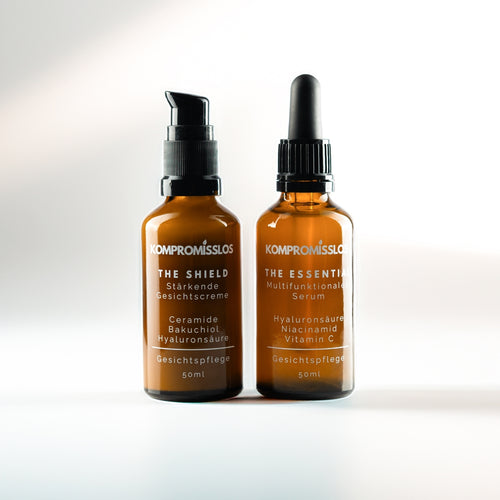
For your everyday skincare alongside it, a serum and a cream are enough. The Duo of The Essential serum and The Shield cream already contains niacinamide: 5% niacinamide is disclosed for the Duo, along with 1% zinc PCA and hyaluronic acid in three molecular sizes in the serum, and ceramide NP and squalane in the cream. If you want to work specifically on your pores, add a separate salicylic acid product on a few evenings a week and then apply the serum and cream on top. You will not need an extra niacinamide serum, and you avoid a double dose from several products. In her review on Judge.me, Sabrina writes: ‘Finally a simple, uncomplicated routine with just 2 products’ (review translated from German).
What does the combination do for oily skin, and when is it too much?
For oily skin, the two complement each other well; it becomes too much as soon as your skin feels tight, stings or flakes. Salicylic acid takes care of the part inside the pore, and for niacinamide there is data on sebum levels: in a study in the Journal of Cosmetic and Laser Therapy, a moisturiser with 2% niacinamide significantly reduced the sebum excretion rate in 100 Japanese participants after two and four weeks, compared with a placebo cream. In a second group of 30 Caucasian participants, surface sebum fell after six weeks, whereas the excretion rate did not change significantly. That points to less shine, not a promise for every skin.
When the combination becomes too much, it is rarely because of the niacinamide and usually because of the total amount of exfoliation. If you use an AHA exfoliant, an acid toner or a cleansing gel with acid alongside salicylic acid, the effects add up without you noticing. The difference between AHA, BHA and PHA helps you choose one acid rather than stacking three. And if inflamed, painful or nodular spots are the real issue, that is a matter for a dermatologist. Skincare can support medical treatment, but it cannot replace it.
How often can dry or sensitive skin handle the combination?
For dry or sensitive skin, two evenings a week with salicylic acid are usually enough, while niacinamide can be used every day. The acid is the part of the combination that strips oil and loosens the outer layer of skin, and that is exactly what dry skin needs least in high doses. Start with two evenings, not back to back, and watch how your skin responds for two to three weeks. If it stays calm, you can go up to three evenings. If it feels tight, the serum stings afterwards or your skin turns rough, scale back. On mature skin that produces less sebum, the acid often only makes sense in the T-zone, while cheeks and neck simply get serum and cream. If your skin is dry and prone to blemishes at the same time, there is more on how to care for dry skin and breakouts without drying it out further.
Apply the acid only to dry skin and only where clogged pores actually are. On acid evenings, leave out any other exfoliants, and the next morning, sunscreen is part of your routine.
I deliberately left both salicylic acid and exfoliants out of our range. Two products are meant to work every day, morning and evening, and for me an acid does not belong in that category. It is a targeted extra step for when clogged pores really are your issue. Otherwise, you can do without it. I disclose the concentrations so that you know the Duo already contains 5% niacinamide before you buy a combination product with extra niacinamide. Both products are fragrance-free. What they do not have is sun protection: during the day you need a separate sunscreen, especially if you use an acid in the evening. Exactly which active ingredients are in them and at what concentration is listed in full on our page.
Frequently asked questions
Does niacinamide make salicylic acid ineffective?
There is no solid evidence for this. The idea comes from the difference in pH between the two products. But the skin’s surface is itself acidic, at around pH 4.7 on average, and some serums combine both ingredients in one formula. If you want to be on the safe side, let the acid dry for a moment before the niacinamide goes on.
Do niacinamide and acid form niacin, which makes the skin red?
With normal use on the skin, this has not been shown. Niacinamide can in principle be broken down chemically into its acid form, but we have not found a study showing this happening in relevant amounts with two cosmetic products applied one after the other. If your skin turns red, the more likely cause is the acid, the amount of niacinamide or an individual intolerance.
Is one product that already contains salicylic acid and niacinamide enough?
Yes, a combination product is the simplest solution, because the question of order and waiting time no longer arises. Check how much niacinamide it contains and whether you are also using another niacinamide product alongside it. And because it contains the acid, the same frequency applies as for a product with salicylic acid alone.
Can I use salicylic acid and niacinamide every day?
You can use niacinamide every day; with salicylic acid, it depends on your skin. Robust, oily skin can sometimes tolerate it daily, but most skin types do better with two to three evenings a week. If your skin reacts with tightness or stinging, cut back on the acid, not the niacinamide.
Can I use salicylic acid, niacinamide and retinol in one routine?
Yes, but not all on the same evening. Put salicylic acid and retinol on different evenings, because both are demanding for the skin. Niacinamide goes with both and can stay in your routine every day. An overview of which skincare ingredients work together helps you put together a weekly plan without overloading your skin.
How can I tell that the combination is too much for my skin?
Typical signs are stinging when you apply the next layer, a tight feeling that lasts until the next day, rough or flaky patches, and skin that is shiny and tight at the same time. In that case, pause the acid until your skin has calmed down, then start again with fewer evenings a week.
Can I use salicylic acid with The Duo?
Yes. Apply the salicylic acid product to cleansed skin in the evening, let it dry for a moment and then use the serum and cream as usual. Because The Duo already provides 5% niacinamide, you do not need an extra niacinamide serum. Start with two acid evenings a week and remember to use sunscreen in the morning.
Sources
- Igarashi A, Abe M, Gunji Y, Nemoto O, Kawamura K, Yokozeki M et al. Evaluation of a Dermocosmetic Serum Containing a Multi-acid Complex and Niacinamide in Japanese Women with Mild Acne. Journal of Clinical and Aesthetic Dermatology, 2025. Source
- Lambers H, Piessens S, Bloem A, Pronk H, Finkel P. Natural skin surface pH is on average below 5, which is beneficial for its resident flora. International Journal of Cosmetic Science, 2006. Source
- Draelos ZD, Matsubara A, Smiles K. The effect of 2% niacinamide on facial sebum production. Journal of Cosmetic and Laser Therapy, 2006. Source
- Kornhauser A, Coelho SG, Hearing VJ. Applications of hydroxy acids: classification, mechanisms, and photoactivity. Clinical, Cosmetic and Investigational Dermatology, 2010. Source