Does drinking water help your skin? What studies show and when more stops helping
ROUTINE
Drinking more water helps your skin if you were not drinking enough before. If you already drink enough, current research suggests that extra litres will not make your skin visibly smoother or plumper. In the few studies on the subject, moisture in the top layer of the skin rose only slightly, and mainly in people who had previously drunk little. Drinking enough is therefore a basic requirement, but not a skincare step you can boost by drinking more.
Does drinking water help your skin?
Drinking enough water is good for your skin, but drinking far more than enough does little for it, as far as we know today. The idea behind the myth sounds logical: skin is largely made up of water, so more water from the inside ought to make it plumper. But the body does not distribute fluid on request. It keeps its water balance within tight limits and gets rid of any excess through the kidneys. If you already drink enough, extra glasses mostly pass straight through your body rather than ending up in the skin on your face. It is a different story if you drink clearly too little over a long period. Then your body is short of fluid, and it is plausible that your skin feels some of the effect too. That is precisely where the studies that find any effect at all come in. Incidentally, drinking plays a smaller part in how fresh your complexion looks than is often assumed. Where dull skin usually comes from is covered in a separate article.
What do studies on water intake and skin really show?
The studies show a small, measurable effect on skin hydration, mainly in people who previously drank little. One study from 2015 was published in the journal Clinical, Cosmetic and Investigational Dermatology. A research group in Lisbon examined 49 healthy women with an average age of 24.5 and divided them into two groups according to how much water they normally took in through their diet: below 3,200 millilitres a day (38 women) and above (11 women). For one month, around 2 litres of water a day were added to their usual diet. Measurements were taken on the face, arm and leg on day 0, day 15 and day 30. Both superficial and deeper skin hydration changed significantly, particularly in the group with the lower water intake. The key measurements of skin biomechanics, such as elasticity, changed in a similar way.
A systematic review in Skin Research and Technology assessed the entire body of research in 2018. Of the 216 papers found, only six met the criteria. The authors’ verdict: the evidence is weak, both in quantity and in methodological quality. According to the review, it is unclear whether the link also applies to older people.
| Study | Who and how | Result | Limitation |
|---|---|---|---|
| Palma et al., 2015 | 49 women, average age 24.5, around 2 litres of extra water a day for 30 days | Higher skin hydration, mainly in women with a lower water intake | Young women, small groups, only one month |
| Akdeniz et al., 2018 | Review of 6 studies, average age per study 24 to 56 | Slightly more moisture in the stratum corneum, mechanism unknown | Weak evidence, effect on older skin unclear |
How much should you drink a day, and what counts?
The Swiss dietary recommendations advise 1 to 2 litres of unsweetened drinks a day, ideally tap water, mineral water and herbal or fruit tea. They are published by the Swiss Society for Nutrition (SGE) together with the Federal Food Safety and Veterinary Office (FSVO), currently in the 2024 edition. According to the SGE, caffeinated drinks such as coffee and black tea can also contribute to your fluid intake; moderate consumption is recommended, which for coffee means up to three cups a day. Soft drinks and fruit juice drinks with added sugar or sweeteners, on the other hand, do not count as drinks in the food pyramid. According to the recommendations, alcoholic drinks should not be on the table every day, and they are no use for quenching thirst anyway.
A study in PLOS ONE shows that coffee does not automatically dehydrate you. Fifty men who habitually drank 3 to 6 cups a day consumed either 4 × 200 millilitres of coffee or the same amount of water for three days at a time. The researchers found no differences in total body water, in urine volume over 24 hours or in the blood markers of hydration. However, the study only included men who were used to caffeine. In everyday terms, this means:
- Count water, unsweetened tea and coffee in moderation together, not just your glass of water.
- Spread your drinking over the day, with meals and in between, as the SGE also recommends.
- In hot weather, during exercise or with a fever, you need more; there is no fixed number of litres that applies to everyone.
- Do not count sweetened drinks, collagen drinks or beauty waters as skincare. The same goes for supplements: they replace neither drinking nor skincare.
Does drinking more water smooth wrinkles or clear spots?
No, there is no solid evidence for either. As things stand, there is no study showing that drinking more smooths wrinkles. The review in Skin Research and Technology merely reports slightly greater extensibility and elasticity of the skin and fewer clinical signs of dryness and roughness in individual studies. According to the authors, whether drinking more actually reduces signs of dryness still needs to be investigated. Wrinkles are mainly caused by genetics, sun exposure and the age-related changes in the deeper layers of the skin. These are processes you cannot drink away. What you drink instead plays more of an indirect role: replacing sugary drinks with water means taking in less sugar, which benefits your general health. Whether and how sugar affects skin ageing is a separate question.
The picture is similar for spots. There are no studies showing that more water is an effective remedy for blemishes. If you have persistent inflamed spots, nodules or scarring, have it checked by a dermatologist rather than hoping that drinking more will help.
Why do older people often drink too little, and does it show in the skin?
Older people often drink too little because the sense of thirst can weaken with age. A study in the New England Journal of Medicine compared seven healthy, active men aged 67 to 75 with seven young men aged 20 to 31. After 24 hours without water, the older men were less thirsty and drank less afterwards, even though their blood values pointed more strongly to a lack of water. The study is small and fairly old, but it is a good reason not to rely on thirst alone as you get older.
A lack of fluid, however, cannot be reliably read from the skin on your face. Mature skin becomes drier mainly because it produces less oil and holds on to moisture less well. Why this happens and what helps is explained in the article on dry skin with age. A fixed routine still helps: a glass with every meal, a bottle within sight. There is one important exception: if you have a fluid limit set by your doctor because of a heart or kidney condition, stick to that rather than to general recommendations. Dizziness, confusion or a sharp drop in the amount of urine you pass should be checked by a doctor.
When does drinking more water stop helping your skin?
Once you drink enough, current research suggests that drinking more does little for your skin. In the Lisbon study, it was mainly the group with the lower previous water intake that benefited, and the review describes the same finding. None of the studies shows a clear benefit beyond your own needs. On top of that, there is one thing drinking cannot solve in principle: the stratum corneum constantly loses water to the air, and no glass of water slows that loss down; only what happens on the outside of the skin does. If your skin feels tight even though you drink enough, read how to recognise and care for dehydrated skin, and check whether a damaged skin barrier is behind it.
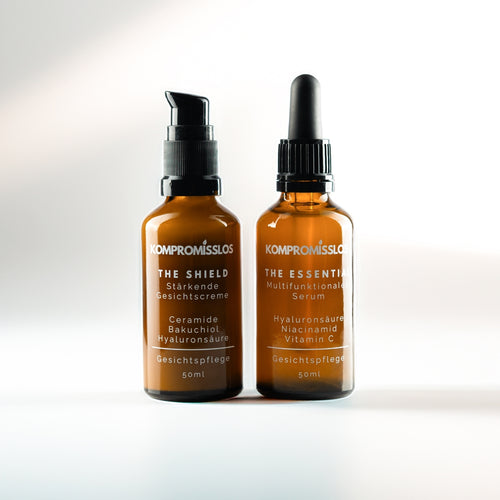
On the outside, two things work together: humectants that bind water in the stratum corneum, and a protective layer on top that keeps it there. How humectants work is explained in the article on what hyaluronic acid really does for skin. In The Duo, The Essential serum with hyaluronic acid in three molecular sizes takes care of the first part, and The Shield cream with Ceramide NP, squalane and jojoba oil takes care of the second. If your skin is dry, you can use a little more of both. In winter, dry heated air adds to the problem, and choosing the right winter face cream helps more than another litre of water.
A simple check to see whether you are drinking enough: if your urine is pale throughout the day and you need the toilet regularly, your intake is usually fine. By the way, a thermal water spray on your face replaces neither drinking nor the cream afterwards.
I will not promise you skin you can drink your way to, nor a cream that replaces drinking. Each has a different job. With The Duo, I put the moisture where skincare can actually make a difference: on the skin. Aloe vera is the base of both products and comes before water in the ingredient list. On top of that, The Duo contains hyaluronic acid in three molecular sizes and tamarind seed, sealed in by Ceramide NP and squalane in the cream. Two products instead of eight, no beauty drink and no powder to stir in. I have set out the role each component plays in our active ingredients in detail.
Frequently asked questions
Are three litres of water a day better for your skin than two?
There is no evidence for that. The Swiss dietary recommendations advise 1 to 2 litres of unsweetened drinks a day. If you sweat a lot, you need more. In the skin studies, it was mainly people who previously drank little who benefited. If you already drink enough, an extra litre will not give you visibly better skin.
Do coffee and tea count towards your fluid intake?
Yes. According to the Swiss Society for Nutrition, coffee and black tea contribute to your fluid intake; moderate consumption is recommended, which for coffee means up to three cups a day. Herbal and fruit teas are among the preferred drinks anyway. Sweetened drinks, on the other hand, are not counted as drinks by the SGE but grouped with sweets and snacks.
How quickly can you see a difference if you drink more?
That cannot be put into a reliable figure. In the Lisbon study, skin was checked with measuring devices after 15 and 30 days, not by eye. A measurable difference does not mean it is visible in the mirror. If you have been drinking far too little, you may feel better overall with more fluid, but that is not a promise about your skin.
Can you drink too much water?
Yes, but it is rare. Drinking extreme amounts in a short time can cause the sodium level in your blood to drop dangerously, which doctors call hyponatraemia. For healthy people drinking normally throughout the day, this is not an issue. If you have a fluid restriction because of a heart or kidney condition, follow your doctor’s instructions.
Does drinking water help with dark circles?
There is no evidence for that. Dark circles are often caused by genetics, thin skin, visible blood vessels or pigmentation, and are frequently made worse by lack of sleep. Drinking more changes little, unless you are drinking clearly too little. If swelling around the eyes appears suddenly and is new, have it checked by a doctor.
Is mineral water better for your skin than tap water?
There is no proven difference for your skin. The Swiss dietary recommendations list both among the preferred drinks and favour tap water for environmental reasons. Water on your skin is a different matter: how hard water affects your skin when you wash has nothing to do with how much you drink.
Do I need less skincare if I drink enough and use The Duo?
No, and the reverse is not true either. Drinking enough supplies your body; skincare keeps water in the top layer of your skin. Each has a different job, and neither replaces the other. With The Duo, your routine stays at two steps, morning and evening, regardless of how much you drink.
Sources
- Palma L, Marques LT, Bujan J, Rodrigues LM. Dietary water affects human skin hydration and biomechanics. Clinical, Cosmetic and Investigational Dermatology, 2015. Source
- Akdeniz M, Tomova-Simitchieva T, Dobos G, Blume-Peytavi U, Kottner J. Does dietary fluid intake affect skin hydration in healthy humans? A systematic literature review. Skin Research and Technology, 2018. Source
- Schweizerische Gesellschaft für Ernährung SGE, Bundesamt für Lebensmittelsicherheit und Veterinärwesen BLV. Schweizer Ernährungsempfehlungen für Erwachsene, Langversion, 2024. Source
- Killer SC, Blannin AK, Jeukendrup AE. No evidence of dehydration with moderate daily coffee intake: a counterbalanced cross-over study in a free-living population. PLOS ONE, 2014. Source
- Phillips PA, Rolls BJ, Ledingham JG, Forsling ML, Morton JJ, Crowe MJ et al. Reduced thirst after water deprivation in healthy elderly men. New England Journal of Medicine, 1984. Source