Thermal water spray: what a face mist really does for your skin and when to skip it
ROUTINE
A thermal water spray refreshes your face for a moment, but it is not a skincare step in its own right. The water sits on your skin only briefly, cools it as it evaporates and then it is gone. Your skin only holds on to moisture when humectants and a cream follow, binding the water and slowing its loss. If you enjoy that moment of freshness, there is nothing against it. But if your routine already includes a serum and a cream after cleansing, you can skip the spray.
What does a thermal water spray really do for your face?
Above all, a thermal water spray gives you a brief sense of coolness and freshness – and, to be honest, that is its main benefit. The fine mist leaves a thin layer of water on your skin. As it evaporates, it draws heat from the surface, which is why your face feels more comfortable straight away on a hot day or after a long day at the office. That is a real, noticeable effect, but it only lasts as long as there is water on your skin. The question of minerals is more interesting. A laboratory study in the International Journal of Cosmetic Science looked at whether magnesium and calcium from thermal water get into the skin. They did, but under conditions that have little to do with a quick spritz: the skin samples sat in closed measuring cells, and the amount of water was practically unlimited. What is more, absorption depended on the formulation the thermal water had been incorporated into.
In everyday terms, that means what happens in the lab under a cover cannot be transferred to a few droplets that evaporate after a short while. A review in the Journal of Clinical Medicine also notes that the effectiveness of thermal water is difficult to assess in practice because the mechanisms behind it are complex. So the spray is a feel-good product, not a vehicle for active ingredients.
What is thermal water, and how is it different from tap or mineral water?
Thermal water is water from a thermal spring that picks up minerals as it travels through rock and usually emerges at the source warmer than ordinary groundwater. Every spring has its own composition. The review in the Journal of Clinical Medicine mentioned above describes how mineral springs differ considerably in their geological origin, their temperature and their chemical composition. “Thermal water” is therefore not a uniform ingredient but a statement of origin. In everyday use, the difference from tap water lies less in its effect than in its packaging: a thermal water spray usually comes in an aerosol can that turns the water into a very fine mist and keeps the contents tightly sealed until you use them. Bottled mineral water or tap water in a spray bottle you fill yourself has the same cooling effect, but after a few days an opened bottle is no longer a hygienic container.
You often read that thermal water neutralises the limescale from tap water. That is promising too much, because a spritz after washing does nothing to change the water you washed with. If the topic is on your mind, read up on what hard water does to your face and what genuinely helps.
Can a face mist dry out your skin?
Yes, a face mist can leave your skin feeling drier if the water evaporates and nothing follows to bind or hold in moisture. Plain water brings neither a humectant nor a protective film. It briefly swells the outermost layer of skin and then evaporates again, often faster than you would like, especially in dry air from heating or air conditioning. What sometimes remains is that familiar tight feeling. A review in Clinical Medicine & Research explains the principle behind skincare products like this: humectants draw water into the outermost layer of skin, while occlusive ingredients form a film that slows water loss. The authors even point out that humectants on their own can increase water loss, because the water they attract evaporates easily, and that they are therefore often combined with occlusives. Plain water does not even have this binding power.
A study in the Journal of Clinical Medicine with 50 healthy volunteers shows how sensitively the skin barrier reacts to water. After the participants had held their hands in cold water for ten minutes, transepidermal water loss on their palms rose from 25.75 to 34.96 g per hour per square metre, and to 58.58 after hot water. A quick spritz is of course not the same as a ten-minute soak, but the direction is clear: water alone does not look after your skin. If your skin often feels tight, it is worth understanding where that tight feeling after washing comes from. And if you suspect it is mainly short of water, find out how to recognise dehydrated skin.
How do you use a thermal water spray properly so it doesn’t just evaporate?
To stop the spray simply evaporating and taking moisture with it, choose one of two routes after spraying: either blot off the excess, or follow straight away with skincare that binds and holds water. What you should avoid is the halfway option, where the water just sits on your skin and dries in the air. After a single spritz, that is no big deal, but it becomes a pattern if you keep spraying again throughout the day because the fresh feeling fades so quickly. Where a spray fits into your routine at all depends on which step goes where in the morning and evening.
- Keep your distance: spray from a little way off with your eyes closed, so that a fine mist reaches your face rather than droplets.
- Keep it short: one or two sprays are enough – more water brings no extra effect.
- Don’t rub: let the mist settle for a moment instead of massaging it in.
- Finish off: after a moment, blot off the rest with a clean tissue or apply your usual skincare.
- Store the can properly: aerosol cans do not belong in blazing sun or a hot car, as the warning on the can also points out.
A quick word on flying, since the question comes up often: in dry cabin air, a spray evaporates particularly quickly. What makes more sense on board is covered in the article on why your face feels tight after flying.
Thermal water, toner or a face mist with active ingredients: what’s the difference?
The difference lies not in the name but in the ingredient list: pure thermal water is just water, a toner often contains additional ingredients, and a face mist can be anything from water with humectants to alcohol and fragrance. With pure thermal water, the INCI list usually shows only the water itself, sometimes alongside a propellant. Face mists with glycerin, hyaluronic acid or other humectants, on the other hand, contain substances that bind water, at least for a short time. That makes them a kind of very thin serum in a spray can. Mists with Alcohol denat. or Parfum near the top of the list often feel particularly fresh but are not the calmest choice for sensitive skin. Whether a classic toner belongs in your routine is another question entirely. A dedicated guide looks at whether you need a toner; here, the focus is on the spray.
| Product | Typical ingredients | What it can do | What to look out for |
|---|---|---|---|
| Pure thermal water spray | Water, possibly a propellant | Briefly cools and refreshes | Blot it off or follow with skincare |
| Face mist with humectants | Water, glycerin, hyaluronic acid, sugar polymers | Briefly binds water in the outermost layer of skin | Without a cream on top, the effect does not last long |
| Face mist with alcohol or fragrance | Alcohol denat., Parfum, essential oils | Feels very fresh | Best avoided if your skin is sensitive |
| Toner or tonic | Humectants, acids or alcohol, depending on the type | Depends on the type, not the name | First check which job is still undone |
When can you skip a thermal water spray?
You can skip a thermal water spray if your routine already includes a serum with humectants and a protective cream after cleansing. In that case, the job the spray is advertised for is already done – and more lastingly. Nor do you need it if you bought it mainly because it is supposed to balance out limescale or supply your skin with minerals from within. Neither is something a spritz can deliver. And if you notice that you are spraying more and more often throughout the day because the tightness comes back faster each time, that points to a gap in your skincare rather than a missing spray. You are still welcome to keep it if it simply feels good on a hot day. A little indulgence does not need to justify itself, as long as you know it is not what looks after your skin.
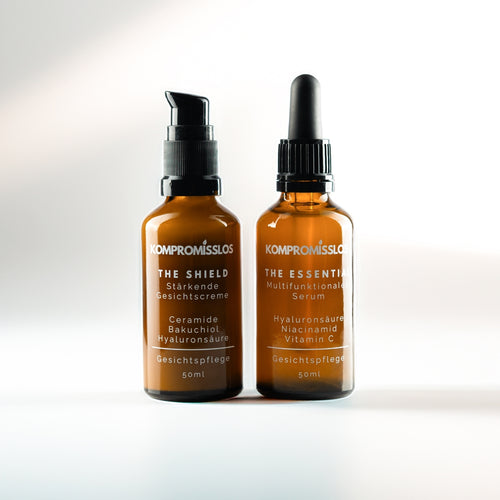
In our routine, layering takes on exactly this job. In The Duo of serum and cream, The Essential provides hyaluronic acid in three molecular sizes, then The Shield adds a protective final layer with Ceramide NP, squalane and jojoba oil. In her review on Judge.me, Andrea G. writes: “Just two products that combine everything you need” (review translated from German).
If you prefer to fill your own spray bottle with mineral or tap water, change the contents every few days and rinse the bottle out. After a while, water standing in an open bottle is no longer something you want to spray on your face.
A face mist would have been the easiest third product I could have made. Water in a can, a nice label, done. I deliberately chose not to, just as I chose not to make a toner. In our routine, cleansing with water is followed directly by serum and cream – the routine does not need any more steps than that. Besides, the base of both products is not simply water: aloe vera juice comes first in the ingredient list, even ahead of water. And both products are fragrance-free, because for me fragrance has no place on sensitive skin, not even in a refreshing mist. If you like spraying, go ahead. You just don’t need it. How the two steps in the morning and evening fit together is something I have deliberately kept simple.
Frequently asked questions
Can I spray thermal water over make-up?
Yes, you can, as long as you spray from far enough away for a fine mist rather than large droplets to land on your face. Many people do this to make powder look less dry or to make their make-up feel fresher. Let the mist dry without rubbing, otherwise your foundation will smudge. The spray does not care for your skin in the process; it only refreshes how your skin feels.
Does thermal water help with redness?
In the short term, the cooling effect can make red, warm skin feel more comfortable. That is a moment of relief, not a solution to the cause. If redness persists for weeks, if pustules, burning or swelling appear, or if your skin reacts to lots of things, see a dermatologist. Studies on thermal water for skin conditions mostly involve medically supervised spa courses, not the spray you use at home.
Is thermal water suitable for sensitive skin?
Pure thermal water without additives is generally unproblematic for sensitive skin, because it contains hardly anything that could irritate it. The ingredient list is what counts: if it shows only water and possibly a propellant, the risk is low. Mists with Parfum, essential oils or Alcohol denat. are the less calming choice for sensitive skin.
Should I blot off thermal water or let it sink in?
Ideally, blot off the excess after a moment or apply your skincare straight away. Simply letting it dry in the air is the worst option, because the water evaporates without being bound. Blotting means pressing gently, not rubbing.
How often a day can I spray thermal water?
There is no fixed upper limit; pure thermal water is not an active ingredient you could overdo. But pay attention to how your skin feels afterwards. If you have to spray more and more often because the tightness returns faster, that is a sign the spray is covering up a gap instead of closing it. Then it is worth taking a closer look at your serum and cream.
Does thermal water replace cleansing?
No, a thermal water spray does not replace cleansing. It does not remove sunscreen, make-up or sebum, and it is not rinsed off either. In the morning, many people find washing with lukewarm water is enough; in the evening, a mild cleanser. The spray can come afterwards if you like it, but not instead.
Do I need a thermal water spray if I use The Duo?
No. The Duo is designed so that two steps follow cleansing with water: serum and cream, morning and evening. Humectants and a protective final layer are already included. You can use a spray to freshen up on hot days, but as a skincare step, the Duo does not need it.
Sources
- Tarnowska M, Briançon S, Resende de Azevedo J, Chevalier Y, Arquier D, Barratier C, et al. The effect of vehicle on skin absorption of Mg2+ and Ca2+ from thermal spring water. International Journal of Cosmetic Science, 2020. Source
- Cacciapuoti S, Luciano MA, Megna M, Annunziata MC, Napolitano M, Patruno C, et al. The Role of Thermal Water in Chronic Skin Diseases Management: A Review of the Literature. Journal of Clinical Medicine, 2020. Source
- Purnamawati S, Indrastuti N, Danarti R, Saefudin T. The Role of Moisturizers in Addressing Various Kinds of Dermatitis: A Review. Clinical Medicine & Research, 2017. Source
- Herrero-Fernandez M, Montero-Vilchez T, Diaz-Calvillo P, Romera-Vilchez M, Buendia-Eisman A, Arias-Santiago S. Impact of Water Exposure and Temperature Changes on Skin Barrier Function. Journal of Clinical Medicine, 2022. Source