Does flying dry your skin? Why your face feels tight after a flight and what to pack in your hand luggage
ROUTINE
Yes, flying dries your skin, and the main culprit is the cabin air: on long-haul flights, one set of measurements found that relative humidity fell below 10 per cent within two hours of take-off, and the skin’s outermost layer gives up its water to that air. That is why your face feels tight after landing. What helps is simple: moisture with a layer of lipids on top, applied before departure and topped up on long flights if needed. A facial mist on its own is not enough – but you do not need a bulging toiletry bag either.
Why does skin dry out on a plane?
Skin dries out on a plane because the cabin air is extremely dry and the stratum corneum, the skin’s outermost layer, loses its water to the surroundings. At cruising altitude, the air outside is very cold and holds almost no water. The air that enters the cabin is warmed, but not humidified to any meaningful degree. A study in Skin Research and Technology measured what this does to eight women on long-haul flights who used no skincare products from twelve hours before the flight and throughout it. Relative humidity in the cabin fell below 10 per cent within two hours of take-off and stayed at that level for the rest of the flight. Measured hydration of the outer skin layer dropped quickly on the face and forearms, most markedly on the cheeks: by up to 37 per cent. The researchers see this as the likely explanation for the discomfort many long-haul travellers know: the skin feels tight and itchy.
Duration matters too. A review in the journal Indoor Air concluded that the effects of low humidity only become noticeable after an exposure of roughly three to four hours. For your skin, a flight to Barcelona is therefore a different matter from twelve hours to Bangkok. If, on the other hand, tightness is a regular companion at home too, the plane is unlikely to be the cause. What may be behind it is explained in the article on tight skin.
Should you moisturise on a plane?
Yes – on flights of about three hours or more, it is worth caring for your skin well before boarding and topping up on long-haul flights if needed. What you apply matters more than when you apply it. A product that only delivers water or humectants does little in very dry air if nothing sits on top: the moisture evaporates almost as quickly as it arrived. What your skin needs in the cabin is the same principle as in everyday life, just applied more consistently. First moisture, for example with hyaluronic acid or glycerin, then a layer of lipids on top that slows down water loss. Why hyaluronic acid often falls short without this second layer is covered in the article on combining hyaluronic acid.
A review in the Journal of the European Academy of Dermatology and Venereology sums up that low humidity and cold generally weaken the skin’s barrier function and make it react more sensitively to irritants. A flight is therefore not a good moment for new active ingredients, acids or an exfoliating treatment the evening before. In practice, that means your usual routine before departure, applied a little more generously. On long-haul flights, you can add a thin layer of cream after a few hours, with clean hands. If your skin is very dry to begin with, you will feel the cabin air most. What this skin fundamentally lacks is described in the article on very dry skin on the face.
What skincare should go in your hand luggage?
Your hand luggage only needs what you will use during the flight or straight after landing, and that is less than the travel-size shelves at the chemist suggest. For your face, two things are really all you need, plus two or three extras depending on the flight:
- A serum with humectants such as hyaluronic acid or glycerin.
- A cream with lipids such as squalane, ceramides or plant oils that keeps the water in your skin.
- A lip balm, because lips have hardly any sebaceous glands and are the first thing to crack in dry air.
- For daytime flights by the window or arrival somewhere sunny: a sunscreen for your face.
- If you have an appointment straight after landing: a small travel-size cleanser.
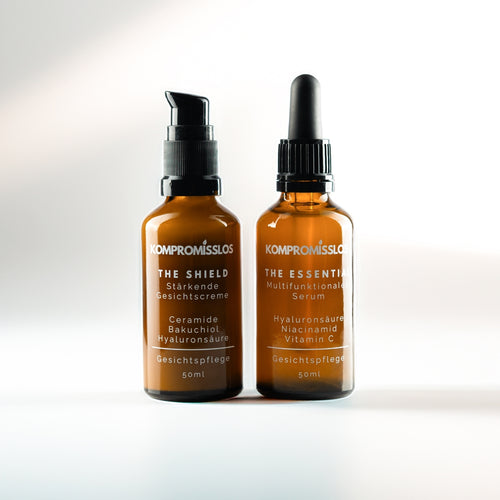
You can skip the facial mist, sheet mask, eye pads and a special in-flight overnight mask if the first two points are covered. That is exactly how The Duo is built: a serum with hyaluronic acid in three molecular sizes and a cream with squalane, jojoba oil and ceramides. Each bottle holds 50 ml, which keeps both under the 100 ml limit. In her review on Judge.me, Beatrix writes: ‘As I like to travel, it is also practical to have the two little bottles with me’ (review translated from German). How few products your skin needs in everyday life, too, is covered in the article on the minimalist skincare routine.
What are the rules for liquids and creams in hand luggage?
Creams, serums and gels in hand luggage are subject to the same rules as drinks: each container may hold no more than 100 ml, and all of them together must fit into a transparent, resealable plastic bag with a maximum capacity of 1 litre. One bag is allowed per person. That is how the Swiss Federal Office of Civil Aviation (FOCA) describes it. The key word is container: what counts is its capacity, not how much is left in it. A 200 ml tube that is only half full will still be taken out at security. According to FOCA, exceptions apply to containers for medical or dietary purposes, such as baby food, and to duty-free purchases presented sealed and with a receipt. Skincare does not fall into either category.
According to FOCA, new rules have applied at Zurich Airport since 26 June 2026: the airport has introduced CT scanners, and where such equipment is in use, containers of up to 2 litres are allowed in hand luggage. However, FOCA explicitly states that the rules vary depending on the airport and the equipment in use. On the return flight or at a connection, the 100 ml rule may apply again – and then your large tube is at stake. If you pack your skincare in containers of up to 100 ml from the start, you will not have to repack on any leg of the journey.
How should you care for your skin after a long-haul flight?
After a long-haul flight, your skin mainly needs rest: cleanse gently, apply moisture and lipids, and avoid experiments for the first few days at your destination. As soon as the surrounding air becomes more humid again, the outer layer of the skin takes water back up, and in healthy skin the tightness usually eases on its own. Exfoliants, acids or a new retinoid do not belong on your first evening at the hotel, because after hours in dry air the barrier can react more sensitively to irritants. A long, hot shower on arrival does your face no favours either, because hot water strips away even more of the skin’s lipids. And after a night spent sitting upright, sleep is the step you are most likely to be missing anyway.
If your skin feels tight after the flight but is shiny or prone to blemishes at the same time, it is more likely lacking water than oil. How to recognise this condition and how it differs from dry skin is explained in the article on dehydrated skin. If the tightness lasts longer than a few days, or if redness, flaking or itching appear and do not subside, it is time to see a dermatologist.
Drink enough on the plane – it is good for your circulation. The dryness on your face, however, develops at the surface of the skin, caused by the air, and that is where skincare applied from the outside comes in. An extra glass of water is no substitute for it.
How do you adapt your routine to a different climate at your destination?
At your destination, adjust your skincare to the humidity, temperature and sun, not to the season back home. Your basic routine stays the same – only the amount and the sun protection change. In warm, humid air, your skin loses less water, so a thinner layer of cream is often enough. In dry heat, in air-conditioned hotels or in the cold, the opposite is true.
| Climate at your destination | What your skin goes through | Adjustment |
|---|---|---|
| Humid and hot, for example in the tropics | Lots of sweat, skincare quickly feels heavy | Apply cream more thinly, use sunscreen consistently |
| Dry and hot, for example in the desert | Dry air, skin loses a lot of water | Be generous with moisture and lipids |
| Cold and dry, for example on a skiing holiday | Cold outside, heated air indoors | More cream, and do not forget your lips |
| Altitude and snow | Strong sun, wind, reflection off the snow | Sunscreen in addition to your skincare |
| City with air conditioning | Dry indoor air for many hours | Your usual routine, a little more cream in the evening |
For cold outside and heated air indoors, there is a separate article on winter face cream. And wherever the sun is stronger than at home, sunscreen for your face is the step that makes the biggest difference – more than any additional travel skincare.
I deliberately limited The Duo to two products, and you notice that particularly when travelling. Instead of a wash bag full of miniatures, you take two bottles of 50 ml each, both well under the 100 ml limit. The serum provides moisture, the cream adds squalane, jojoba oil and ceramides on top. Your facial skincare does not need more than that for a trip. I am just as clear about what the two cannot do: they contain no sun protection factor. If you sit by the window on a daytime flight or head out into the sun at your destination, you also need a separate sunscreen. And a long-haul flight does not change how you use them either. How to apply the two morning and evening is set out, unchanged, in the guide to using them.
Frequently asked questions
Does a facial mist help on a plane?
On its own, hardly. A facial or thermal water spray is refreshing for a moment, but the water quickly evaporates again in the dry cabin air. If you like using one, follow it straight away with a cream that holds in the moisture. Without that layer, your skin can even feel drier after the water has evaporated than it did before.
Should I wear make-up on a plane?
You can – it does not harm your skin in principle. On long flights, though, less is more comfortable: powder and matte foundations accentuate dry patches, and you can only top up your moisturiser cleanly if there is no layer on top. A simple solution is to wear only skincare during the flight and to put on your make-up shortly before landing.
Why do I break out after flying?
There is no single, well-documented cause. Usually several things come together: little sleep, a disrupted rhythm, touching your face often, unfamiliar products and a stressed skin barrier. Stick to your usual skincare at your destination rather than trying out anything new. If the blemishes persist for weeks, have them checked by a dermatologist.
Do I need sunscreen on a plane?
On a daytime flight in a window seat, it makes sense. A study in JAMA Dermatology took measurements in a cockpit and found that the windscreen blocked UVB but let UVA through – at 30,000 feet almost twice as much as on the ground. There is hardly any data on passenger windows. On night flights or in an aisle seat, you can leave it out. If you are arriving somewhere in the south or in the mountains, it belongs in your hand luggage anyway.
How much cream can I take in my hand luggage?
As much as fits in containers of up to 100 ml each inside a transparent 1-litre bag, one bag per person. What counts is the capacity of the container, not how much is left in it. At Zurich Airport, the CT scanners have allowed containers of up to 2 litres since June 2026, but that does not automatically apply at other airports.
Is a sheet mask on a plane worth it?
It does no harm, but it does less than it promises. The mask releases moisture as long as it is on your face. Afterwards, that moisture evaporates again in the cabin air unless a cream follows. A serum and a cream do the same job with less waste, and you do not have to sit it out in your seat with a wet mask on.
Can I take The Duo in my hand luggage?
Yes. The Essential and The Shield each hold 50 ml, which keeps them under the 100 ml limit for liquids and gels. Like all serums and creams, both go in the transparent 1-litre bag, except at airports with CT screening and relaxed rules. You can find out more about the two products on the page for The Duo.
Sources
- Guéhenneux S, Gardinier S, Morizot F, Le Fur I, Tschachler E. Skin surface hydration decreases rapidly during long distance flights. Skin Research and Technology, 2012. Source
- Nagda NL, Hodgson M. Low relative humidity and aircraft cabin air quality. Indoor Air, 2001. Source
- Engebretsen KA, Johansen JD, Kezic S, Linneberg A, Thyssen JP. The effect of environmental humidity and temperature on skin barrier function and dermatitis. Journal of the European Academy of Dermatology and Venereology, 2016. Source
- Sanlorenzo M, Vujic I, Posch C, Cleaver JE, Quaglino P, Ortiz-Urda S. The risk of melanoma in pilots and cabin crew: UV measurements in flying airplanes. JAMA Dermatology, 2015. Source
- Bundesamt für Zivilluftfahrt BAZL. Flüssigkeiten. Source