Skin after summer: why less skincare now does more
SKIN CONDITION AND SEASON
Your skin after summer changes because two stresses collide: behind it lie weeks of UV, salt, chlorine and air conditioning, and ahead of it cooler and considerably drier air. The right response is a smaller routine, not a bigger one. Binding moisture and supporting the lipid layer matter more now than any new active ingredient.
Why does your skin change after summer at all?
Your skin after summer faces a double shift in stress, and that is exactly why it changes. Behind it lie weeks of UV radiation, salt water, chlorine and dry air-conditioned air, all of which have taken their toll on the outermost layer. Ahead of it lie sudden drops in temperature, noticeably lower humidity and the first days of the heating being on at home. Both come together within a few weeks at the end of August and in September. That is why your skin does not just feel drier but often more sensitive, duller and more unsettled at the same time. The difference between skin type and skin condition helps here: your type stays largely stable, while your condition fluctuates with climate, stress and skincare. What you see in September is almost always a condition, not a new predisposition. Dark spots after sun exposure also often look more pronounced now, because your tan is fading and the contrast increases.
For context: The Duo does not contain an SPF and does not replace sunscreen. UV protection remains a separate step with its own product; you will find everything you need to know under sun protection for your face.
Why do the effects of summer only show up later?
The effects of summer show up with a delay because the high humidity in summer has masked existing dryness for weeks. As long as the surrounding air holds a lot of water, the outer layer of the skin loses less water to the outside and so looks plumper and smoother than it really is. When humidity drops in September and heated air is added, this compensation disappears within a few days. Only then does what has been there for a while become visible. According to a review in the Journal of the European Academy of Dermatology and Venereology, low humidity levels in humans are associated with changes in the water content of the stratum corneum, reduced skin elasticity and increased roughness. Typical now, therefore, is a feeling of tightness after washing that was not there before, or signs of a weakened skin barrier, such as stinging from products you have used without problems for years.
To be honest, the evidence is not as clear-cut as many autumn articles make it sound. A systematic review in Skin Health and Disease evaluated 15 studies on the environment and transepidermal water loss and found contradictory results in the five papers on seasonal variation. What is established is the link between ambient climate and the condition of the skin, not a fixed autumn effect in figures.
Why more products are the wrong reflex in autumn
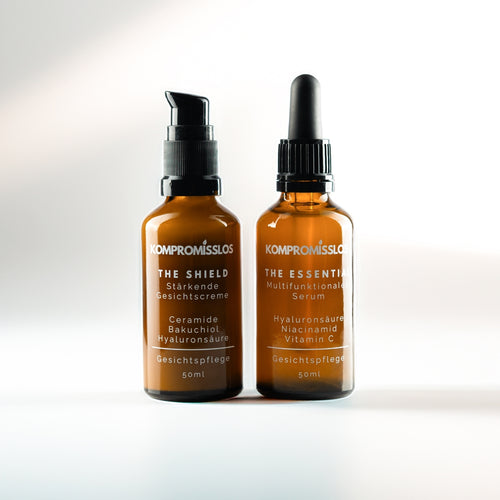
More products are the wrong reflex in autumn, because every additional product brings new active ingredients, new emulsifiers and new preservatives to skin that is already irritated. The typical sequence is almost always the same: the skin feels tight, a richer product is added, then a mask, then an oil. After three weeks, the routine is twice as big, the skin is more unsettled than before, and the cause can no longer be traced. That is the real damage of this additive reaction: not that any single product is bad, but that with five simultaneous changes you can no longer attribute any of them. A routine is only useful for working out what is going on as long as you can keep it all in your head. That is exactly why our range consists of The Duo, with serum and cream, and not an autumn line with six steps.
A customer wrote to me in the autumn that after her holiday she had bought several new products in a short space of time because her skin suddenly felt tight, and that things had then got worse rather than better. She could no longer tell which product had triggered the redness. I did not recommend anything extra; instead I advised her to leave out everything except cleansing, serum and cream for a few weeks. After that, for the first time, she knew what her skin was actually reacting to.
What your skin really needs in autumn
In autumn, your skin needs three things: moisture binding, support for the lipid layer and as little potential for irritation as possible. Humectants such as hyaluronic acid and panthenol draw water into the upper layers of the skin, while lipid building blocks such as ceramides and squalane make sure that this water stays there and does not evaporate. One without the other works poorly: a pure hydrating serum on a leaky barrier fizzles out within hours in October, because the water it has bound evaporates again straight away. The Duo as a whole contains, among other things, 2% hyaluronic acid and 5% niacinamide for this purpose, along with ceramides, squalane, panthenol and jojoba oil with no stated percentage. Whether you need two products for this or one is enough is something we have broken down separately: do you really need serum and cream. Low irritation simply means: no introducing several new products at once, no experimenting with fragrances and no switching every week.
| Step | In September | Why |
|---|---|---|
| Frequent exfoliation | Reduce, once a week at most | The outer layer of the skin is already under strain after summer. |
| Starting new actives at the same time | Leave it out | Two new products at once make any reaction impossible to attribute. |
| Binding moisture | Keep it | Humidity drops, so the support from outside disappears. |
| Supporting the lipid layer | Keep it, and apply more generously in the evening | The barrier keeps the water where it belongs. |
| Extra masks, oils, ampoules | After four weeks at the earliest | Every extra product brings new preservatives to irritated skin. |
How to adjust your routine in September
Adjust your routine in September by reducing first and only adding afterwards, if at all. The order is crucial, because only from a small base can you tell what your skin is actually missing. In practice, this means: in the first two weeks, drop everything that is not cleansing, serum, cream and sun protection. Reduce how often you exfoliate your face considerably rather than increasing it, even if your skin feels rough. In the two weeks after that, only adjust the amount, not the products. If something is still missing after that, add exactly one thing and wait again. If you want to stick to two steps, our two-step basic routine for CHF 109.90 offers exactly that, and how to put it together is explained on the how-to-use page.
- Weeks 1 to 2: reduce to cleansing, serum, cream and sun protection.
- Weeks 3 to 4: only adjust the amount – 3 to 6 drops of serum and 3 to 6 pumps of cream.
- From week 5: one addition at most, then watch again for four weeks.
One distinction belongs here: skincare is cosmetics, not treatment. If redness, flaking, itching or blisters persist, spread or hurt, that is a matter for a dermatologist, not for a new cream.
Every autumn I am asked whether we could make a richer winter version of The Shield cream. I have deliberately decided against it. Two products, all year round, the same formula: that is not convenience, it is the point. As soon as I sell you a different formula in October, by November you no longer know whether your skin is reacting to the season or to the new product. What may change with the seasons is the amount you use, not the formula. That is why none of our bottles carries a summer or winter label. If you are still looking for something considerably richer, you will honestly be better served by a classic winter cream than by us.
Frequently asked questions
Why does my skin change in September?
In September, humidity drops, temperatures fluctuate more and the first days of heating come along. At the same time, your skin has weeks of UV, salt and chlorine behind it. Summer humidity masked existing dryness, and that compensation now disappears. What becomes visible is strain that has been there for a while.
Why does my skin feel drier after a holiday?
Your skin feels drier after a holiday because salt water, chlorine, sun and air conditioning have put the outer layer under strain for weeks. Back in everyday life, the high humidity that cushioned this while you were away is also missing. Your skin has not got worse; it is simply showing what was previously being compensated for.
Is a richer cream enough in autumn?
A richer cream is often not necessary at all in autumn. What matters is that your skincare binds moisture and supports the lipid layer, not that the texture becomes heavier. Very rich products can also cause problems for combination skin. It makes more sense to apply more generously in the evening and keep the formula the same.
Do I still need sun protection in autumn?
Yes. UV radiation does not disappear in autumn; it just becomes less noticeable because the heat and glare subside. UVA is relevant all year round, even when it is cloudy. Sun protection remains a separate step with its own product. The Duo does not contain an SPF and does not replace sunscreen.
How long does it take for skin to adjust to the new season?
In adults, the outer layer of the skin renews itself over several weeks, and adjusting to a new season takes place within that timeframe too. So allow at least four weeks before you judge a routine. If you change something every few days, you will never see what actually worked.
Does exfoliating make sense in autumn?
Exfoliating can make sense in autumn, but much less often than during summer. After weeks of UV and salt, the outer layer of the skin is already under strain, and removing more of it increases sensitivity. Once a week at most is realistic for most people. If you have redness, it is better to pause altogether.
How can I tell if I am overdoing my skincare?
Typical signs of overdoing it are stinging shortly after application, persistent redness, small rough patches and the feeling that nothing is being absorbed properly any more. Often you also can no longer say which product is causing what. The most useful test is to cut back consistently for a few weeks.
Are serum and cream enough for the colder months?
For most people, a serum and a cream are enough in winter too, provided both bind moisture and support the lipid layer. The Duo as a whole contains, among other things, 2% hyaluronic acid and 5% niacinamide for this purpose, along with ceramides, squalane and panthenol. What may change with the season is the amount, not the number of products.
Sources
- Goad N, Gawkrodger DJ. Ambient humidity and the skin: the impact of air humidity in healthy and diseased states. Journal of the European Academy of Dermatology and Venereology, 2016. Source
- Green M, Kashetsky N, Feschuk A, Maibach HI. Transepidermal Water Loss (TEWL): Environment and Pollution, A Systematic Review. Skin Health and Disease, 2022. Source