Probiotic skincare: what microbiome products can do and what is just marketing
ACTIVE INGREDIENTS
Probiotic skincare almost never contains live bacteria. What it contains are bacterial components: ferments, lysates or filtrates, listed in the INCI as Lactobacillus Ferment or Bifida Ferment Lysate, for example. In small studies, some of them run by the manufacturers themselves, individual extracts have made sensitive skin measurably less reactive. There is no evidence, however, that a cream can deliberately ‘rebuild’ your skin microbiome. For most people, a routine with few irritants does more than yet another trendy ingredient.
What is the skin microbiome, and what does skincare have to do with it?
The skin microbiome is the community of bacteria, fungi and viruses that lives on your skin, and skincare mainly changes the conditions this community lives in. A review in Nature Reviews Microbiology describes the skin as a dry, nutrient-poor and acidic habitat. It is precisely these conditions that make it hard for pathogens to settle, and yet the skin is home to a diverse microbiota. The review focuses on species such as Staphylococcus epidermidis, Cutibacterium acnes (still under its old name, Propionibacterium acnes) and Staphylococcus aureus. One point is worth keeping in mind: there is no target value for which mix is ‘right’ for you. That is why no label can restore it.
A small study in BMC Biology shows what skincare actually does. Researchers followed 11 volunteers over 9 weeks to see how four everyday products changed their skin. The effects lasted for weeks and varied greatly from person to person. Face and arm lotions barely changed bacterial diversity, but they did change the chemical make-up of the skin’s surface. So a cream does not deliver bacteria; it is part of the environment the bacteria live in: moisture, lipids, acidity and the number of irritants.
Does probiotic skincare really contain live bacteria?
No, probiotic skincare almost never contains live bacteria, and that comes down to the rules for cosmetics. Probiotics are defined as live microorganisms that provide a health benefit when given in adequate amounts. A review in the journal Molecules points out that, for safety reasons, cosmetics should contain only very low numbers of microbes, and concludes that a true probiotic cosmetic cannot exist. There are also two practical hurdles: preservatives are there to inhibit or kill microbes in the product, and in a water-based cream, dried bacteria would either multiply or die.
The same review analysed 50 products marketed as probiotic from two large North American cosmetics retailers. Of the bacterial ingredients listed on the labels, 78 per cent were ferments in the form of extracts, filtrates or lysates. Yoghurt accounted for 10 per cent, with no indication of which bacteria it contained or whether they were alive. So ‘probiotic’ on a cream usually means that it contains something once derived from bacteria. That need not be worthless, but it is not what the term promises.
What is the difference between prebiotics, probiotics and postbiotics in creams?
Prebiotics are meant to feed certain skin bacteria, probiotics would be the live bacteria themselves, and postbiotics are inanimate bacteria or their components – which is much of what ‘probiotic’ creams actually contain. Postbiotics have a scientific definition: a preparation of inanimate microorganisms and/or their components that confers a health benefit on the host. By that definition, pure filtrates without any cell components do not count. On packaging, though, the three terms are often used interchangeably, because ‘probiotic’ is the one people know best. Not every ingredient that comes from fermentation belongs to this family: fermented sugars such as Biosaccharide Gum-1 are used in cosmetics mainly as humectants and have nothing to do with the microbiome promise.
| Term | What it is | Typical INCI listing | What you can realistically expect |
|---|---|---|---|
| Prebiotics | Sugars or oligosaccharides meant to preferentially feed desirable skin bacteria | e.g. Inulin, Alpha-Glucan Oligosaccharide | Moisture, as with other sugars; the targeted effect on skin bacteria has barely been studied in humans |
| Probiotics | Live microorganisms | Practically never in creams; ‘live cultures’ only in rare exceptions | The term rarely applies to cosmetics |
| Postbiotics | Inanimate bacteria or their components | Lactobacillus Ferment, Bifida Ferment Lysate, Lactococcus Ferment Lysate | Individual extracts with small studies; a result only applies to the extract tested, in the amount tested |
What do studies on probiotic skincare show so far?
So far, studies show that individual bacterial lysates can soothe sensitive skin in certain amounts, but not that microbiome skincare as a category does more than good basic care. A frequently cited example is a study in Experimental Dermatology: 66 women with reactive skin applied either a cream containing 10% of a Bifidobacterium longum lysate or a control cream twice a day for two months. In the extract group, sensitivity in the stinging test fell significantly, the skin coped better with physical and chemical stress, and after 29 days it was less dry, according to both the doctors’ assessment and the participants’ own.
This needs some context. The study was carried out by researchers from a large cosmetics group, it tests exactly one extract at exactly one concentration, and it measures skin sensitivity and barrier function, not the microbiome itself. Whether a cream that lists ‘Bifida Ferment Lysate’ far down its INCI contains anything like that amount is impossible to tell from the outside. The review in Molecules reaches a similarly sober conclusion: firm claims would need further strain-by-strain research and randomised trials in humans. In this field, then, promising means interesting for research, but not yet a reason to overhaul your routine.
What upsets the skin microbiome day to day, and what is gentle on it?
Your skin microbiome is most likely to be thrown off balance by the same things that put strain on the skin’s surface: cleansing too often and too harshly, using lots of products at once, constant exfoliating and fragrance on sensitive skin. That said, direct evidence in humans for each individual factor is thin. The reasoning goes via the habitat: if the skin’s acidity, lipids and moisture keep tipping out of balance, the conditions for the bacteria living on it change. A weakened barrier is usually the more visible part of the problem, and how to recognise a damaged skin barrier is a topic in its own right. With cleansing, what matters most is how mild it is and how often you do it – more on that in the article on what kind of cleanser your skin really needs. And if more products are making your skin more irritated rather than calmer, it is worth reading up on the signs that you are using too many products.
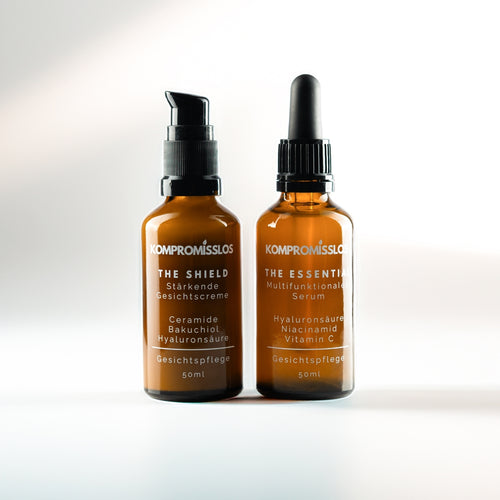
Conversely, the gentle option is a short routine with few irritants. That is exactly the idea behind The Duo serum and cream, although it is not probiotic skincare: it contains neither live bacteria nor bacterial lysates. Both products are fragrance-free and contain no essential oils. The Shield provides Ceramide NP, squalane and jojoba oil, and The Essential provides hyaluronic acid in three molecular sizes. In her review on Judge.me, Andrea G. writes: ‘My skin feels nourished and soft, but not overloaded’ (review translated from German).
If you want to try a new microbiome cream, use it to replace a product you already have rather than adding it on top. That is the only way to judge, after a few weeks, what it actually changes.
How can you tell from the INCI whether microbiome skincare is more than a buzzword?
You can tell whether there is more to microbiome skincare than a buzzword from specific details: which bacterial ingredient, in what form, where it sits on the list and whether there is a study on exactly that ingredient. Without these details, terms such as ‘microbiome-friendly’ or ‘strengthens the skin flora’ tell you little. One labelling rule helps here: ingredients are listed in descending order of quantity, and only very small amounts may follow at the end in any order. Anything right at the end of the list is therefore usually present only in trace amounts.
- Look for a bacterial ingredient: does the INCI include something like Lactobacillus Ferment, Bifida Ferment Lysate or Lactococcus Ferment Lysate? If not, ‘microbiome’ usually refers only to a test or a seal.
- Check its position: far down the list means very little of it. That is not automatically bad, but it sits poorly with a big promise.
- Be sceptical of ‘live cultures’ in a preserved, water-based cream.
- Ask about the study: does the manufacturer state the number of participants, the duration and the concentration for exactly this extract?
- Read the rest of the formula: fragrance, essential oils or alcohol near the top are an odd fit for a cream that presents itself as especially gentle. There is more on this in the guide to caring for sensitive skin.
I deliberately left bacterial lysates and ‘probiotics’ out of the formula. Not because I think these extracts are nonsense, but because I do not want to put anything on a bottle whose effect on the skin cannot be properly substantiated. Instead, I focused on reducing irritants: two products instead of eight, fragrance-free, disclosed concentrations, and, according to our instructions for use, cleansing with water only. That is less spectacular than a new trendy ingredient, but every decision behind it is easy to follow. I will be upfront about the limit: The Duo does not specifically change your microbiome, and we do not promise that it does. Everything that is in it, and everything that is not, is in our full A to Z ingredient list.
Frequently asked questions
Can bacteria from a cream settle permanently on your skin?
That is very unlikely. Most creams contain no live bacteria at all, only lysates or ferments. And even live microbes would land on skin that is dry, nutrient-poor and acidic, and already colonised by its own microbiota. There is no solid evidence that strains from cosmetics persist there for good.
Do preservatives destroy the skin microbiome?
There is no evidence in humans that they destroy it. The review in Molecules does point out, however, that preservatives are designed to inhibit or kill bacteria and could therefore also affect the skin flora; solid data on this is lacking. There is more on this in the article on preservatives in natural skincare. The Duo is preserved with Sodium Benzoate and Sodium Levulinate, supported by Pentylene Glycol and Glycerin.
Is ‘microbiome-friendly’ a protected term?
No, there is no legal definition of ‘microbiome-friendly’. Advertising claims on cosmetics do have to be substantiated, but which tests count as evidence is usually decided by the manufacturer or a private testing institute. So ask what exactly was tested, on how many people and for how long.
Do probiotic yoghurt face masks help?
There are no solid studies showing an effect on the skin microbiome. Yoghurt cultures are adapted to milk, not to skin. The lactic acid in yoghurt can smooth the surface slightly, but it can also sting on sensitive skin. If you like the mask, there is no harm in using it now and then. As a microbiome treatment, though, it is no use.
Can oral probiotics help your skin?
The evidence is thinner than the advertising suggests. A Cochrane review of 39 randomised trials of oral probiotics concluded that the available strains probably make little or no difference to eczema symptoms as rated by patients. For skin problems, seeing a doctor makes more sense than taking a supplement on your own initiative.
Is probiotic skincare a good idea for acne or atopic eczema?
With acne or atopic eczema, that decision belongs with a dermatologist. There are small studies on individual bacterial extracts, but no basis for using a cream as a treatment. At most, cosmetics can complement therapy supervised by a doctor, and even then only after you have checked with them.
Do I need probiotic skincare if I use The Duo?
No, healthy skin does not need additional probiotic skincare. The Duo itself contains no bacteria and no lysates, and it does not promise any effect on the microbiome. It relies on few irritants, moisture and lipids. Another cream on top would mainly mean more products, when the serum-and-cream Duo is deliberately designed to get by with two.
Sources
- Byrd AL, Belkaid Y, Segre JA. The human skin microbiome. Nature Reviews Microbiology, 2018. Source
- Bouslimani A, da Silva R, Kosciolek T, Janssen S, Callewaert C, Amir A, et al. The impact of skin care products on skin chemistry and microbiome dynamics. BMC Biology, 2019. Source
- Puebla-Barragan S, Reid G. Probiotics in Cosmetic and Personal Care Products: Trends and Challenges. Molecules, 2021. Source
- Guéniche A, Bastien P, Ovigne JM, Kermici M, Courchay G, Chevalier V, et al. Bifidobacterium longum lysate, a new ingredient for reactive skin. Experimental Dermatology, 2010. Source
- Makrgeorgou A, Leonardi-Bee J, Bath-Hextall FJ, Murrell DF, Tang ML, Roberts A, et al. Probiotics for treating eczema. Cochrane Database of Systematic Reviews, 2018. Source