Skin before and after quitting smoking: what recovers, how long it takes and what stays
SKIN OVER 40
After you quit smoking, your skin partly recovers: the blood-vessel-narrowing effect of nicotine wears off, and small wounds become infected less often after only about four weeks without cigarettes. A calmer, fresher-looking complexion appears over months, if at all. Wrinkles, sagging and fine lines on the upper lip that have built up over years, on the other hand, largely remain. Above all, quitting stops new damage from being added – and that is the biggest gain of all.
Does your skin recover when you quit smoking?
Yes, your skin recovers after you quit smoking, but not completely and not at the same pace everywhere. The processes that smoking constantly disrupts are the quickest to change: nicotine narrows the blood vessels, and with every cigarette you no longer smoke, that trigger falls away. This is best studied for wound healing, because it can be measured cleanly. For the visible appearance of the skin – complexion, texture and elasticity – the evidence is much thinner and consists mainly of small observational studies without a comparison group. What has built up in the structure of the skin over years recovers more slowly or not at all: broken-down collagen, declining elasticity, wrinkles in the mid and lower face. So the effects of quitting show up beneath the surface first, then become slightly visible, and above all quitting stops any further breakdown.
What does smoking do to your skin, and which part of it can be reversed?
Smoking slows down the production of collagen and at the same time speeds up its breakdown – and what can be reversed is mainly the ongoing process, not the damage that has already accumulated. A study in the British Journal of Dermatology compared 47 smokers with 51 people who had never smoked. In the smokers, the production of type I and type III collagen was 18 and 22 per cent lower respectively, while the collagen-degrading enzyme MMP-8 was 100 per cent higher. On top of that come poorer circulation and oxidative stress caused by the substances in smoke. How smoking compares with other factors is covered in the article on how to slow down skin ageing.
One thing matters for your expectations: this study compared smokers with non-smokers, not the same people before and after quitting. It is plausible that new collagen is produced more normally again once the smoke is gone. There is no evidence that collagen which has already been broken down comes back. Your complexion is a similar story: part of the pallor depends on circulation and can improve. What else lies behind it is explained in the article on why your complexion looks dull and grey.
How long does it take to see a difference after quitting smoking?
Measurable changes appear after a few weeks, changes you can see in the mirror more likely after several months – and the evidence for each is not equally strong. The most solid figure comes from a randomised trial in the Annals of Surgery: in smokers who stopped smoking for four weeks, small, standardised skin wounds became infected significantly less often than in those who carried on smoking. That concerns healing, not appearance. For the look of the skin, the main evidence is a pilot project from Milan involving 64 women who quit smoking. Signs of skin ageing were assessed after 3, 6 and 9 months, and the changes became statistically significant from about 6 months onwards. The fact that visible changes do not show up within days also has to do with how long the skin cell turnover cycle takes.
| When | What can change | How well it is supported |
|---|---|---|
| First few days | The blood-vessel-narrowing effect of nicotine wears off, provided you are not replacing the nicotine | Mechanism known, visible effect on the skin not studied |
| After about 4 weeks | Small skin wounds become infected less often | Well supported by a randomised trial, but on wounds, not on how the skin looks |
| After about 6 months | Complexion, texture and elasticity may improve slightly | Weakly supported, one pilot project without a comparison group |
| After 9 months | Calculated skin age clearly lower on average than at the start | Weakly supported, same pilot study, figure from a calculation model |
| After years | No new smoking-related damage, existing wrinkles largely remain | Plausible; there is no evidence that existing wrinkles recede |
The Milan study needs to be put into honest perspective. According to its abstract, the participants’ calculated biological skin age was on average 9 years above their actual age at the start, and by the end of the programme it had fallen by around 13 years. That sounds spectacular, but it is based on an algorithm built from measurements such as smoothness, brightness and elasticity, with no comparison group and with accompanying support from specialists in skin, psychology and nutrition. The direction is encouraging, but you should not apply the figure to your own face.
Why does skin sometimes get worse in the first weeks after quitting smoking?
If your skin gets worse in the first few weeks, this is very probably down to the circumstances of quitting, not to toxins being expelled through the skin. Detoxing through the skin in this sense does not exist, and there is little good evidence from studies that skin typically gets worse after quitting smoking. What does happen are changes in everyday life that can show on your face, because the adjustment is demanding and throws a lot off balance at once. Typical candidates are:
- Stress and temporarily more restless sleep
- A different diet, often with more sweets and snacks
- Touching your face more often because your hands are looking for something to do
- A new skincare product that happens to be introduced at exactly this stage
Most of this settles once your new everyday routine has bedded in. If redness, inflammation or spots persist for weeks or get worse, see a dermatologist – and the same goes for any unusual or changing patch of skin.
If you want to change your skincare, wait until a few weeks after you have quit smoking. If your skin changes during that first phase, you will at least know that a new cream is not to blame.
What traces remain even after years without a cigarette?
As far as we know today, it is mainly the structural changes in the mid and lower face that remain: wrinkles, under-eye bags and a sagging contour. A study in Plastic and Reconstructive Surgery shows where smoking leaves its mark on the face. It involved 79 pairs of identical twins in which only one twin smoked or one had smoked for at least 5 years longer than the other. The twins who smoked scored worse for sagging upper eyelid skin, under-eye bags, puffiness over the cheekbones, nasolabial folds, lines on the upper and lower lip, and jowls. For forehead lines, frown lines and crow’s feet, the researchers found no clear difference. Even a 5-year difference in how long someone had smoked was visible in the face. For you, this cuts both ways: there is no evidence that existing lines recede once you quit. But every year without a cigarette is a year in which no further smoking-related damage is added.
A second point makes the case for being consistent with sun protection. A study in Photodermatology, Photoimmunology and Photomedicine showed in cell experiments that tobacco smoke extract and UVA light together stimulate the collagen-degrading enzyme MMP-1 more strongly than either factor on its own. If you smoked for years, quitting takes one of the two factors away from your skin. The second one you can control with sunscreen.
How do you support your skin after quitting smoking without overloading your routine?
After you quit smoking, your skin does not need a detox or smoker’s skin range, but what makes sense for any skin over 40: moisture, lipids for the barrier and sun protection. The biggest lever is not a product but quitting itself. Second comes protection from UV light, because it slows the breakdown that is still left after quitting. Everything else is care at the surface: it makes skin look smoother and calmer, but it does not repair smoking damage deep down. Trying lots of new products at this stage is more likely to lead to irritation than to progress.
- Stay smoke-free: this is the step with the greatest effect on your skin.
- Sun protection: daily sunscreen for your face is part of every morning, in winter and on cloudy days too.
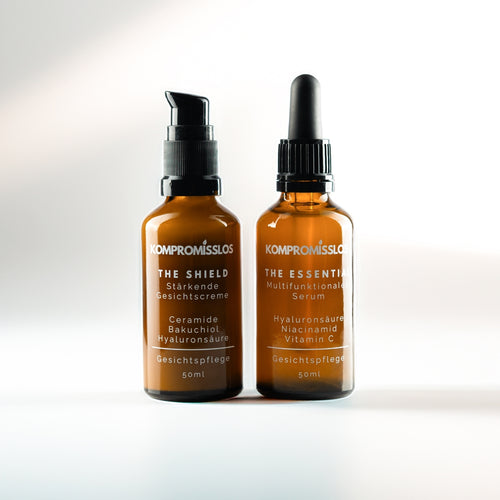
- Moisture and lipids morning and evening, for example with The Duo of serum and cream: The Essential with hyaluronic acid in three molecular sizes and niacinamide for a more even-looking complexion, followed by The Shield with ceramide NP, squalane and jojoba oil.
- Take warning signs seriously: if tightness, stinging or flaking appear, it helps to know how to recognise a damaged skin barrier. The rule then is to apply less, not more.
The Shield contains no sun protection factor. During the day, a separate sunscreen therefore goes on top as the final step.
I sell two products and no smoker’s skin range, and that does not change for this topic either. You make the biggest difference by quitting and by wearing sunscreen, not with an extra specialist cream. The cream deliberately contains no SPF, so during the day a separate sunscreen goes on top. The Duo contains 5% niacinamide and 2% vitamin C as stable 3-O-Ethyl Ascorbic Acid, and these figures are openly listed on our page about the active ingredients. What The Duo cannot do is undo years of smoking. It can supply your skin with moisture and lipids while it recovers without smoke. That is all I promise.
Frequently asked questions
Do you get spots after quitting smoking?
Some people get more spots in the first weeks after quitting smoking, but there is no evidence for such an effect. It is not your body detoxing through the skin. Stress, restless sleep, more sweet food or new products are more likely causes. Keep your routine unchanged during this phase. If the spots persist for weeks or become badly inflamed, have them checked by a dermatologist.
Do smoker’s lines on the upper lip go away?
No, existing fine lines on the upper lip hardly recede after quitting smoking, but no new smoking-related ones are added. What skincare can do there and where it stops is covered in the article on upper lip wrinkles.
Are e-cigarettes or nicotine patches just as good for your skin?
That cannot be said for certain, because the evidence on skin is thin. Nicotine narrows the blood vessels, whatever its source. In the Annals of Surgery study, there was no difference in wound infections between nicotine patches and placebo patches. Which quitting aid suits you is something to discuss with your GP, at the pharmacy or with the free Swiss quitline on 0848 000 181.
Does your skin get drier after quitting smoking?
There is no solid evidence for this. If your skin feels drier after quitting smoking, other reasons are usually behind it: dry heated air, washing more often, new products or simply age. Skincare with humectants and lipids, morning and evening, is usually enough. If your skin still stings or flakes, the barrier is more likely overwhelmed than undersupplied.
Is it too late for your skin to quit smoking at 50 or 60?
No, it is never too late for your skin. In the twin study, even a 5-year difference in how long someone had smoked had visible effects on the face, so every smoke-free year counts. Existing wrinkles remain, but wound healing improves and further smoking-related breakdown stops. For your health as a whole, this applies all the more.
Do I need special skincare for smoker’s skin after quitting?
No, smoker’s skin is not a skin type of its own that needs its own product line. After you quit, your skin needs nothing different from before: simple care for moisture and the barrier, plus sunscreen during the day. You can skip detox products that claim to draw residues out of the skin. What matters more is keeping your routine simple and consistent in the first few weeks.
Do I need extra products after quitting smoking if I use The Duo?
No, apart from a sunscreen for the daytime. Serum and cream cover moisture and lipids morning and evening, and a smoker’s skin product would add nothing significant. As the cream contains no SPF, a separate sunscreen goes on top in the morning. You can see how the two steps work together on the page for The Duo.
Sources
- Sorensen LT, Karlsmark T, Gottrup F. Abstinence from smoking reduces incisional wound infection: a randomized controlled trial. Annals of Surgery, 2003. Source
- Serri R, Romano MC, Sparavigna A. “Quitting smoking rejuvenates the skin”: results of a pilot project on smoking cessation conducted in Milan, Italy. Skinmed, 2010. Source
- Knuutinen A, Kokkonen N, Risteli J, Vähäkangas K, Kallioinen M, Salo T et al. Smoking affects collagen synthesis and extracellular matrix turnover in human skin. British Journal of Dermatology, 2002. Source
- Okada HC, Alleyne B, Varghai K, Kinder K, Guyuron B. Facial changes caused by smoking: a comparison between smoking and nonsmoking identical twins. Plastic and Reconstructive Surgery, 2013. Source
- Yin L, Morita A, Tsuji T. Skin aging induced by ultraviolet exposure and tobacco smoking: evidence from epidemiological and molecular studies. Photodermatology, Photoimmunology and Photomedicine, 2001. Source