Peeling skin on your face: after sun, cold, peels or retinol – what helps now
SKIN CONCERNS
If the skin on your face is peeling, its outer layer has almost always had too much to deal with: sun, cold and dry air, an exfoliant, retinol or water that is too hot. What helps now is less, not more. Pause exfoliants and strong active ingredients, wash with lukewarm water, leave the flakes alone and use a gentle cream with lipids such as ceramides and squalane. Once the trigger is gone, the skin usually settles down on its own. Blisters, weeping patches or peeling for no obvious reason are a matter for a dermatologist.
Why is the skin on your face peeling?
The skin on your face peels because its outer layer has been damaged, so dead cells no longer shed invisibly one at a time but come away in visible flakes and patches. Normally this layer renews itself continuously without you noticing. When it is irritated by UV radiation, cold, dry heated air, acids or retinoids, it loses water, the bonds between the cells loosen and renewal speeds up and becomes disorganised. You see the result as flakes on your cheeks, nose and chin or around your mouth, often accompanied by tightness, redness or burning.
With retinol, peeling is a well-known reaction in the early weeks. An older, small study of six volunteers in Acta Dermato-Venereologica shows that retinoids can cause scaling: prescription-only retinoic acid caused more scaling than glycolic acid, even after treatment had stopped. What is normal with retinol and when to stop is covered in the article on retinol side effects such as redness and flaking. The table gives an overview of the most common triggers.
| Trigger | Typical signs | What helps now |
|---|---|---|
| Sunburn | Large patches of peeling skin a few days after the redness, often on the nose and forehead | Cool the skin, add moisture, do not pop blisters, avoid the sun |
| Cold, wind, central heating | Fine flakes on the cheeks and nose, tightness after washing | A lipid-rich cream, lukewarm water, less cleansing |
| Exfoliant or acid product | Shiny, sensitive patches, burning when you apply products | Pause all acids and exfoliants, basic skincare only |
| Retinol or retinoids | Flaking around the nose and mouth, especially in the first few weeks | Use less often or pause, barrier first |
| No obvious trigger | Recurring red or greasy, yellowish scales | Have it checked by a dermatologist |
What helps when your skin peels after exfoliating or sunburn?
After exfoliating or sunburn, the main thing that helps is restraint: stop removing anything, cool the skin and give it simple moisturising care until the new outer layer is stable again. In both cases, the peeling is the result of damage that has already been done. You cannot undo it, but you can avoid prolonging it. After a peel or exfoliant that was too strong or used too often, that means leaving out all acids, exfoliating pads, retinoids and scrubs, even if the flakes tempt you to give things another push. Whether your face needs exfoliating at all afterwards, and if so how often, is a separate question – and one to ask only once your skin has calmed down. If your skin peels after laser treatment, your clinic’s instructions come first; how to look after it in the weeks that follow is covered under skincare after laser treatment.
With sunburn, first aid comes before your skincare routine: according to the American Academy of Dermatology, you cool the skin, use a simple moisturiser, leave blisters intact and stay out of the sun until your skin has recovered. What to do straight away about sunburn on your face, and when it needs a medical professional, is covered in a separate article.
Peeling after cold or wind: what helps the skin barrier?
If your face peels after cold, biting wind or central heating, the barrier mainly needs lipids and less irritation, not extra active ingredients. A review in the Journal of the European Academy of Dermatology and Venereology concludes that low humidity and low temperatures generally weaken barrier function and make the skin more susceptible to mechanical stress. The skin then also reacts more strongly to irritants. That explains why a product you tolerate perfectly well in summer suddenly stings in January. What a damaged skin barrier really needs is fats that resemble the skin’s own, such as ceramides and squalane, with humectants such as glycerin or hyaluronic acid underneath and a cream that seals both in. Panthenol is a good companion because it binds water and is very well tolerated.
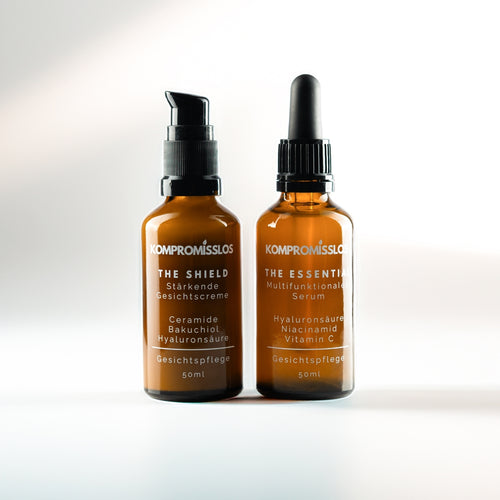
Day to day in winter, that means using a richer cream in the evening, not going too light in the morning, and not heading out for a walk in the cold with a freshly applied watery layer on your face. Which winter face cream mature, dry skin needs is covered in a separate article. Once your skin has calmed down, it is worth having a routine that supports the barrier rather than constantly pushing it. The Duo combines ceramides, squalane and panthenol and uses bakuchiol instead of retinol in the cream.
Should you remove the flakes?
No, you should not pull, rub or exfoliate the flakes away, even if they bother you. Beneath the loose bits of skin lies an outer layer that has not finished rebuilding. If you pull at them, you often tear off more than would have come away anyway and expose fresh, sensitive skin, which then burns and turns red. Exfoliating only shifts the problem: the surface looks smoother for a day, but the barrier is even weaker afterwards and the peeling carries on. It is better to soften the flakes than to remove them. A cream with lipids makes them lie flatter and look less noticeable, and they come away at their own pace.
One factor is often underestimated: water temperature. In a study of 50 healthy volunteers in the Journal of Clinical Medicine, transepidermal water loss on the hands rose from 25.75 to 58.58 g/h/m² after prolonged contact with hot water, but only to 34.96 g/h/m² after cold water. The researchers therefore recommend cold or lukewarm water. The measurements were not taken on the face, but washing briefly in lukewarm water certainly does irritated facial skin no harm. If the flaking is not tied to a trigger but persists, the cause is more likely to be very dry skin, which needs more lipids than just a break.
How do you care for a peeling face until it recovers?
The best way to care for a peeling face is a short, gentle routine: mild cleansing with lukewarm water, a cream with lipids and sun protection during the day. Everything else takes a break until your skin no longer burns and the flakes have gone. In practice, it looks like this:
- Pause active ingredients: leave out retinol, acids, exfoliants and high-dose vitamin C until your skin has calmed down.
- Cleanse with lukewarm water: in the morning, water alone is often enough; in the evening, use a mild cleanser without rubbing, then pat your skin dry rather than wiping it.
- Apply lipids: a fragrance-free cream with ceramides, squalane or panthenol, twice a day and a little more generously if needed.
- Sun protection during the day: the new outer layer should not be damaged again straight away – in winter too, when there is snow.
- Return slowly: reintroduce active ingredients one at a time, starting with infrequent use.
Most relapses happen at this last step, because everything comes back at once. If you go back to retinol later, the article on what to mix with retinol helps you avoid two irritating active ingredients ending up on your skin on the same night. Barbara F. describes what too much can feel like in her review on Judge.me, written after years of a long routine: ‘My skin was well cared for, but always a little overwhelmed’ (review translated from German).
When should you see a dermatologist about peeling skin?
Peeling skin is a matter for a dermatologist if it appears without an obvious trigger, does not improve after a few weeks’ break or comes with blisters, weeping patches, severe pain or fever. Recurring flaking on the face can be a sign of skin conditions that need a diagnosis, for example seborrhoeic dermatitis with yellowish, greasy scales on the sides of the nose and the eyebrows, eczema, perioral dermatitis around the mouth or psoriasis. A contact allergy to an ingredient can also show up as redness, itching and flaking. In these cases, skincare can play a supporting role, but it cannot diagnose or treat anything. An appointment is also worthwhile if a prescribed retinoid treatment makes your skin peel so badly that you want to stop: often the way you use it can be adjusted rather than giving it up altogether.
I deliberately left exfoliants out of our range and used bakuchiol instead of retinol in the cream. Both decisions have to do with this topic: when a face peels, I rarely see it as a sign that something is working, but usually as a sign that it was too much. In a randomised study in the British Journal of Dermatology, participants using 0.5% retinol reported scaling and stinging more often than those using 0.5% bakuchiol. That does not mean bakuchiol suits every skin – sensitive skin can react to it too. And if your face is peeling right now, what you need first is rest, not a new product. I have listed which active ingredients are in The Duo, and in what concentrations, on our page of active ingredients with disclosed concentrations.
Frequently asked questions
How long does it take for skin to stop peeling?
It depends on the trigger. After mild sunburn or an exfoliant that was too strong, it usually takes a few days for the flakes to come away and the skin to settle. With cold and central heating, the peeling lasts as long as the strain continues, but becomes much milder with the right skincare. If it has not stopped after a few weeks despite a break and gentle care, have it checked.
Can I wear make-up when my skin is peeling?
Yes, but sparingly and over a cream. Powdery foundation and powder settle into the flakes and tend to emphasise them. A light, creamy texture on well-cared-for skin is less noticeable. Remove it gently in the evening, without rubbing and without exfoliating pads. If your skin is burning or broken, leave make-up off those areas.
Should I pause active ingredients when my skin is peeling?
Yes, you should pause irritating active ingredients such as retinol, AHA, BHA and exfoliants until your skin stops peeling and burning. Then reintroduce them one at a time, using them only occasionally at first. Do not stop a prescribed treatment on your own; discuss any adjustment with your dermatologist.
Which cream helps with peeling skin?
The best cream for peeling skin is a fragrance-free, gentle one with skin-identical lipids such as ceramides and squalane, complemented by humectants such as glycerin, hyaluronic acid or panthenol. What it leaves out matters more than any particular active ingredient: no fragrance, no acids, no retinol. Apply it morning and evening, and in between as well if needed.
Can hot water make peeling skin worse?
Yes, water that is too hot can make peeling worse. Hot water increases the skin’s water loss much more than cold water and can also trigger redness. So wash your face briefly with lukewarm water, in the shower too. Especially in winter, when hot showers are tempting, this makes a visible difference.
Why does my skin burn when it is peeling?
Your skin burns because the protective outer layer is thinner and full of gaps. Irritants from skincare products, water or wind reach the nerve endings underneath more easily. Even active ingredients you normally tolerate well can then tingle. That is a sign to simplify your routine. If the burning continues after a break, have your skin looked at.
Can I use The Duo when my face is peeling?
Yes, if the peeling is mild and caused by cold or dry air – the cream contains ceramides and squalane. If your skin is burning or broken after exfoliating or retinol, wait until it has calmed down, because niacinamide and vitamin C can also tingle on irritated skin. After that, The Duo with bakuchiol instead of retinol works well as a calm everyday routine.
Sources
- Effendy I, Kwangsukstith C, Lee JY, Maibach HI. Functional changes in human stratum corneum induced by topical glycolic acid: comparison with all-trans retinoic acid. Acta Dermato-Venereologica, 1995. Source
- American Academy of Dermatology. How to treat sunburn. AAD, accessed 2026. Source
- Engebretsen KA, Johansen JD, Kezic S, Linneberg A, Thyssen JP. The effect of environmental humidity and temperature on skin barrier function and dermatitis. Journal of the European Academy of Dermatology and Venereology, 2016. Source
- Herrero-Fernandez M, Montero-Vilchez T, Diaz-Calvillo P, Romera-Vilchez M, Buendia-Eisman A, Arias-Santiago S. Impact of Water Exposure and Temperature Changes on Skin Barrier Function. Journal of Clinical Medicine, 2022. Source
- Dhaliwal S, Rybak I, Ellis SR, Notay M, Trivedi M, Burney W et al. Prospective, randomized, double-blind assessment of topical bakuchiol and retinol for facial photoageing. British Journal of Dermatology, 2019. Source