Skincare after laser treatment: how to look after your skin in the weeks that follow
ROUTINE
Skincare after laser treatment on the face follows only your clinic’s aftercare plan for the first few days: usually very gentle cleansing, the healing or protective cream you were prescribed and no other cosmetics. Only once the skin has closed, is no longer weeping or stinging and the clinic gives the go-ahead for normal skincare does a short, fragrance-free routine come back. Active ingredients such as retinol, acids or vitamin C follow later, one at a time. Sunscreen stays with you for months afterwards, because freshly lasered skin darkens easily.
Why does skin need different care after laser treatment?
Skin needs different care after laser treatment because the laser injures it in a targeted, controlled way so that it renews itself afterwards. How deep this injury goes depends heavily on the procedure. Ablative lasers such as fractional CO2 or erbium lasers remove tissue and open up the skin’s surface at many tiny points. Non-ablative lasers heat deeper layers but leave the surface largely intact. IPL, pigment lasers and vascular lasers target the colour in dark spots or tiny blood vessels and often leave nothing more than redness, slight swelling or small dark crusts on the treated areas. What all these procedures have in common is that the barrier is more permeable for a while, the skin reacts more strongly to irritants, and the inflammation that follows the procedure can stimulate pigment production.
A review from the Department of Dermatology at Jena University Hospital, published in the journal Der Hautarzt, notes that there are no official guidelines in Germany for skincare before and after laser and peel treatments, and that aftercare is based on the practitioner’s own experience. That explains why two clinics may hand you different aftercare sheets. This is not a contradiction; it simply reflects the fact that the device, the settings and the skin type are different every time.
What applies in the first few days after laser treatment, and who decides on your skincare?
In the first few days after laser treatment, your clinic’s written aftercare plan alone decides on your skincare – not a guide and not your bathroom cabinet. Typically, this means very gentle cleansing with lukewarm water, a prescribed healing or protective cream that keeps the irritated skin moist, and nothing else. How long this phase lasts depends on the procedure: after an ablative laser it is considerably longer than after a pigment or vascular laser. The Jena review describes the aim of aftercare as calming the inflammation and keeping the skin’s moisture in balance; this includes light moisturising care, broad-spectrum UV protection and avoiding exercise and sweating. If your clinic tells you something different, follow the clinic, because it knows how deeply and how densely the laser was applied. If you were not given an aftercare sheet or something is unclear, phone the clinic rather than improvise. An extra cream from the chemist, a home remedy or a serum ‘to help things along’ has no place in this phase.
| Phase | What applies | What is paused |
|---|---|---|
| First few days: skin open, weeping, crusted or very red | Only the clinic’s plan: gentle cleansing, prescribed healing or protective cream, staying out of the sun | Make-up, serums, active ingredients, your own creams, exercise, sauna |
| Until healed: skin closed, flaking or feeling tight | Keep following the clinic; once approved, a gentle, fragrance-free cream; sunscreen as instructed | Retinol, acids, exfoliants, vitamin C, rubbing at flakes |
| Weeks and months afterwards: skin calm, possibly still pink | A short routine of cleansing and skincare, sunscreen every day | Several new products at once; active ingredients only one at a time and once approved |
Peeling or shedding fine dark flakes after an ablative or fractional laser is part of the renewal process, and you let them fall off on their own. What else can be behind flaking skin is covered in the article on peeling skin on your face.
Which cream suits the weeks afterwards, and what should you leave out?
In the weeks after laser treatment, the right choice is a simple, fragrance-free cream with lipids and humectants that supports the barrier – not a product that adds further irritation. Useful building blocks are ceramides, squalane, glycerin, hyaluronic acid or panthenol, which is found in many aftercare products; what is known about panthenol for skin and when it really helps is covered separately. During this time, leave out fragrances and essential oils, toners containing alcohol, scrubs with grains, cleansing brushes and anything that stings when you apply it. The number of products matters too: the fewer layers you use, the easier it is to tell what your skin is reacting to.
You can tell whether your skin is still sensitive after laser treatment by tightness, stinging when you apply products and new redness. These are the same signals that help you recognise a damaged skin barrier; how the barrier rebuilds itself in general is described in detail there. Here, the point is simply not to put any extra strain on freshly lasered skin. Do not swap the prescribed healing cream for cosmetics on your own initiative; only switch once the clinic gives you the green light.
Why is sunscreen so important after laser treatment?
Sunscreen is so important after laser treatment because freshly lasered skin can react to UV light by producing extra pigment, which means dark patches where there were none before. Specialists call this post-inflammatory hyperpigmentation: the inflammation after the procedure makes the pigment cells more active, and sunlight intensifies the effect. In a split-face study in the Journal of the European Academy of Dermatology and Venereology, 30 people were treated with a fractional CO2 laser. Both sides of the face received a petrolatum ointment; the side that was also given a broad-spectrum sunscreen with anti-inflammatory additives from the first day showed a significantly lower melanin index after one week than the comparison side. An expert panel in the same journal describes broad-spectrum protection with high UVB and UVA protection as essential for all procedures.
A literature review published in the journal Life in 2025 concludes that sun protection should continue every day for at least three to six months after the procedure, supported by clothing and shade during the midday hours. For the sensitive early period, it describes mineral filters such as zinc oxide and titanium dioxide as generally well tolerated. When you can start applying sunscreen to the fresh skin is for the clinic to decide; until then, protection mainly means shade, a hat and staying indoors. Which sunscreen is enough for everyday life, and how much of it you need, is covered in the guide to sunscreen for your face if your skincare has no SPF. If some areas have already darkened, you will find the background in the article on dark spots on the face.
When can retinol, acids, vitamin C and niacinamide go back into your routine?
Retinol, acids, vitamin C and niacinamide can only go back into your routine once the skin has fully healed, is no longer sensitive and your clinic has approved normal skincare – and even then, one at a time. There is no fixed number of days that applies to every laser: after a light pigment laser, the skin is ready much sooner than after ablative resurfacing. You wait longest with anything that deliberately irritates or peels the skin, such as retinol, retinal, AHAs, BHAs and exfoliants. How retinol behaves on skin that is still sensitive is described in the article on retinol side effects such as redness, flaking and stinging. Incidentally, some clinics use retinoids deliberately before laser treatment; the Jena review lists them alongside UV protection and brightening ingredients as part of the preparation. That does not mean, however, that you should restart them early afterwards. Milder active ingredients such as niacinamide or stable forms of vitamin C usually return sooner, but also only once approved and initially once a day.
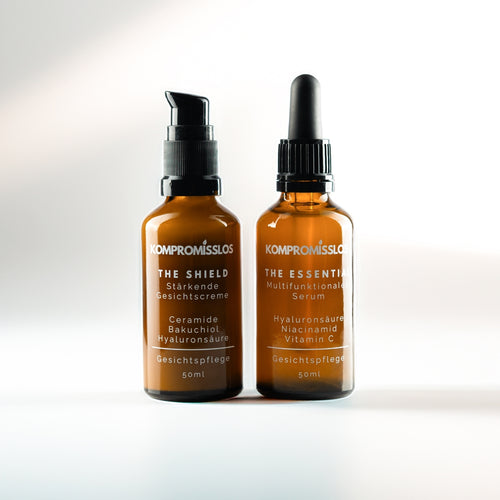
This is also where the honest limit lies for our products. The Duo of serum and cream contains 5% niacinamide, 2% vitamin C as 3-O-Ethyl Ascorbic Acid and bakuchiol – active ingredients that have no place on freshly lasered skin. Once the clinic approves normal skincare, the Duo is a short, fragrance-free routine: The Shield, with ceramide NP, squalane and jojoba oil, supports the skin barrier, and the Duo also contains panthenol and aloe vera juice, which comes first in the ingredient list. Start with one application a day, try it on a small area first and watch for a few days before using it on your whole face.
Which reactions after laser treatment are normal, and when should you contact the clinic?
Normal reactions after laser treatment include redness, a warm or sunburn-like feeling, slight swelling and, depending on the procedure, flaking or fine dark crusts that lessen from day to day. How long the redness lasts depends heavily on the procedure: after non-ablative lasers and IPL it is often brief, after ablative procedures considerably longer. Your clinic will give you the range for your treatment, and that is the benchmark to go by. What matters is the direction: reactions that are fading are part of healing. Reactions that are getting worse are a reason to pick up the phone. Contact the clinic or your dermatologist without hesitation if any of the following occurs:
- Pain, swelling or warmth increases rather than decreases after the first few days.
- Yellowish crusts, pus, areas that start weeping again, or fever.
- Blisters, or areas that turn whitish or noticeably dark.
- Small blisters or burning around the mouth, especially if you are prone to cold sores; according to the Jena review, this is why clinics give tablets to prevent herpes before some procedures.
- Redness that lasts considerably longer than the range your clinic gave you, or new dark patches.
For the first two weeks, take a photo every morning in the same light. That way you can see whether the redness and swelling really are going down, and if you have a question for the clinic, you can show them how your skin has developed.
Whether The Duo is suitable after laser treatment is an obvious question. My honest answer: in the first few days, it has no place on your skin. Aftercare is the clinic’s job. After that, your skin does not need a special product line – it needs a few gentle products and sunscreen. That is exactly why we make two products instead of eight, both without fragrance. What we do not have is an SPF in the cream. That was a deliberate decision, but it also means that, especially after laser treatment, you need a separate sunscreen, and it is not something I sell. Once the clinic approves normal skincare, one application a day is enough to start with. How the serum and cream build on each other is explained in the guide to using The Duo.
Frequently asked questions
When can I wear make-up again after laser treatment?
Make-up only comes back once the skin has closed, is no longer weeping and your clinic gives the go-ahead. After pigment or vascular lasers, that is often soon; after ablative procedures, it takes considerably longer. To start with, use a product you already tolerate well and clean brushes or sponges, and remove your make-up thoroughly but gently in the evening.
How long does skin stay red after laser treatment?
That depends on the procedure: usually not long after non-ablative lasers and IPL, considerably longer after ablative procedures. According to the American Society of Plastic Surgeons, the new skin still looks pink for two to three months after laser resurfacing, and it can take up to a year for the pinkness to disappear completely. The benchmark is the range your clinic gives you for your procedure.
Can I go to the sauna or exercise after laser treatment?
Not in the first few days. Heat and sweat intensify redness and swelling, and the Jena review explicitly lists avoiding exercise and sweating as part of aftercare. When you can return depends on the procedure and is set out on your clinic’s aftercare sheet. After that, the sauna rules are the same as at any other time: keep sessions shorter and make sure your skin is well cared for.
Does aloe vera help after laser treatment?
Aloe vera does not replace the care your clinic prescribes after laser treatment. Many aloe gels also contain alcohol or fragrances that can irritate freshly lasered skin. Once healing is complete and the clinic approves normal skincare, there is nothing wrong with aloe as an ingredient in a fragrance-free cream, provided your skin tolerates it. You do not need a separate product for it.
Should I care for my skin differently before laser treatment?
Only in the way your clinic instructs. Some clinics prepare the skin deliberately, for example with consistent UV protection, retinoids or brightening ingredients; others ask you to pause exactly these products beforehand. What applies to you depends on the procedure. Either way, it makes sense not to build up a tan before your appointment and not to try out any new products.
How should I wash my face after laser treatment?
In the first few days, follow your clinic’s instructions – usually just lukewarm water or a very gentle cleanser, applied with your fingers rather than a flannel or brush. Afterwards, pat your skin dry with a clean towel instead of rubbing, and let flakes and crusts fall off on their own. Avoid hot water and exfoliants until your skin has settled.
Can I use The Duo after laser treatment?
Yes, but only once your skin has healed and your clinic approves normal skincare – not in the first few days. The Duo is fragrance-free but contains active ingredients such as 5% niacinamide, 2% vitamin C and bakuchiol. So start with one application a day and always use a separate sunscreen during the day, because the Duo of serum and cream contains no SPF. It does not replace your clinic’s aftercare.
Sources
- Pahnke F, Peckruhn M, Elsner P. Pre- and post-interventional skin care for laser and peel treatments. Der Hautarzt, 2021. Source
- Wanitphakdeedecha R, Phuardchantuk R, Manuskiatti W. The use of sunscreen starting on the first day after ablative fractional skin resurfacing. Journal of the European Academy of Dermatology and Venereology, 2014. Source
- Amici JM, Cogrel O, Jourdan M, Raimbault C, Canchy L, Kerob D, et al. Expert recommendations on supportive skin care for non-surgical and surgical procedures. Journal of the European Academy of Dermatology and Venereology, 2023. Source
- Lee KWA, Chan LKW, Song JK, Lee CH, Kim JH, Yi KH. Importance of Using Sunscreen After Light or Laser Facial Treatment: A Literature Review. Life (Basel), 2025. Source
- American Society of Plastic Surgeons. What should I expect during my laser skin resurfacing recovery? Patient information, accessed 2026. Source