Sunburn on your face: what to do straight away and how to care for your skin afterwards
SKIN CONCERNS
If you have sunburn on your face, get out of the sun straight away, cool your skin with cool – not ice-cold – water or a damp cloth, and drink more than usual. After that, your face mainly needs rest: a simple, fragrance-free moisturiser, no exfoliants, no acids, no retinol. Blisters, marked swelling, a fever or chills need a doctor, as does sunburn in young children. Mild sunburn usually settles within a week.
What should you do straight away if you have sunburn on your face?
If you have sunburn on your face, the first thing to do is get out of the sun and cool your skin before you put anything on it. The redness shows that UV radiation has already damaged the outer layer of your skin, and the full extent often only becomes visible a few hours later. Every extra minute in the sun makes the damage worse; anything you do afterwards only eases the symptoms. The American Academy of Dermatology recommends frequent cool showers or baths to relieve the pain, a moisturiser containing aloe vera or soy, and drinking extra fluids, because sunburn draws fluid to the skin’s surface and away from the rest of the body. For your face, that means in practice:
- Get out of the sun – including the bright partial shade by the lake, on the terrace or in the snow.
- Cool: rinse your face with cool water or lay a clean, damp cloth on it for a few minutes, and repeat this several times a day.
- Drink: water or unsweetened tea, and skip alcohol that evening.
- Leave out: make-up, exfoliants, acid toners, retinol and anything with fragrance. Cleanse with water only.
- Moisturise: only once your skin no longer feels hot, apply a thin layer of a simple, fragrance-free moisturiser.
If the pain is severe, ask a pharmacist or your doctor rather than experimenting with ointments from your medicine cabinet. If your face swells up, go straight to a doctor.
Mild or severe sunburn: when does your face need a doctor?
Mild sunburn with redness, warmth and tightness usually settles on its own, but your face needs a doctor as soon as blisters form, it swells noticeably or your whole body reacts. The UK’s National Health Service (NHS) lists these warning signs that call for urgent help: blistering or swelling of the skin, a very high temperature or feeling hot, cold or shivery, severe tiredness, dizziness or nausea, headaches and muscle cramps, and any sunburn in babies and young children. Some of these signs point to heat illness, which is more than a skin problem. On the face, there is the added issue that eyelids and lips often swell considerably. If you can barely open your eyes, or they sting and water, get it checked rather than waiting to see what happens.
Blisters are a sign of deeper sunburn. The American Academy of Dermatology expressly advises against popping them, because they protect the skin from infection while it heals. In Switzerland, the right places to go are your GP practice, a walk-in clinic (Permanence) or, outside surgery hours, your canton’s out-of-hours medical service. Extensive sunburn across the face, neck and shoulders is also better seen by a professional than treated at home.
What cools a sunburnt face, and what should you avoid putting on it?
Plain cool water is the most reliable way to cool a sunburnt face; after that, only apply what will not irritate the skin further or seal it under a heavy film. A review in the American Journal of Clinical Dermatology evaluated 40 studies on sunburn. Of the 14 studies that actually looked at treatment after sunburn, the majority concluded that neither corticosteroids, anti-inflammatory painkillers, antioxidants, antihistamines nor moisturising creams shortened recovery time. The authors therefore recommend relieving the symptoms: redness, pain and itching. What this means for you is that a moisturiser after sunburn may feel pleasant, but it does not undo the damage any faster. The NHS also advises against putting ice or ice packs directly on the skin and against applying petroleum jelly.
| Remedy | Verdict | Why |
|---|---|---|
| Cool water, damp cloth | Yes, several times a day | Cools without leaving anything on the skin |
| Aloe vera gel without fragrance or Alcohol Denat. | Can feel pleasant | Light, cooling film – check the ingredient list |
| Simple, fragrance-free moisturiser | Yes, once the skin no longer feels hot | Eases tightness and dryness |
| Ice or an ice pack directly on the skin | No | The NHS advises against it; a cool, damp cloth is enough |
| Quark, yoghurt, cooking oils | Not recommended | Cool for a moment, but are not hygienic skincare products and are unsuitable for blisters |
| Lemon, essential oils, fragrance, Alcohol Denat. | No | Irritate skin that is already irritated |
| Exfoliants, acids, retinol | No | Strip away more of the skin that is already damaged |
Aloe vera is the best-known home remedy and has at least been studied to some extent, but it is no substitute for proper skincare. You can read more about what aloe vera gel can and cannot do in a separate article.
When can you go back to your normal skincare, and which active ingredients should you pause?
You can go back to your normal skincare once your face no longer stings, no longer feels hot and has no blisters or open areas – with mild sunburn, usually after a few days. Until then, water and a simple, fragrance-free moisturiser are enough. Pause anything that strips or challenges the skin: physical scrubs, acids such as AHAs and BHAs, retinol and retinoids. Even active ingredients you normally tolerate well, such as niacinamide, vitamin C or bakuchiol, should only come back once your skin has calmed down, and then at first only once a day. Humectants and lipids feel more comfortable during this phase, for example panthenol for irritated skin, glycerin or ceramides. If your face still feels tight after two or three weeks, stings with every cream or stays red and blotchy, the article on how to recognise a damaged skin barrier will help.
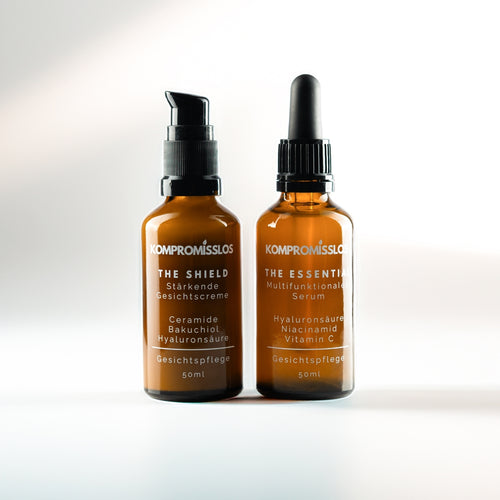
If you use The Duo, the same order applies. Both products are fragrance-free, aloe vera juice comes first in the ingredient list, The Shield contains Ceramide NP and squalane, and The Duo contains panthenol. That makes them a gentle choice for the period afterwards. But because the serum also contains niacinamide and vitamin C as 3-O-Ethyl Ascorbic Acid, and the cream contains bakuchiol, only start once nothing stings any more – at first once a day if needed.
Skiing sunburn: why does your face burn so quickly in the mountains?
Your face burns so quickly when you ski because more UV radiation reaches you at altitude and fresh snow reflects a large part of it back. According to the World Health Organization’s guide to the UV Index, UV radiation increases by 10 to 12 per cent with every 1,000 metres of altitude, and fresh snow can reflect up to 80 per cent of UV radiation. Together, altitude and snow can double your exposure, according to the WHO. Because the radiation also comes from below, areas that are normally in shade get burnt: the underside of your nose and chin, your ears and the skin between your nose and upper lip. On top of that, cold air and wind mask the burning sensation. That is why many people only notice the sunburn in the evening, in the mountain hut or back at home.
Aftercare is no different from summer sunburn: cool your skin, drink enough, avoid exfoliants and use a simple, fragrance-free moisturiser. Wind and cold have also dried your skin out, so your skincare can be a little richer in the days that follow. What helps against the cold itself is explained in the article on cold weather face cream for skiing. On the slopes, prevention means applying sunscreen before you set off, topping it up on the chairlift and not forgetting your lips.
Your eyes can get sunburnt too. The WHO compares the inflammation of the cornea and conjunctiva caused by UV radiation to sunburn of the eyeball and eyelids; it usually appears within a few hours and can be very painful. Snow blindness is a severe form of it. Burning, watering eyes and sensitivity to light after a day on the slopes therefore need a doctor.
How do you protect your face while the sunburn heals?
While the sunburn heals, the main way to protect your face is to avoid the sun: shade, a wide-brimmed hat and staying indoors around midday. The NHS recommends keeping sunburnt skin out of direct sunlight until it has fully healed. Sunscreen comes in as soon as your skin tolerates it without stinging – so not on fresh blisters and not on hot, very red skin. Above all, don’t be lulled into a false sense of security on cloudy days: according to the WHO, up to 80 per cent of UV radiation passes through light cloud. A freshly burnt patch on your face cannot cope with a second dose in the weeks that follow, and every further sunburn adds up for your skin in the long run.
Which sun protection factor makes sense day to day, and how much to apply, is a topic of its own. You will find guidance in the article on which sunscreen your face needs every day. For the period after sunburn, one principle is enough: preferably fragrance-free, applied generously and as the last step after your skincare. If your cream has no SPF, you need a separate sunscreen anyway.
I deliberately made The Shield without SPF, and we don’t sell sunscreen. That is why The Duo always needs a separate sunscreen during the day, including the days when sunburn is fading. To be honest, The Duo can’t do anything about sunburn. Cooling and shade come first, and a doctor if there are blisters or a fever. Serum and cream only come back once nothing stings any more, and then it is perfectly fine to start with once a day. I made both products fragrance-free so that irritated skin doesn’t also have to cope with a fragrance that does nothing for it. How serum and cream follow on from each other is explained on the page on how to use The Duo.
Frequently asked questions
How long does sunburn on the face last?
According to the NHS, sunburn that you can treat yourself usually gets better within seven days. The redness tends to fade after a few days, but your skin may then peel and stay sensitive for a while. If it takes noticeably longer, blisters appear or you feel generally unwell, have it checked by a doctor.
What should you do if your face is swollen after sunburn?
A swollen face after sunburn is a warning sign and needs a doctor, especially if your eyelids swell so much that you can barely open your eyes. The NHS lists swelling among the reasons to get urgent help. Until then, cool your face with damp cloths, drink enough and don’t put anything irritating on it.
Does aloe vera help with sunburn on the face?
Aloe vera can make sunburn more comfortable, but it cannot undo it. In a study in Skin Pharmacology and Physiology, a gel containing 97.5% aloe vera reduced UV redness after 48 hours, but a hydrocortisone cream was more effective. It was tested on covered areas of the back, not on the face. Look for gels without fragrance or Alcohol Denat.
Can I wear make-up with sunburn on my face?
As long as your face stings, feels hot or has blisters, it is better to skip make-up. It has to come off again in the evening, and that rubbing and cleansing puts extra strain on the skin. If you really can’t do without it, wait until the redness has faded, apply a thin layer of a fragrance-free product and cleanse especially gently in the evening.
What should you do if the skin on your face peels after sunburn?
If your skin peels after sunburn, don’t pull off the flakes or rub them away; just keep using a fragrance-free moisturiser. An exfoliant is out of place at this stage. You can read what else helps with peeling skin on your face in a separate article.
Can sunburn leave dark spots on your face?
Sunburn can leave dark spots behind or make existing ones darker, because UV radiation stimulates melanin production. This does not always show straight away. Consistent sun protection in the period afterwards is the most important step. What skincare can realistically soften when it comes to dark spots on the face is explained in a separate article.
Can I use The Duo after sunburn on my face?
Yes, but only once your face no longer stings, no longer feels hot and has no blisters. During the acute phase, you don’t need a serum or a cream with active ingredients. After that, you can start using The Duo once a day and build up to twice a day. It contains no sun protection, so you also need a sunscreen during the day.
Sources
- American Academy of Dermatology. How to treat sunburn. AAD, patient information. Source
- NHS. Sunburn. National Health Service, patient information. Source
- Han A, Maibach HI. Management of acute sunburn. American Journal of Clinical Dermatology, 2004. Source
- Reuter J, Jocher A, Stump J, Grossjohann B, Franke G, Schempp CM. Investigation of the anti-inflammatory potential of Aloe vera gel (97.5%) in the ultraviolet erythema test. Skin Pharmacology and Physiology, 2008. Source
- World Health Organization, World Meteorological Organization, United Nations Environment Programme, International Commission on Non-Ionizing Radiation Protection. Global Solar UV Index: A Practical Guide. WHO, 2002. Source