Nasolabial folds: why they deepen and what a cream can really do
SKIN OVER 40
No cream for nasolabial folds can fill in the line between your nose and mouth, because it forms mainly through a loss of volume and support in the midface, not in the surface of the skin. What a cream can do concerns the skin around the fold: it looks plumper and suppler, fine dehydration lines within it soften, and the line looks gentler as a result. What you can influence yourself: daily sunscreen slows skin ageing, including around the fold. If the fold still deepens, that is a question for aesthetic medicine, not for yet another skincare product.
What are nasolabial folds, and why are they not ordinary wrinkles?
Nasolabial folds are the two lines that run diagonally down from the sides of the nose to the corners of the mouth, and they are more a border between two zones of the face than a wrinkle in the skin itself. A review in the journal Diagnostics describes them in exactly these terms: as paired furrows in the skin running from the sides of the nose to the corners of the mouth, where cheek and upper lip meet. On the cheek side there is a separate fat pad, and beneath it run the muscles that lift the upper lip when you smile. An anatomical study in the journal Plastic and Reconstructive Surgery showed that the fat beneath the skin of the face is divided into separate compartments and that the nasolabial region forms a unit of its own with clear boundaries. So the line is there from the start, which is why it already shows in young faces when they laugh.
A forehead line or crow’s feet, by contrast, form mainly in the skin itself, through repeated facial expressions and declining elasticity. With the nasolabial fold, it is what lies beneath the skin that determines how deep it looks. For your skincare, this means that fine lines within the furrow respond to moisture, while the furrow itself hardly does. How to tell dehydration lines and wrinkles apart is covered in a separate article.
Why do nasolabial folds get deeper with age?
Nasolabial folds get deeper because the midface loses volume and support over the years, and the tissue above the fold pushes downwards and forwards. The review in Diagnostics notes that the folds can become longer and deeper in the course of natural ageing and distinguishes three causes: too little volume next to the nostrils, weakening support in the tissue that lets the cheek fat descend, and fibres of the muscles that lift the upper lip pulling directly into the skin. In most people, these factors work together, in varying proportions.
Then there is the bone. A review in Aesthetic Plastic Surgery describes how the upper jaw recedes around the nasal opening with age, and attributes a pronounced nasolabial fold to a considerable extent to this loss of bony projection. For a long time, it was put down to sagging skin alone. The skin itself does lose collagen and elasticity as well, but that affects the whole face and is explained in detail in the article on sagging skin on the face. At the nasolabial fold, what matters most is what happens underneath.
Can a cream fill in nasolabial folds?
No, a cream cannot fill in a nasolabial fold, because it does not reach the missing volume in the fat pads and bone. Skincare works in the stratum corneum and, at best, in the upper layers of the skin. There it can bind moisture, support the skin barrier and make the surface look smoother. The furrow, however, forms much deeper down, where the cheek fat descends and the upper jaw recedes. No active ingredient in a jar rebuilds this volume, even if product names featuring ‘filler’ or ‘volume’ suggest otherwise.
What you sometimes see right after applying a cream is an instant effect: film-forming ingredients tighten the surface, and moisture briefly plumps up the top layer. That effect is real, but it is gone once you wash your face. You can read more about what so-called botox creams can really do and where they stop in a separate article. Which active ingredients are best researched for wrinkles in general, retinoids for example, is covered in the article on whether anti-wrinkle creams actually work. At the nasolabial fold, the realistic expectation is more modest: softer skin around the line, not a flatter line.
| At the nasolabial fold | Can skincare do this? | Why |
|---|---|---|
| Make the skin around the fold look plumper and suppler | Yes | Humectants and an intact barrier work in the upper layers of the skin |
| Soften fine dehydration lines in the furrow | Yes | These lines sit in the surface and respond to moisture |
| Slow further sun damage | Only with sunscreen | UV protection requires an SPF, and a moisturiser without SPF cannot provide it |
| Replace lost volume in the midface | No | Fat pads and bone lie beyond the reach of a cream |
| Permanently reduce the depth of the fold | No | The furrow is caused by structures beneath the skin |
What can skincare visibly improve around the nasolabial fold?
Skincare can make the skin around the nasolabial fold look visibly plumper and smoother, which softens the shadow of the line a little. Dry, rough skin scatters light unevenly, and fine lines running beside and within the furrow reinforce the impression of a deep groove. Well-hydrated skin reflects light more evenly. The furrow remains, but it looks less harsh. Honestly, that is as much as cosmetics can achieve here, and for many people it is already enough, because the fold often stands out most in the mirror when the skin is tired and dry.
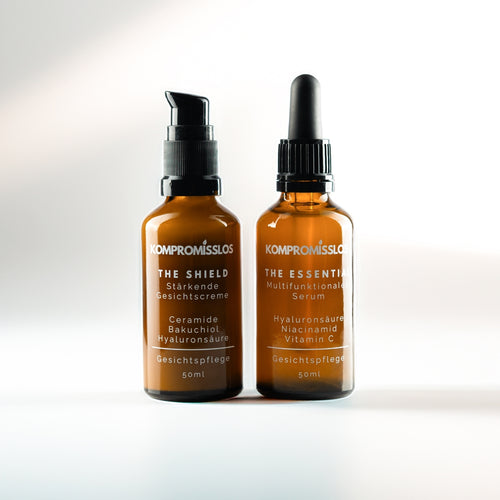
This is exactly where The Duo of Essential serum and Shield cream comes in: The Essential, with 5% niacinamide and hyaluronic acid in three molecular sizes, provides moisture, while The Shield, with ceramide NP, bakuchiol and squalane, goes on top and supports the skin barrier. You apply both from the centre of your face outwards, so directly over the area between nose and cheek. During the day, a separate sunscreen goes on top. In her review on Judge.me, Nicole B. writes: ‘The little lines don’t go away, which isn’t the idea anyway […], but the overall expression becomes softer’ (review translated from German). That sums up the realistic expectation rather well.
Look at the fold in daylight and with a relaxed face, not straight after laughing and not under a lamp directly overhead. Light from above deepens every shadow in the midface and makes the furrow look considerably deeper than it really is.
What role do sun, weight loss and sleeping position play?
Sun measurably speeds up skin ageing, significant weight loss after 40 can make the face look older, and your sleeping position presses additional lines into your cheek at night. On sun exposure, there is a randomised trial in the Annals of Internal Medicine involving adults under 55: the group using sunscreen every day showed no detectable increase in skin ageing after 4.5 years, and their skin ageing was 24 per cent lower than in the group that only applied sunscreen when they felt like it. Which product is suitable is explained in the article on sunscreen for your face.
Weight is where it gets paradoxical. A twin study in Plastic and Reconstructive Surgery found that a body mass index four points higher was associated with an older appearance in twins under 40, but with a younger one after 40. That is no reason to put on weight, but it does fit with the fact that the nasolabial fold often looks deeper after significant weight loss: along with the fat, the midface loses volume too. The same study linked longer smoking and more sun exposure with an older appearance. And if you sleep on your side, you press your cheek towards your nose for hours on end. What that does is explained in the article on sleep wrinkles on the face.
When is a nasolabial fold no longer a skincare issue?
A nasolabial fold is no longer a skincare issue when it is the depth of the furrow itself that bothers you, rather than the quality of the skin around it. Then it is about volume, and only aesthetic medicine can provide that, typically with fillers. Whether a treatment suits your face, and which one, should be discussed in a consultation with a dermatologist or an experienced aesthetic practitioner. The review in Diagnostics points out that filler injections at the nasolabial fold carry a risk of vascular complications because the facial artery runs through this area, and that belongs in the conversation too.
Two neighbouring issues are often confused with the nasolabial fold: marionette lines run down from the corners of the mouth towards the chin, while hollow cheeks concern volume further out. And one special case is important: if the nasolabial fold suddenly flattens on one side, for instance together with a drooping corner of the mouth, that is not a skin issue but a reason to get medical help immediately.
I could easily have marketed The Shield with a ‘filler effect’, as you can read on plenty of jars. I don’t, because it isn’t true: a cream does not fill in a nasolabial fold, and ours is no exception. Instead, I disclose what is in it, such as 5% niacinamide and 2% vitamin C as 3-O-Ethyl Ascorbic Acid in The Duo, so that you can judge for yourself what to expect from it. For the cream, I chose bakuchiol instead of retinol, and even that does not change the fact that a furrow caused by volume loss cannot be filled from the outside. And because The Duo contains no sun protection factor, I say it openly: the most important protection against sun-induced skin ageing is a separate sunscreen, not my cream. The role each active ingredient plays is set out in our overview of active ingredients with disclosed concentrations.
Frequently asked questions
Does every woman have nasolabial folds?
Yes, the line between nose and mouth is part of normal facial anatomy and is present in women and men alike. It marks the transition from cheek to upper lip and shows when you smile, even at a young age. The only difference is how early and how deeply it stays visible when your face is relaxed.
At what age do nasolabial folds get deeper?
There is no fixed age, because bone structure, fat distribution, sun exposure and weight all play a major part. A review in Aesthetic Plastic Surgery notes that women and men differ in the speed and extent of the changes to the bone. It usually becomes noticeable when the midface loses volume, often earlier after significant weight loss.
Does hyaluronic acid in a cream help with nasolabial folds?
Hyaluronic acid in a cream binds moisture in the upper layers of the skin and makes fine lines in and beside the fold look softer. It does not fill the furrow itself. What is injected under the skin as a hyaluronic acid filler during a treatment is a different product with a different job.
Does facial massage or face yoga help with nasolabial folds?
The research on face yoga and massage is thin and does not allow any reliable conclusion about the nasolabial fold. There is nothing wrong with it as a pleasant ritual while you apply your skincare, but you should not expect a visible effect on the depth of the fold.
Does laughing make nasolabial folds deeper?
Laughing makes them briefly more pronounced, because the muscles of the upper lip pull directly into the skin at the fold. But laughing alone is not the main reason for a deep nasolabial fold. Loss of volume and support in the midface carries more weight. Laughing less is therefore not a sensible way to prevent them.
Can you prevent nasolabial folds?
You cannot prevent them entirely, but you can slow them down. The things that help most are daily sunscreen, not smoking and keeping your weight as stable as possible without large fluctuations. If you sleep on your side, you can try sleeping on your back. Skincare keeps the skin around them supple, but it is the smaller lever.
What can The Duo do for nasolabial folds, and what can’t it do?
The Duo can make the skin around the nasolabial fold look plumper and suppler and soften fine dehydration lines within it. It cannot fill in the furrow or replace lost volume. Because it contains no sun protection factor, sunscreen goes on top during the day. You do not need a special product just for the fold as well: the Duo of serum and cream covers the skincare for this area.
Sources
- Hong GW, Song S, Park SY, Lee SB, Wan J, Hu KS, et al. Why Do Nasolabial Folds Appear? Exploring the Anatomical Perspectives and the Role of Thread-Based Interventions. Diagnostics, 2024. Source
- Rohrich RJ, Pessa JE. The fat compartments of the face: anatomy and clinical implications for cosmetic surgery. Plastic and Reconstructive Surgery, 2007. Source
- Mendelson B, Wong CH. Changes in the Facial Skeleton With Aging: Implications and Clinical Applications in Facial Rejuvenation. Aesthetic Plastic Surgery, 2012. Source
- Hughes MC, Williams GM, Baker P, Green AC. Sunscreen and prevention of skin aging: a randomized trial. Annals of Internal Medicine, 2013. Source
- Guyuron B, Rowe DJ, Weinfeld AB, Eshraghi Y, Fathi A, Iamphongsai S. Factors contributing to the facial aging of identical twins. Plastic and Reconstructive Surgery, 2009. Source