Skincare ingredient apps: how reliable are Yuka, Codecheck and co?
SWISS BUYING GUIDE
Skincare ingredient apps such as Yuka and Codecheck are reliable at translating an ingredient list for you quickly, but as a verdict on a whole product they are of limited use. Each app sorts every ingredient into colour-coded levels according to its own criteria, mixing health, allergy potential and environmental impact. What they do not know is how much of an ingredient the product contains and how your skin reacts to it. Use them as a reference and as a filter for ingredients you have been shown not to tolerate, not as a grade for your skincare.
How reliable are Yuka, Codecheck and other skincare ingredient apps?
Skincare ingredient apps are reliable when it comes to making an ingredient list readable, and considerably less reliable when they turn it into an overall score. There are two reasons for this. The first is the data. Product information comes from large databases, directly from manufacturers and, to a large extent, from users who photograph the packaging. Yuka itself states that it cannot guarantee the absolute reliability of its data and therefore checks entries using image and text recognition, algorithms and its own team. When a manufacturer changes a formula, the database sometimes lags behind. The second reason is the rating itself. Each app decides which sources it draws on, how strictly it classifies an ingredient and how it turns many individual values into a colour or a number. These decisions are clearly documented, but they are decisions, not measurements. A score in an app is therefore one method’s opinion of an ingredient list. That is useful, as long as you know what the colour stands for.
How do skincare apps rate the ingredients in a cream?
Skincare apps first rate each individual ingredient and then calculate an overall result from these ratings, without taking into account how much of each ingredient the product contains. According to its own methodology, Yuka sorts ingredients into four risk levels, from red to green. The criteria are possible endocrine disruption, allergy potential, irritation potential, carcinogenic properties and environmental impact. The score is set by the most critical ingredient: if a cream contains a red ingredient, it automatically scores below 25 out of 100; if the most critical ingredient is orange, below 50. Codecheck shows a rating circle based on a database of more than 14,000 cosmetic ingredients. According to the app, its sources include assessments by the German Allergy and Asthma Association, the Hamburg consumer advice centre, Greenpeace and WWF. Where there are no external assessments, the classification relies on scientific publications, guided by the principle of precautionary consumer and environmental protection. If an ingredient has both a health rating and an environmental rating, the stricter one counts in the circle.
| Criterion | Yuka | Codecheck |
|---|---|---|
| Display | Score from 0 to 100 with a colour code | Rating circle with coloured segments |
| Levels per ingredient | Red, orange, yellow, green | Red, orange, light green, green, grey for an individual rating |
| What determines the overall result | The most critical ingredient sets the upper limit | The share of each rating, with the stricter one counting where an ingredient has two |
| Takes the amount in the product into account | No | No |
| Size of the ingredient database | Around 12,500 ingredients | More than 14,000 ingredients |
This is precisely where apps differ from an official safety assessment. Under the guidelines of the EU’s Scientific Committee on Consumer Safety (SCCS), exposure is calculated from the amount of an ingredient in the product category concerned and how often the product is used. An app rates the hazard an ingredient can pose in principle; an authority rates the risk under real-life use. How these two approaches fit together, and which warning lists actually hold up, is a topic in its own right.
Why do two apps rate the same product so differently?
Two apps rate the same product differently because they use different sources, different thresholds and different calculation methods, not because one of them gets its sums wrong. With Yuka, a single ingredient can drag down the whole score, whereas with Codecheck a single critical ingredient only shows up as one segment of the circle. Then there is how much weight is given to environmental concerns. With silicones in skincare, for example, some of the criticism is mainly about the environment, not the skin. An app that mixes the two will then show a deduction that has little to do with your skin. Assessments of preservatives also often diverge. Whether you follow an app’s precautionary approach or the official assessment is best decided by knowing how concerning phenoxyethanol really is, rather than going by the colour alone. Finally, personal settings change the result. In Codecheck, for instance, you can decide whether palm oil should affect the rating.
You may recognise the pattern from retailers’ own exclusion lists. There, too, each list decides for itself which ingredients are left out. Once you know what the term clean beauty promises, you will also understand why two green results do not necessarily mean the same thing.
What can an app not know about a product?
All an app knows about a product is what is on the packaging, and that is mainly the list of ingredient names. The most important gap is the amount. The order of the list gives only rough clues, and if you can read an ingredient list yourself, you will quickly see where those clues run out. No app can tell whether an active ingredient is present in an amount at which it does useful work, or only in traces. Nor does it know anything about the quality of the raw materials, the stability of the formula, the packaging or whether the product has been tested for tolerability on people. Even when a manufacturer puts that on the pack, it is worth knowing what “dermatologically tested” actually means. And least of all does the app know anything about your skin.
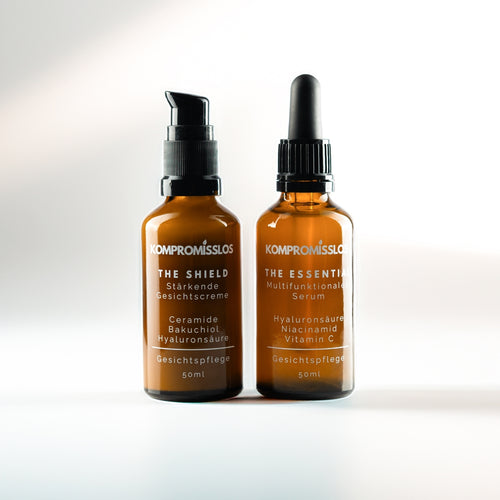
Only the manufacturer can close this gap, by disclosing concentrations. With The Duo of Essential serum and Shield cream, they are there for everyone to see: 5% niacinamide, 2% vitamin C as 3-O-Ethyl Ascorbic Acid and 1% zinc PCA, relating to The Duo as a whole. These are exactly the details no app can give you. Both products are formulated without fragrance and without phenoxyethanol, parabens or silicones. In a review on Judge.me, J.D. praises the “great transparency regarding ingredients” (review translated from German).
Yuka or Codecheck: which app suits which question in Switzerland?
Which app suits you better depends on whether you want a quick overall assessment or a personal filter. Codecheck was developed in Switzerland: the app launched here in 2010 and is now owned by Producto Check GmbH. Its strength lies in personal settings that let you be warned about allergenic fragrances, microplastics or endocrine-active substances, for example. The free version gives you five scans per calendar week, and the app is funded through a subscription, scan packs and advertising. Yuka comes from France, carries no advertising and, by its own account, is funded mainly through a premium subscription. Its strength is the quick overall score, which works without any settings. INCI Beauty, which awards its own ratings, also comes from France. None of these apps is objectively better; they answer different questions.
- You want a quick overview of an unfamiliar product in the shop: an app with an overall score, such as Yuka.
- You have been shown not to tolerate certain ingredients: an app with a personal filter, such as Codecheck, set to exactly those ingredients.
- You want to understand why an ingredient is flagged: the detailed view in any app, with the sources it lists.
- You want to know how much of an active ingredient a product contains: not an app, but the information from the manufacturer.
How can you use a skincare app sensibly without it unsettling you?
You use a skincare app sensibly when you read the detailed view instead of following the colour, and only rule out ingredients you have a specific reason to avoid. The app is most useful if you have a known contact allergy. If a patch test has shown which ingredient triggers your reactions, you can have the app search for that ingredient specifically. A Danish analysis in the Journal of the European Academy of Dermatology and Venereology shows how important it is to look at individual names: of 5,588 fragranced products recorded via a non-commercial app, 329 products (5.9 per cent) contained at least one of the 26 fragrance substances that must be declared, without “parfum” appearing on the label. If you only search for the word parfum, you will miss cases like these. An app is no substitute for a patch test, though. If your skin reacts repeatedly, have it looked into by a dermatologist.
- Check the data: does the list in the app match the list on your packaging?
- Read the reason: is an ingredient flagged for health, allergy potential or the environment?
- Set filters: only for ingredients you have been shown not to tolerate or deliberately want to avoid.
- Watch your skin: a product your skin has tolerated well for months does not get any worse because of a colour.
Do not scan your entire bathroom cabinet in one go. Check new products before you buy them, and finish the ones your skin already tolerates well without worrying.
I decided to disclose the concentrations of our most important active ingredients because that is exactly the information an app does not have. It sees names and their order, nothing more. That is why our 5% niacinamide, 2% vitamin C in the stable 3-O-Ethyl form and 1% zinc PCA are there for everyone to see, together with the complete list of ingredients from A to Z. To be honest: sodium benzoate is a synthetic preservative and may cost points in some apps. I do not hide it; I name it. And even the most complete disclosure cannot do one thing: it is no substitute for testing on your own skin. Whether a product suits you becomes clear after a few weeks of use, not from a colour.
Frequently asked questions
Is a red rating in the app a reason to throw the cream away?
No, not automatically. Check the detailed view to see why an ingredient is marked red. If it is about precaution or the environment and your skin tolerates the cream well, you can finish it without worrying and choose differently next time you buy. If your skin reacts, stop using the product and have the cause looked into by a dermatologist.
Are skincare apps independent?
Yuka and Codecheck both state that manufacturers cannot influence their ratings. Their funding differs: Yuka carries no advertising and relies mainly on its premium subscription, while Codecheck is funded through a subscription, scan packs and advertising, including affiliate links. Being independent of manufacturers does not mean the method is neutral, though, because each app sets its own criteria.
Do Codecheck and Yuka work with Swiss products?
Yes, both recognise products by their barcode, provided they are in the database. Codecheck was created in Switzerland; the app launched here in 2010. With cosmetics, the language on the packaging matters less, because ingredients are named uniformly worldwide using INCI. Smaller Swiss brands may still be missing, because the databases rely heavily on user entries and manufacturer data.
What do I do if the app cannot find a product?
You can add it yourself in either app: scan the barcode, then photograph or type in the packaging and the ingredient list as instructed. If Yuka’s text recognition cannot read too much of the photo, the product remains unrated until the list has been typed up and checked. With Codecheck, a scan is not deducted for a product that is not found. Alternatively, you can read the INCI list directly.
Do apps also rate how well sensitive skin will tolerate a product?
No. Apps flag ingredients with a known allergy or irritation potential, but they do not know whether your skin reacts to them. Sensitive skin often reacts to the sum of the products it is given, or to an ingredient that does not appear on any warning list. If you keep getting redness or eczema, a patch test with a dermatologist will give you more clarity than any app.
Is a green result proof of good skincare?
No. Green only means that the app has nothing to object to in the listed ingredients, not that the product works or suits your skin. An analysis in the journal Dermatitis shows how little a clean label says about tolerability: 93.8 per cent of 1,470 products marketed as “clean” contained at least one potential contact allergen.
How does The Duo score in skincare apps?
We do not rate that ourselves, and the result may vary depending on the app and its settings. What we can do is disclose everything. The complete INCI list and the concentrations of the most important active ingredients are on our website. You are welcome to scan The Duo yourself and check in the detailed view which reasons the app gives for its rating.
Sources
- Yuka (Yuca SAS). How are cosmetic products evaluated? Yuka Help Center, accessed 2026. Source
- CodeCheck (Producto Check GmbH). FAQ: Wie bewerten wir Kosmetika und Lebensmittel? Was kostet CodeCheck? Wie unabhängig ist CodeCheck? Accessed 2026. Source
- Scientific Committee on Consumer Safety SCCS. The SCCS Notes of Guidance for the Testing of Cosmetic Ingredients and their Safety Evaluation, 12th Revision. SCCS/1647/22, Corrigendum 2, 2023. Source
- Bennike NH, Oturai NB, Müller S, Kirkeby CS, Jørgensen C, Christensen AB et al. Fragrance contact allergens in 5588 cosmetic products identified through a novel smartphone application. Journal of the European Academy of Dermatology and Venereology, 2018. Source
- Tran JM, Comstock JR, Reeder MJ. Natural Is Not Always Better: The Prevalence of Allergenic Ingredients in “Clean” Beauty Products. Dermatitis, 2022. Source