Perioral dermatitis: what to change in your skincare and when to see a dermatologist
SKIN CONCERNS
With perioral dermatitis, good skincare is mostly about leaving things out: no heavy layers of cream, no make-up, no fragrance and no exfoliants on the irritated area – and no steroid cream on your face unless a doctor has told you to use it. Diagnosis, stopping a steroid cream and any treatment belong with a dermatologist. They also decide whether anything should go on your skin at all during the acute phase. Only once your skin has healed do you slowly build up a short, fragrance-free routine again.
What is perioral dermatitis, and how is it different from dry skin around the mouth?
Perioral dermatitis – known in everyday German as Mundrose – is an inflammatory skin condition with small red bumps, sometimes pustules and fine flaking around the mouth and nose, and occasionally around the eyes. A typical sign is a narrow strip of skin right along the edge of the lips that stays clear while the skin next to it is red. In its patient information, the British Association of Dermatologists describes it as a common skin condition that more often affects women between 20 and 50, whatever their skin type. Dry skin around the mouth looks different: it feels tight, flakes finely and feels rough, but it does not form bumps or pustules. If all you have is flaking and a feeling of tightness, start by reading what helps with dry skin around the mouth. Once bumps appear, it is no longer a question of finding the right cream.
The overview below is not a substitute for a diagnosis. It only helps you judge whether there is something you can change yourself or whether your skin belongs in professional hands.
| Condition | What it looks like | Typical area | What to do |
|---|---|---|---|
| Dry skin around the mouth | Tightness, fine flaking, rough patches, no bumps | Corners of the mouth, chin, often the cheeks too | Cut out irritants, use one gentle cream, watch for two to three weeks |
| Perioral dermatitis | Small red bumps, sometimes pustules, flaking, a clear strip along the edge of the lips | Around the mouth and nose, sometimes around the eyes | Cut your skincare right back and see a dermatologist |
| Rosacea | Persistent redness, visible small blood vessels, sometimes bumps, a tendency to flush | Cheeks, nose, forehead, chin | See a dermatologist; gentle skincare only as a supporting measure |
Because the three can overlap, it is also worth reading about rosacea skincare if the redness persists. Telling them apart, however, is a job for your appointment.
What role do cosmetics, steroid creams and too many layers of skincare play?
Steroid creams used on the face are considered the main trigger of perioral dermatitis, while cosmetics and multiple layers of skincare are common aggravating factors. A systematic review in the Journal of Cosmetic Dermatology found the strongest evidence for misuse of topical corticosteroids as the principal cause. At the same time, the authors point out that how the condition develops is not yet fully understood. The catch with steroid cream on the face is that it visibly calms the skin at first – which is exactly why so many people reach for it again as soon as the bumps return. The result is a cycle that is hard to break on your own.
With cosmetics, it is less about any single product than about the total. In an Australian case-control study in the Australasian Journal of Dermatology, using foundation, moisturiser and night cream together was linked to a 13-fold increased risk, whereas a moisturiser on its own was not. The authors suspect an occlusive effect, in other words too many sealing layers on top of one another. How to recognise patterns like this more generally is covered in the article on skincare overload.
When should you see a dermatologist about perioral dermatitis?
You should see a dermatologist as soon as you suspect perioral dermatitis, not only once your own attempts have failed. The reason is simple: rosacea, a contact allergy, acne or eczema can look similar around the mouth, yet each needs something different. A wrong guess costs you weeks. You should definitely book an appointment if you have ever used a steroid cream on your face or are using one now, if the bumps spread to your nose or the area around your eyes, if a child is affected, or if nothing improves even though you have cut your skincare right back.
Prepare for the appointment by writing down every product that has ended up on your face in recent months: creams, serums, make-up, sunscreen, lip balm, toothpaste and, above all, any ointment that was ever prescribed or recommended to you. Photos from different days help, because the skin can change quickly. The more complete the list, the faster it is to narrow down what is irritating your skin. Whether you need treatment, and which one, is decided by a professional, not by a product off the shelf.
What is so-called zero therapy, and why does it need medical supervision?
By zero therapy, professionals mean temporarily leaving out all products on the face so that the skin can settle without any new irritants. A review in Acta Clinica Croatica describes it as the treatment of choice for mild forms. In its patient information, the British Association of Dermatologists advises stopping all face creams, including steroids and cosmetics, unless your healthcare professional says otherwise, and washing your face with water only until the condition clears.
The same review explains why it is still not a do-it-yourself project: anyone who has previously used steroids should be closely followed up at first, because the skin usually gets temporarily worse after stopping – a so-called rebound. The UK’s Primary Care Dermatology Society adds that after stopping suddenly, the spots may get worse for a few days before they settle. This is exactly the phase in which many people reach for the ointment again. On top of that, zero therapy only makes sense with the right diagnosis. With eczema or an allergy, your skin may need something entirely different. So how long, how strict and with what support is something you decide together with your dermatologist.
Which skincare habits should you drop while your skin is irritated?
While your skin is irritated, leave out anything that adds irritation or seals the skin, and discuss everything else with your doctor. To many people this feels wrong, because the reflex with irritated skin is to reach for a new, soothing product. With perioral dermatitis, though, the sheer number of products is part of the problem. These are the habits to put on hold for now:
- Fragrance and essential oils, including in lip balm, cleanser and facial oil. What really counts on the packaging is explained in the article on fragrance-free moisturiser.
- Make-up and foundation on the affected area, as well as extra layers of sunscreen. What exactly to do about sun protection is something to clarify with your dermatologist.
- Exfoliants, fruit acids and retinoids – even if they are only meant for your forehead and cheeks and travel down to your mouth as you spread them.
- Heavy, occlusive layers such as rich night creams, balms or several creams on top of one another.
- Steroid cream on your face without a doctor’s instructions. An ongoing treatment, however, is not something to stop on your own – only after talking it through with your doctor.
For sun protection, the Primary Care Dermatology Society suggests liquid or gel textures because they are less greasy, and recommends washing them off once you are out of the sun. Whether that suits you is for your doctor to decide.
How do you rebuild your skincare after healing without triggering a relapse?
Once your skin has healed, rebuild your skincare slowly and one product at a time, starting with a single fragrance-free cream – and only when your doctor gives you the go-ahead. After the condition has cleared, the British Association of Dermatologists recommends a soap substitute as advised by your healthcare professional and, for dry or sensitive skin, an unperfumed moisturiser. The Primary Care Dermatology Society mentions a light, oil-free moisturiser, applied thinly, if the skin becomes too dry. The British Association of Dermatologists also notes that the skin usually stays clear as long as steroids are avoided on the face, but that the condition sometimes comes back. Test each new product on a small area away from your mouth for a few days first, then wait one to two weeks before adding the next. That way, if your skin reacts, you know where the reaction came from.
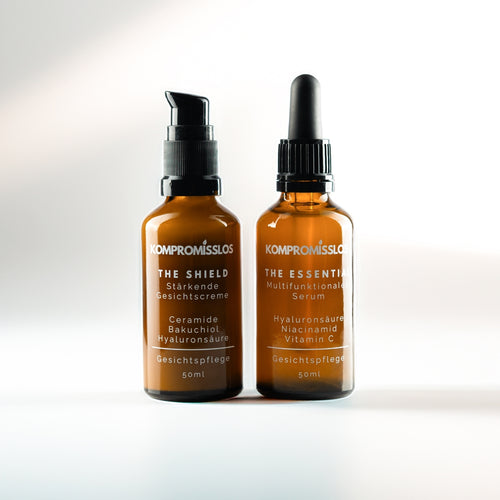
In the long run, what protects you most is a short routine. Fewer layers mean less occlusion and fewer potential irritants. Just how little that can be is shown in the article on how many products your skin really needs. If your skin still stings or feels tight easily after healing, a damaged skin barrier is often behind it, and that needs time. One option for getting back into skincare is The Duo, with just two fragrance-free products: The Essential with hyaluronic acid and niacinamide, and The Shield with ceramide NP and squalane. Because The Shield also contains lipids in the form of squalane and jojoba oil, check with your doctor beforehand whether a cream like this is right for you yet. Introduce the two separately, each with a patch test. The Duo does not work against perioral dermatitis; it is skincare for the time afterwards.
I deliberately limited Kompromisslos to two products and made both of them without fragrance. With an irritated area around the mouth, those are exactly the two things that matter: few layers, and nothing in there purely for the sake of the scent. Even so, I draw a clear line here. The Duo is a cosmetic product; it does not replace a proper medical assessment and it is not a treatment for perioral dermatitis. That is why I make no promises about its effect, and during the acute phase, what your dermatologist says goes – even if they advise you not to apply anything at all. What I can give you is transparency: you can print out the full list of ingredients and take it to your appointment. Then the decision is made by someone who has actually seen your skin.
Frequently asked questions
Is perioral dermatitis contagious?
No, perioral dermatitis is not contagious. You cannot pass it on by kissing or by sharing towels. It is an inflammatory reaction of the skin in which steroid creams, too many layers of skincare and other irritants play a part.
Can I stop using steroid cream for perioral dermatitis on my own?
Do not stop using a steroid cream on your own – talk it through with your dermatologist first. After stopping, the skin often gets worse before it settles. Medical articles describe this rebound explicitly and recommend close supervision during this phase. With support, you are more likely to get through it without reaching for the ointment again out of frustration.
How long does perioral dermatitis last?
Perioral dermatitis usually lasts from several weeks to several months; there is no fixed timeframe. The British Association of Dermatologists says it can persist for a few months until the cause is identified and treated. How quickly it clears in your case depends on whether steroids were involved and how consistently irritants are cut out. Expect to need patience rather than a quick fix.
Can toothpaste contribute to perioral dermatitis?
It is possible, but not well proven. Toothpaste comes up in the medical literature as a possible irritant, but the link is far less firmly established than it is for steroid creams. So mention your toothpaste when you have your skin assessed, especially if you have recently switched brands. Either way, it is worth rinsing any foam residue off the area around your mouth with water after brushing your teeth.
Can I wear make-up with perioral dermatitis?
While your skin is irritated, it is better to keep make-up off the affected area. Foundation is considered one of the factors that can make perioral dermatitis worse, especially in combination with other creams. If you cannot do without it for work, check with your dermatologist what is acceptable during this phase. After healing, only reintroduce make-up once your skin has been calm for a few weeks.
Is perioral dermatitis the same as rosacea?
No, perioral dermatitis is not the same as rosacea, even though the two are easily confused. They are separate skin conditions that can look alike, because redness and small bumps occur in both. Rosacea typically appears on the cheeks, nose and forehead, whereas perioral dermatitis appears around the mouth and nose. Only a dermatologist can reliably tell them apart, and that matters, because each needs different treatment.
Can I use The Duo if I have perioral dermatitis?
During the acute phase, your dermatologist decides whether anything should go on your skin at all, and that includes The Duo. Often the advice is to leave everything out. Only once your skin is calm again and your doctor agrees can a short, fragrance-free routine such as The Duo with its serum and cream be a good fit – introduced one product at a time and with a patch test. It does not work against perioral dermatitis itself.
Sources
- Searle T, Ali FR, Al-Niaimi F. Perioral dermatitis: Diagnosis, proposed etiologies, and management. Journal of Cosmetic Dermatology, 2021. Source
- Malik R, Quirk CJ. Topical applications and perioral dermatitis. Australasian Journal of Dermatology, 2000. Source
- Mokos ZB, Kummer A, Mosler EL, Čeović R, Basta-Juzbašić A. Perioral dermatitis: still a therapeutic challenge. Acta Clinica Croatica, 2015. Source
- British Association of Dermatologists. Peri-oral dermatitis. Patient information leaflet, updated February 2023. Source
- Primary Care Dermatology Society. Perioral dermatitis. Patient information leaflet, updated January 2025. Source