Dry, chapped lips in winter: what really helps and what makes them drier
SKIN CONCERNS
What helps dry, chapped lips most is a plain, fragrance-free lip balm based on sealing fats or waxes, applied several times a day and thickly before bed. What you leave out matters just as much: licking your lips, picking at flakes of skin and products with menthol, camphor or flavourings that tingle and irritate. Outdoors, your lips also need UV protection. If things have not improved after two to three weeks, it is time to have your lips looked at by a professional.
Why do lips dry out faster than the rest of your face?
Lips dry out faster because the red part of the lip has only a thin, not fully matured outer layer and hardly any oil glands to replenish its lipids. It is the only place on the face where mucous membrane permanently faces the outside world. A study in the British Journal of Dermatology measured this in 303 healthy women during winter: water loss through the lips was almost three times as high as on the cheek, and surface hydration was about one-third of the cheek values. The authors attribute this to the immature cells on the lip surface, which hold on to water less well and offer less protection. In everyday life, everything comes together at this one spot: cold wind outdoors, dry heated air indoors, breathing through your mouth during exercise or in your sleep, and saliva that evaporates. How much dry indoor air in winter affects the rest of your skin is covered in the article on what mature, dry skin needs from a winter face cream. For your lips, the short version is enough: they feel it first because they have the smallest reserves.
What really helps dry, chapped lips?
What helps chapped lips is a product that forms a film and slows evaporation, together with a few habits that give your lips time to heal. The American Academy of Dermatology recommends a non-irritating lip balm several times a day and before bed. For very dry, cracked lips, it advises a thick ointment such as white petroleum jelly, because ointments seal in moisture for longer than waxes or oils. You do not need active ingredients with big promises for this. What matters is that your lips get a protective layer and are not constantly irritated all over again.
- Choose a fragrance-free lip balm without flavourings, for example one with petroleum jelly, shea butter, castor oil or plant waxes.
- During the day, reapply whenever your lips feel dry, and put on a thicker layer in the evening before bed.
- Make a conscious effort to stop licking. Saliva evaporates and takes moisture with it, so your lips get drier and you lick them even more often. If the skin around your mouth also turns red and rough, that is a separate issue: dry skin around the mouth.
- Do not peel or bite off flakes of skin; let your lip balm soften them instead.
- Outdoors, use a lip balm with UV protection, even in winter.
Which ingredients in lip balm make your lips even drier?
The ingredients most likely to make your lips even drier are the ones that cool, tingle or taste of something: menthol, camphor, eucalyptus, phenol, fragrance and flavourings such as cinnamon, citrus or peppermint. The American Academy of Dermatology names exactly these substances as sources of irritation for chapped lips, along with salicylic acid, the UV filters octinoxate and oxybenzone, propyl gallate and lanolin. It also points out a common misconception: burning, stinging or tingling is often taken as a sign that a product is working. On irritated lips, it usually means the opposite. So the fresh, cooling feel that many lip balms are sold on is not a mark of quality. The same applies to natural sources of fragrance – more on this in the article on why essential oils can irritate sensitive skin. The table shows what to look out for in the ingredient list.
| Ingredient in lip balm | What it does | For chapped lips |
|---|---|---|
| Petroleum jelly (petrolatum) | Forms a dense film and slows evaporation | Suitable, especially as a thick layer at night |
| Waxes (e.g. candelilla, carnauba, beeswax) | Give the stick its shape and seal the surface | Suitable, but do not last as long as an ointment |
| Shea butter, castor oil, ceramides | Add lipids and protect the surface | Suitable |
| Lanolin (wool wax) | Has a strong sealing effect | On the AAD’s list of ingredients to avoid; can trigger contact allergies |
| Menthol, camphor, eucalyptus, phenol | Cool, tingle and give a fresh feeling | Rather irritating, best left out |
| Fragrance and flavourings (cinnamon, citrus, mint) | Provide scent and taste | Rather irritating, and they tempt you to lick them off |
| Salicylic acid | Loosens flakes of dead skin | Rather irritating on cracked lips |
| Zinc oxide, titanium dioxide | Mineral UV filters | Suitable for outdoors |
If you are wondering whether petroleum jelly and paraffin on your lips are a concern because you end up swallowing some of them, a separate article on what’s behind the criticism of mineral oil and MOAH puts it into perspective.
Is lip balm addictive, or why do you need it all the time?
Lip balm is not addictive in any physical sense, but some products keep alive the very dryness they are meant to relieve. Your lips do not get used to the fat, nor do they stop producing their own oil – they hardly produce any anyway. The cycle has other causes. If the balm contains menthol, camphor or flavourings, your lips stay slightly irritated, feel dry again after a short while, and you reach for the stick once more. If the balm tastes of something, it gets licked off, and the protective film goes with it. A third reason is simply habit: if the stick is always in your hand, you apply it even when there is no need and notice every little rough patch more. And sometimes the problem is not the product at all, but a cause that stays: mouth breathing, licking or the cold. The simplest test takes two to three weeks. Switch to a plain, fragrance-free balm without a cooling effect and see whether you need it less often over time. If you do, it was the product and not your lips.
Keep the same plain lip balm wherever you need it: on your bedside table, in your coat pocket, at your desk. With one always within reach, you lick your lips less and do not end up grabbing whichever flavoured stick happens to be lying around.
Why do your lips stay dry despite lip balm?
Lips usually stay dry despite lip balm because the irritation does not stop or because the balm goes on too thinly and too rarely. Common reasons are a product with cooling agents or flavourings, a balm that has already worn off after your first coffee, licking out of habit, breathing through your mouth at night and peeling off flakes of skin, which keeps creating new tiny wounds. Less obvious are reactions to a new lipstick or a new toothpaste. Medication can also dry out the lips considerably, for example isotretinoin for acne. In that case, talk to the doctor who prescribed it about how to care for your lips. If you spend a lot of time outdoors, in a biting wind or on the ski slopes, your face needs more protection too. What makes sense then is covered in the article on when you need a cold weather face cream.
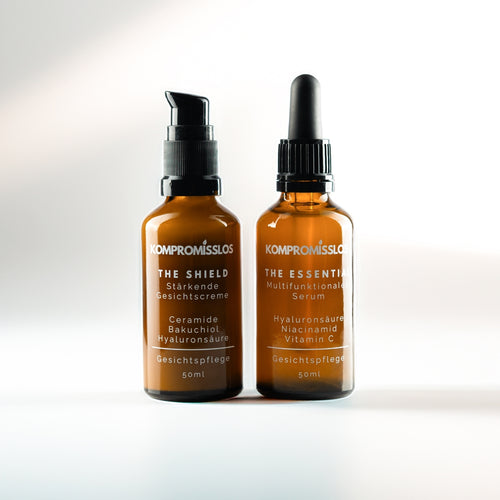
If the skin on your face feels tight as well, it is not just your lips. In winter, cold and heated air take their toll on both, but your face needs different care from your lips. A simple layering is enough for this: a serum with hyaluronic acid, topped with a cream that supports the skin barrier. With The Duo, made up of The Essential and The Shield, the serum provides hyaluronic acid in three molecular sizes, while the cream contributes ceramide NP, squalane and jojoba oil. If your skin is dry, use a little more of both. Then look after your lips separately with your lip balm.
When are dry lips no longer a skincare issue and a case for a professional?
Dry lips are a case for a professional if they have not improved after two to three weeks of consistent, simple care, or if signs appear that go beyond dryness. The American Academy of Dermatology gives this time frame as a guide. Inflamed lips can have many causes: a review in the journal Dermatitis lists irritant and allergic contact reactions, atopic, light-induced and infectious forms, nutritional deficiencies and medication. Because the symptoms are so similar, even specialists often find it difficult to tell them apart. That is a good reason not to experiment on your own. Have your lips looked at by your GP, a dermatologist or a pharmacist if you notice any of these signs:
- Cracked corners of the mouth that do not heal or keep coming back.
- Blisters, crusts or a tingling in one spot before something breaks out there.
- Swelling, burning or redness that extends beyond the red of the lips, for example after using a new lipstick.
- A rough, whitish or scaly patch on the lower lip that does not go away, or a small sore that does not heal, especially if you spend a lot of time in the sun.
- Small bumps or pustules on the skin around the mouth.
The fourth point is important: a systematic review in the Journal of the European Academy of Dermatology and Venereology describes actinic cheilitis, a sun-related change to the lip, as a precursor that can develop into squamous cell carcinoma. That is no reason to panic, but it is a clear reason to book an appointment.
Two products instead of eight also means there is no Kompromisslos lip balm. I am telling you this openly because your lips need something different from your face: a plain, fragrance-free balm with fats or waxes, the kind you can find in any chemist’s. Developing a stick of our own would give you nothing except a third product. The logic behind it is the same as with The Duo: it is fragrance-free because fragrance and flavourings can irritate sensitive areas in particular, and that is especially true of the lips. The Duo is meant for the face and neck, as described in how to apply the serum and cream. For your lips, the rule is simple: pick the most boring balm on the shelf.
Frequently asked questions
Should I exfoliate dry lips?
Not if they are chapped. A scrub rubs over small cracks and can make them bigger. Loose flakes come away on their own if you apply a thick layer of balm overnight. Picking or biting creates new wounds and slows healing. Once nothing is cracked any more and a few flakes still bother you, wipe them away with a soft, damp cloth without rubbing.
Does Vaseline help chapped lips?
Yes, white petroleum jelly such as Vaseline is one of the products the American Academy of Dermatology specifically recommends for very dry, cracked lips, because a thick ointment seals in moisture for longer than waxes or oils. It does the most good as a thick layer before bed.
Do lips need sun protection in winter?
Yes, as soon as you spend any length of time outdoors, especially in the snow and in the mountains. Your lips catch the sun just like the rest of your face, but they are often forgotten when you apply sunscreen. The American Academy of Dermatology recommends a lip balm with at least SPF 30 outdoors and advises reapplying it every two hours. How to protect your face as well is covered in the article on sunscreen for your face when your skincare has no SPF.
Do honey or coconut oil help dry lips?
Both feel pleasant for a moment, but neither is a particularly good choice. Honey tastes sweet and is therefore quickly licked off. Coconut oil is an oil, and according to the American Academy of Dermatology, oils seal in moisture for less time than a thick ointment. A plain, unflavoured lip balm protects more reliably and for longer.
Does sleeping with your mouth open dry out your lips?
Yes, if you breathe through your mouth at night, you often wake up with dry, tight lips because your breath passes over them for hours. A thick layer of lip balm before bed helps. The American Academy of Dermatology also suggests a humidifier in the bedroom. If your nose is permanently blocked, it is worth having it checked by a doctor.
How long does it take for chapped lips to heal?
With consistent, simple care, you should see a clear improvement within two to three weeks, according to the American Academy of Dermatology. This assumes you consistently cut out irritants, licking and picking. If there is no improvement, your lips are a case for a professional. If what bothers you on your upper lip is fine lines rather than dryness, that is a different topic: upper lip wrinkles and what a cream can do.
Can I put The Duo on my lips if I use it on my face?
No, The Duo is intended for the face and neck; the directions for use do not cover the lips. For the red of your lips, use a separate, fragrance-free lip balm instead. The easiest way is to apply the serum and cream to your face first, then the balm to your lips separately. That way, each area gets what it needs. You can find out more about caring for your face on the page for The Duo.
Sources
- Kobayashi H, Tagami H. Functional properties of the surface of the vermilion border of the lips are distinct from those of the facial skin. British Journal of Dermatology, 2004. Source
- American Academy of Dermatology. 7 dermatologists’ tips for healing dry, chapped lips. AAD, patient information. Source
- Narayanan D, Rogge M. Cheilitis: A Diagnostic Algorithm and Review of Underlying Etiologies. Dermatitis, 2024. Source
- Trager MH, Farmer K, Ulrich C, Basset-Seguin N, Herms F, Geskin LJ, et al. Actinic cheilitis: a systematic review of treatment options. Journal of the European Academy of Dermatology and Venereology, 2021. Source