Sore nose from blowing: what helps and how to care for the skin around it
SKIN CONCERNS
For a sore nose from blowing, what helps most is less friction: soft tissues, dabbing instead of wiping and, after each blow, a thin layer of fragrance-free cream on the sides of your nose and your upper lip. If needed, add a thin protective layer to the rawest spots so that nasal discharge does not soften the skin any further. You usually do not need a special cream for this; a break from exfoliants, acids and fragrance does more. Areas that weep, form yellow crusts or blister, on the other hand, need to be seen by a doctor.
Why does your nose get sore when you have a cold?
Your nose gets sore during a cold because the skin on the sides of your nose, between your nostrils and on your upper lip has to cope with an unusual amount of friction, moisture and drying out all at once, within just a few days. Every time you blow your nose, paper is dragged across the same small area, often dozens of times a day. Then there is the nasal discharge: it keeps the skin constantly damp, softens the outermost layer of skin and then dries on it again. This switching between wet and dry makes that outer layer more permeable, so that suddenly even mild products sting. In Switzerland, colds also tend to coincide with the heating season, and that plays a part as well. A review in the Journal of the European Academy of Dermatology and Venereology concludes that low humidity and low temperatures generally weaken the skin’s barrier function and make it more susceptible to mechanical stress. And that stress is exactly what a tissue delivers, several times an hour.
What you see is therefore usually irritation from the outside rather than a skin disease: redness, tightness, fine flaking and sometimes small cracks where the nose meets the upper lip. How the outer layer works as a protective shield, and what happens when it is overloaded for a long time, is explained in the article on a damaged skin barrier. For your nose, a simple logic is enough: reduce friction and moisture, give back lipids and hydration, and add nothing irritating.
What helps quickly when the skin around your nose is red and sore?
What helps quickly is anything that cuts friction straight away and covers the skin: dabbing instead of wiping, a little cream after every blow and a thin, greasy layer on the rawest spots. This will not make the redness disappear overnight, but the skin is no longer rubbed raw again every time you blow your nose, so it can settle down. Clean the area morning and evening with lukewarm water only, without a flannel and without a scented foaming cleanser, and pat it dry with a soft towel. Then press the cream on lightly rather than rubbing it in. Do not pick off small flakes of skin on the side of your nose, however tempting it is, because the new outer layer underneath is often not fully formed yet. A clean, cool, damp cloth can take the edge off the stinging for a moment, but it does not replace the care that comes afterwards. Panthenol is found in many products for stressed skin and is well tolerated. If you want to know what panthenol can do for irritated skin, there is a separate article on it.
Just as important is what you leave out over these days. Exfoliants, acid toners and retinol on the nose area can quickly turn friction irritation into a much bigger problem. If, on the other hand, you kept getting rough or flaky patches on your nose or around your eyebrows even before the cold, the cold is probably not the only cause. In that case, the article on dry patches on your face will help you work out what is going on.
How do you blow your nose without irritating the skin further?
Blowing your nose without irritating the skin further comes down to touching it as rarely and as gently as possible: soft tissues, dabbing instead of rubbing and a fresh tissue every time. That sounds trivial, but it accounts for most of the irritation. There are even dedicated tolerance tests for tissues that measure how much friction the skin under the nose can take. In a study in the journal Cutaneous and Ocular Toxicology, the participants’ skin was first deliberately stressed with adhesive tape. Then, in three studies with 15 to 16 participants each, they wiped from the bridge of the nose down to the upper lip ten times every 20 minutes, 170 times a day in total, using a different product on each side of the nose. The participants clearly preferred the tissue with lotion to those without. In the redness and dryness rated by experts, however, the differences were less consistent. The author was working for a company that sells tissues itself, which is worth bearing in mind as you read. For everyday life, this means that softer, lotion-coated tissues feel better, but what really makes the difference is still how often and how hard you rub.
How to blow your nose without hurting your skin:
- Dab instead of wiping, especially across the strip between your nostrils and the sides of your nose.
- Do not keep wiping: if your nose is only running slightly, catch it with a quick dab.
- Use a fresh, soft tissue every time, and do not keep using cloth handkerchiefs for days.
- Do not rub the skin dry afterwards; let it air-dry briefly and apply a thin layer of cream.
- Keep a small tube of fragrance-free cream in your bag or jacket instead of only looking after your skin in the evening.
Which cream suits sore skin on the sides of your nose, and what is better avoided?
The right cream for sore skin on the sides of your nose is fragrance-free, fairly rich and contains lipids and humectants – not a special cream with a cooling effect. Good building blocks are ceramides, squalane, glycerin, panthenol or plant oils, because they fill the gaps in the outer layer of skin and bind water. On the rawest spots, you can also apply a thin layer of petroleum jelly or a plain, fragrance-free ointment to keep discharge away from the skin. Avoid anything that is already borderline on intact skin: fragrance, alcohol near the top of the ingredient list, scrub particles, acids and retinoids. Vapour rubs and nose creams for colds containing eucalyptus or mint oil, menthol or camphor deserve a separate mention. They smell as if they clear your head, but on skin that has been rubbed raw these substances are more likely to be an extra irritant; the article on essential oils in skincare explains why. The inside of the nose, meaning the mucous membrane and the area just inside the nostrils, follows different rules. Nasal ointments, nasal sprays and nasal rinses are best discussed with a pharmacist or your doctor.
| Situation | What helps | What to avoid |
|---|---|---|
| Skin is red and feels tight | Fragrance-free cream after every blow | Rubbing, scented products |
| Fine flakes on the side of the nose | A little more cream, a thin protective layer in the evening | Exfoliating, picking off flakes |
| Small cracks where the nose meets the upper lip | A thin, greasy layer, dabbing only | Products containing alcohol, make-up on the cracks |
| Every cream stings | A few plain products, brief cooling | Vapour rubs with essential oils, acids, retinol |
| An area weeps, forms yellow crusts or blisters | Medical assessment | Trying out more creams |
How do you care for the skin around your nose morning, evening and overnight until the cold is over?
Until the cold is over, keep up your normal routine and simply give the sides of your nose more: a little extra cream morning and evening, top-ups after blowing during the day and, overnight, a thin protective layer on the rawest spots. You do not need a new routine for this. In the morning, cleanse with lukewarm water, apply your skincare as usual and add a second thin layer of cream to the sides of your nose and your upper lip. During the day, reapply small amounts after blowing your nose rather than putting on one thick layer. In the evening, cleanse gently again and focus your skincare on the nose area. Night-time is when the skin is rubbed least; a thin protective layer on the rawest spots then keeps moisture in the skin and discharge at bay.
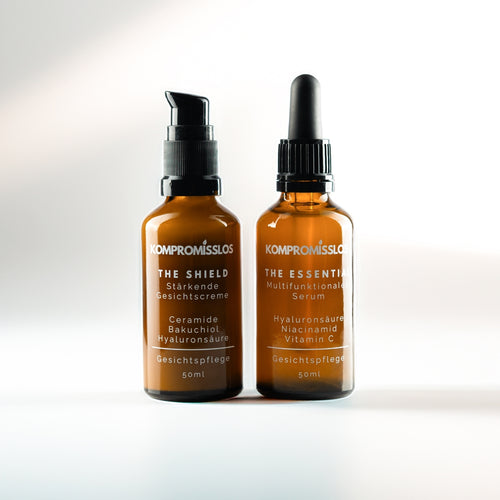
If you use The Duo of serum and cream, you stick to the same two steps. For dry skin, the directions for use simply say: a little more cream. That applies here too. If the serum stings on raw areas, leave it off there for a few days and use only the cream. The Shield contains Ceramide NP and squalane, and the Duo also contains panthenol and aloe vera. Both products are fragrance-free and contain no essential oils. The cream supports the skin barrier and provides moisture, but it is not a nasal ointment, and it does not belong on broken skin either.
If, after a few days of a cold, it is not just your nose but your whole face that is peeling, there is usually more behind it than tissues, such as cold weather, sun or an active ingredient. What helps in that case is covered in the article on peeling skin on your face.
When is a sore nose more than irritated skin, and when should you see a doctor?
You should see a doctor about a sore nose if the affected areas weep, form yellowish crusts, ooze pus or blister, if there is painful swelling just inside the nostril, or if the skin has not calmed down one to two weeks after the cold. Skin irritated by blowing is red, feels tight and flakes finely, but it stays dry and gets better day by day once there is less friction. It is a different matter when honey-yellow crusts form. A review in American Family Physician describes the most common form of impetigo, a bacterial skin infection, as characterised by honey-coloured crusts on the face and limbs. According to the same paper, impetigo is the most common bacterial skin infection in children aged two to five. Small, clustered blisters at the entrance to the nose can point to herpes. And recurring flaking on the sides of the nose that also appears without a cold often has a cause other than friction.
In all these cases, another cream will not help; what you need is an assessment by your GP or a dermatologist, especially for children, if there is a fever or if the redness is spreading. A diagnosis cannot be made from a distance, and experimenting with ointments from the medicine cabinet is more likely to delay it.
Leaving fragrance and essential oils out of The Duo was a deliberate decision, and a sore nose shows quite well why. Skin that has just been rubbed raw does not need a scent; it needs rest, lipids and moisture. A balm that smells of eucalyptus feels like help, but it can irritate this kind of skin even more. To be honest: The Duo is not a nasal ointment. It belongs neither inside the nose nor on open, weeping or crusted areas. For those, you do not need a third product from us, but rather, if necessary, something from the pharmacy and a professional opinion. What you can do with the Duo is simple: keep using it as usual and put a little more cream on the sides of your nose. You can see what is in it, and what is not, in the full list of ingredients.
Frequently asked questions
Does Vaseline help a sore nose?
Yes, as a thin protective layer on the rawest spots, petroleum jelly can help because it keeps nasal discharge and friction away from the skin. It does not add any moisture itself but holds in what is already there, so it goes on top of your cream and never inside your nose. You can read more about the method in the article on slugging with a petroleum jelly layer overnight.
Are tissues with balm better for your skin?
In terms of how your skin feels, usually yes. In a study in the journal Cutaneous and Ocular Toxicology, the participants clearly preferred tissues with lotion to those without, but the differences in redness and dryness rated by experts were less clear-cut. Look for fragrance-free versions. Even so, dabbing instead of rubbing does more than any coating.
Can I use a nasal ointment on the skin outside my nose?
That depends on the ointment, so check the package leaflet first or ask at the pharmacy. Nasal ointments are designed for the area just inside the nostrils and the mucous membrane, and some contain active ingredients or essential oils that are not ideal on raw skin on the outside. For the sides of your nose, a plain, fragrance-free cream is usually enough, with a thin, greasy layer on top if needed.
Should I pause actives like retinol or acids when my nose is sore?
Yes, at least on the nose area. Retinol, AHAs, BHAs and exfoliants loosen or remove the outer layer of skin, and that is exactly what is already overloaded there. Keep caring for the rest of your face as usual, as long as it stays calm. You can start again once the sides of your nose have stopped stinging or feeling tight for a few days.
Can I wear make-up on a red nose?
On skin that is red but intact, yes; on open or cracked areas, better not. Apply cream first, let it sink in briefly and then dab a little concealer or foundation on top instead of blending it in. In the evening, remove your make-up with a mild cleanser and without rubbing, otherwise taking it off costs your skin more than covering up gains you.
How long does it take for the skin around your nose to calm down?
The skin usually becomes noticeably calmer within a few days of the cold ending, once the constant nose-blowing stops. Fine flakes can last a little longer, until the top layer of skin has renewed itself. If it has not improved after one to two weeks, if the area weeps or if crusts form, have a doctor look at it.
Can I keep using The Duo when the skin around my nose is sore?
Yes, on intact skin you can keep using The Duo and put a little more cream on the sides of your nose. Both products are fragrance-free and contain no essential oils. If the serum stings on raw areas, leave it off there for a few days. Do not use it inside your nose or on open, weeping or crusted areas. You can see how the routine is structured on the page for the Duo of serum and cream.
Sources
- Engebretsen KA, Johansen JD, Kezic S, Linneberg A, Thyssen JP. The effect of environmental humidity and temperature on skin barrier function and dermatitis. Journal of the European Academy of Dermatology and Venereology, 2016. Source
- Farage MA. Assessing the skin irritation potential of facial tissues. Cutaneous and Ocular Toxicology, 2005. Source
- Hartman-Adams H, Banvard C, Juckett G. Impetigo: diagnosis and treatment. American Family Physician, 2014. Source