Hypothyroidism and dry skin: when dryness isn’t a skincare problem
SKIN CONCERNS
Your thyroid can cause dry skin, particularly when it is underactive: in hypothyroidism, the sweat and oil glands release less because thyroid hormones are in short supply, and the skin barrier rebuilds more slowly. The skin then often becomes dry, rough and finely flaky all over the body, and barely improves despite consistent skincare. If you also notice tiredness, sensitivity to cold or weight gain, that is a matter for your GP. Skincare can make your skin feel better in the meantime, but it does not fix the cause.
Can your thyroid cause dry skin?
Yes, an underactive thyroid is one of the recognised physical causes of dry skin. Thyroid hormones act directly in the skin: keratinocytes, the main cells of the epidermis, carry their own receptors for them, as Joshua Safer describes in a review in Dermato-Endocrinology. According to this review, when the hormones are lacking, the sweat glands secrete less, the oil glands produce less sebum, and enzymes that matter for building the skin barrier work more slowly. The result is skin that looks rough and flakes finely, especially on the outer sides of the arms and legs. A clinical study in the Indian Journal of Dermatology involving 460 people with hypothyroidism shows how common this is: the examiners found xerosis, meaning markedly dry skin, in 57.17 per cent of them, making it the most common skin sign in that study. This also means it is dryness from within. It is not caused by the wrong skincare, and better skincare alone will not make it go away.
How can you tell whether dry skin might be coming from your thyroid?
One clue pointing to the thyroid is dryness that is not limited to the face, barely improves despite good skincare and comes with symptoms that have nothing to do with the skin. Dryness caused by your skincare habits usually follows a recognisable pattern: it arrives with winter, after hot showers, after a new cleanser or after too many active products. Dryness caused by an underactive thyroid, by contrast, creeps in gradually, affects the whole body and responds little to cream. A single sign tells you little on its own. A population-based study in the European Journal of Endocrinology compared 140 people with newly diagnosed autoimmune hypothyroidism with 560 controls: 63 per cent of those affected had dry skin and 81 per cent were tired. Yet no single symptom was reliable enough to decide who should be tested. What matters, then, is how the signs add up. Get your thyroid checked if several of these points apply to you:
- Your skin is dry, rough or flaky all over your body, not just on your face.
- It stays dry even though you have been looking after it consistently, morning and evening, for weeks.
- You are constantly tired and feel the cold more than you used to.
- You are putting on weight without eating more or moving less.
- Your hair and nails are becoming brittle, and you are losing more hair than usual.
- Your eyelids and face look swollen or puffy.
Does an overactive thyroid make your skin dry too?
An overactive thyroid does not usually make the skin dry; it tends to make it warm, moist and smooth. In Safer’s review, the skin in hyperthyroidism is compared to the texture of a baby’s skin: the warmth comes from increased blood flow, the moisture from the faster metabolism. Many people with the condition sweat more, cope poorly with heat and notice palpitations or restlessness. Itching can occur, but according to Safer it is more likely to be linked to hives than to the overactive thyroid itself. So dry skin is not a typical hallmark of hyperthyroidism. Things can look different after treatment: if an overactive thyroid is treated with medication, radioactive iodine or surgery, thyroid function can later tip over into hypothyroidism. If new dryness appears at that point, it is a reason to have your levels checked, not primarily a reason to change your skincare.
| Feature | Underactive thyroid | Overactive thyroid | Dryness caused by skincare habits |
|---|---|---|---|
| How the skin feels | Dry, rough, finely flaky, rather cool | Warm, moist, smooth | Tight, flaky in places |
| Where it shows | Whole body, often the outer sides of arms and legs | Whole body | Mostly face and hands |
| Accompanying signs | Tiredness, feeling cold, weight gain, brittle hair | Sweating, palpitations, restlessness, weight loss | None; depends on the weather and your routine |
| What helps | Medical assessment and treatment, skincare alongside | Medical assessment and treatment | Milder cleansing, fewer products, moisture plus lipids |
What does Hashimoto’s have to do with dry skin?
Hashimoto’s does not dry out the skin directly; it does so through the hypothyroidism it can lead to. In Hashimoto’s thyroiditis, the body’s own immune system attacks the thyroid and keeps a chronic inflammation going. According to a review in Nature Reviews Disease Primers, in regions with adequate iodine intake, acquired hypothyroidism is more often caused by this chronic autoimmune inflammation than by iodine deficiency. The same review notes that hypothyroidism usually begins gradually and that symptoms often appear only late in its course. For your skin, this means: as long as the thyroid still produces enough hormones despite the inflammation, dry skin cannot simply be blamed on Hashimoto’s, and other causes deserve just as much attention. If hormone production falls, the skin can gradually become drier, often so slowly that you first put it down to winter or age. From 40 onwards, it is therefore worth looking in both directions: perimenopause skin changes and a slowing thyroid can feel similar and can also occur at the same time.
When should you get your thyroid checked, and who should you see?
You should get your thyroid checked if dry skin occurs together with other points from the list above, or if it does not improve over several weeks despite consistent skincare. Your GP is the first port of call: a blood test there shows whether your thyroid is supplying enough hormones; if the results are abnormal or the picture is unclear, you will be referred to an endocrinologist. The study in the European Journal of Endocrinology draws a clear conclusion from its findings: because no single symptom is reliable, even a slight suspicion should lead to a blood test. The skin itself is a matter for a dermatologist if it is red, weeping, very itchy or looks like eczema. Medication can also dry out the skin, so bring a list of what you take to the appointment. If your skin looks not only dry but also grey and pale, iron deficiency is sometimes involved; there is more on this in the article on dull skin and a grey-looking complexion.
Before your appointment, write down how long your skin has been dry, exactly where, which skincare you have already tried and what other changes you have noticed. That keeps the conversation with your doctor shorter and the assessment more focused.
Does your skin get better once your thyroid levels are stable?
Your skin often improves once hypothyroidism is being treated, but not overnight and not completely for everyone. The skin changes are tied to the hormone deficiency; once it is corrected, the brakes that were acting on the sweat glands, oil glands and barrier come off. The skin then needs time, because the epidermis renews itself layer by layer and better-supplied cells first have to work their way up to the surface. On top of that, the right dose is often found only over several check-ups. The review in Nature Reviews Disease Primers also notes that a considerable proportion of people on treatment continue to have symptoms despite normalised levels. If your skin stays dry even after your levels are stable, the thyroid may be the reason, but it does not have to be. Over the years, skin produces fewer lipids anyway, as the article on dry skin with age shows, and too many products can put additional strain on a damaged skin barrier. In that case, alongside the medical check-ups, it is worth taking a look at your skincare too.
What can skincare do for dry skin caused by your thyroid, and what can’t it do?
Skincare can make your skin feel better while the cause is being investigated and treated, but it replaces neither diagnosis nor treatment. The order is therefore clear: the thyroid comes first, with skincare playing a supporting role in the meantime and afterwards. What helps is nothing spectacular: cleanse gently, avoid very hot showers, apply moisturiser straight afterwards, and choose a combination of humectants and lipids. Why exactly this layering matters is explained in the article on what very dry skin on the face is really missing; what to look for when buying is covered in the guide to choosing a moisturiser for dry skin. What does little good, on the other hand, is a row of specialist products used side by side, exfoliants to tackle the flakes or heavily perfumed creams that put extra strain on irritated skin.
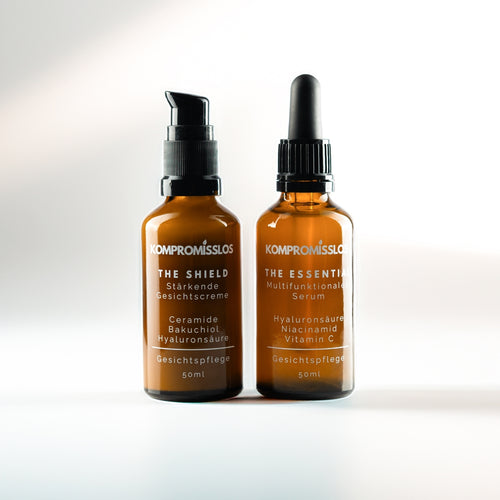
For the face, a simple, fragrance-free layering is enough. With The Duo of serum and cream, The Essential with hyaluronic acid in three molecular sizes goes on first, followed by The Shield with ceramide NP, squalane and jojoba oil; The Duo also contains panthenol. This provides moisture and supports the skin barrier. It does nothing for your thyroid, and for the dry skin on your arms and legs you will need a simple body lotion anyway, because The Duo is designed for the face and neck.
When the cause lies within, a shelf full of specialist creams achieves nothing. That is one of the reasons I built Kompromisslos on two products instead of eight and made both of them fragrance-free. Skin that is currently out of balance does not need extra fragrance or constant experiments; it needs a calm routine that stays the same every day until the treatment takes effect. I am open about where the limit lies: skincare cannot replace a thyroid or make a diagnosis, and that includes ours. What it can do is make your skin feel more comfortable during this time. With dry skin, you can use a little more than the standard amount; exactly how much serum and cream is set out in the instructions for use.
Frequently asked questions
Is dry skin an early sign of hypothyroidism?
It can be, but it is not a reliable early sign. In the study in the European Journal of Endocrinology, 63 per cent of people with newly diagnosed hypothyroidism had dry skin, yet no symptom on its own was enough to identify the condition. Dry skin is also very common and usually has harmless causes. It only becomes meaningful in combination with tiredness, feeling the cold or weight gain.
Is a blood test enough to check your thyroid?
For the first step, usually yes. A blood test shows whether your thyroid is producing enough hormones. Whether antibodies, an ultrasound or a referral to an endocrinologist are also needed is for your doctor to decide based on the results and your symptoms. What the results mean for you is best discussed directly with your doctor.
How long does it take for skin to improve after starting treatment?
Expect weeks to months rather than days. The epidermis renews itself layer by layer, and the right hormone dose is often found only over several check-ups. How quickly it happens varies from person to person. If your skin stays dry once your dose is stable, mention it at your next check-up and, at the same time, check whether your skincare suits your skin.
Can I deal with thyroid-related dry skin myself?
You can look after your skin yourself, but you cannot fix the cause on your own. Hypothyroidism needs a diagnosis and usually hormone therapy prescribed by a doctor. What is in your hands is skincare: cleanse gently, moisturise after showering, avoid fragrance and keep a note of any changes. Taking hormone preparations without medical supervision is not a good idea.
Does iodine or selenium help with dry skin?
There is no evidence for either iodine or selenium as a remedy for dry skin. Whether a supplement makes sense for a thyroid condition depends on the diagnosis; that is something to clarify with the practice overseeing your treatment. It is better not to take anything on your own initiative, especially not before your thyroid has been checked.
What skincare suits a swollen, puffy face?
The same calm, fragrance-free skincare as usual, applied gently; there is no special cream for the swelling. In pronounced hypothyroidism, the swelling itself is caused by deposits of glycosaminoglycans in the dermis, as Safer describes. This is a process in the tissue that no cream can dissolve; only treating the thyroid can improve it. Newly swollen eyelids should therefore be checked by a doctor.
Is The Duo suitable for dry skin with a thyroid condition?
Yes, as supporting skincare for the face and neck, not as a substitute for treatment. The Duo is fragrance-free, contains no hormones and combines moisture from the serum with lipids such as ceramide NP and squalane from the cream. With dry skin, use a little more than the standard amount. If your skin is also red or weeping, have a dermatologist look at it first before you introduce The Duo.
Sources
- Safer JD. Thyroid hormone action on skin. Dermato-Endocrinology, 2011. Source
- Keen MA, Hassan I, Bhat MH. A clinical study of the cutaneous manifestations of hypothyroidism in Kashmir valley. Indian Journal of Dermatology, 2013. Source
- Carlé A, Pedersen IB, Knudsen N, Perrild H, Ovesen L, Laurberg P. Hypothyroid symptoms and the likelihood of overt thyroid failure: a population-based case-control study. European Journal of Endocrinology, 2014. Source
- Chaker L, Razvi S, Bensenor IM, Azizi F, Pearce EN, Peeters RP. Hypothyroidism. Nature Reviews Disease Primers, 2022. Source