Sunscreen stinging your eyes: why it happens and which filters are gentler
ROUTINE
Sunscreen stings your eyes when ingredients from it get into the tear film and irritate the sensitive nerve endings on the surface of the eye. Usually this happens indirectly: sweat, warmth or your own fingers carry the sunscreen from your forehead and eyelids into your eye. The main suspects are certain chemical UV filters such as octocrylene, along with fragrance and alcohol. Many people find purely mineral filters, solid textures such as sticks and a little distance from the lash line more comfortable. If the stinging continues after rinsing, have your eye checked by an ophthalmologist.
Why does sunscreen sting your eyes?
Sunscreen stings your eyes because the surface of the eye reacts far more sensitively to foreign substances than the skin you applied it to. Facial skin is protected by a tough, keratinised outer layer, but the cornea has no such layer: it is covered only by the thin tear film and densely packed with nerve endings. When dissolved ingredients from a sunscreen get into this film, the nerves immediately signal stinging, your eye waters and you squeeze it shut. This is a protective reflex designed to flush the foreign substance out again. One important point here: stinging and measurable irritation are not the same thing. A study in the journal Cutaneous and Ocular Toxicology describes eye discomfort from sun protection as a common problem. UV filters are considered the prime suspects, but clear scientific evidence for this has so far been lacking. In the standard laboratory tests for eye irritation, the two UV filters examined in the study were rated non-irritating, yet in a cell model one of them activated a receptor that signals burning. That could explain why a sunscreen can be classed as well tolerated and still sting when it gets into your eye.
If a cream already stings on the skin itself, on your cheeks or forehead, that is a different question. What might be behind it is explained in the article on face cream stinging and whether it is a harmless tingle.
Which UV filters and other ingredients irritate the eyes most often?
The most concrete evidence on stinging eyes concerns the chemical UV filter octocrylene; fragrance, alcohol and some emulsifiers are also frequently named as sources of irritation. In the study by Zhang and colleagues mentioned above, octocrylene triggered an influx of calcium into corneal cells via the TRPV1 receptor, whereas the UV filter ethylhexyl methoxycinnamate did not. The authors see this as a possible explanation for eye stinging caused by UV filters. This is a cell model, not a trial in humans, but it fits with what many people describe. Octocrylene is also known to trigger contact and photocontact allergies, as a review in Contact Dermatitis summarises. That, however, is a different process from the brief stinging in the eye. Avobenzone and fragrances are also often mentioned in advice articles, but there is less robust data on what they do to the eye.
In the end, what matters is not a single substance but the formula as a whole. A study in Toxicology in Vitro used the hen’s egg test HET-CAM to assess 41 moisturisers and sunscreens sold in Algeria for their potential to irritate the eye. In the test, 36.6 per cent of the creams caused irritation: 44.0 per cent of the moisturisers and 25.0 per cent of the sunscreens. That does not mean sunscreen is harmless and your skincare is the real culprit. It means that every layer around the eye counts, including the one under your sun protection.
| Possible trigger | How to recognise it | What you can change |
|---|---|---|
| Octocrylene or other dissolved UV filters | Stinging almost every time you use it, even without exercise | Try a formula without octocrylene or with purely mineral filters |
| Fragrance and essential oils | A noticeable scent, “Parfum” or “Fragrance” in the ingredient list | Fragrance-free sunscreen and fragrance-free skincare underneath |
| Alcohol denat. | A cool, quick-drying film, often with sprays and fluids | A cream or stick without alcohol denat. near the top of the list |
| Sweat and heat | Stinging only during exercise, in the heat or when hiking | More distance from the eye, a headband, a stick instead of a fluid |
| Too much product at the lid margin | Stinging shortly after applying, slightly blurred vision | Apply only up to the bony rim of the eye socket, not right up to the lashes |
How does sunscreen get into your eyes if you don’t put it there?
Sunscreen travels: sweat, body heat, water and your fingers carry it from your forehead, temples and eyelids to the lid margin and from there into the tear film. The most common route is sweat, which runs down over your eyebrows during exercise or on hot days and takes dissolved filters with it. The second is warmth, because on warm skin sunscreen softens and spreads further into the folds of your eyelids than where you applied it. The third is your hands. If you rub your eyes or put in contact lenses after applying sunscreen, you bring it straight to the surface of the eye. Then there is the mist from sunscreen sprays, water when you swim and wind that makes your eyes water, so that you wipe them with the back of your hand. Runny textures such as fluids and sprays spread more easily than thicker creams or sticks. That is why it does little good to leave out only your eyelids if the forehead above them is thickly covered and you then go for a run. If you want to understand why it stings, start by noticing when it stings: straight after applying, only once you sweat, or after rubbing your eyes.
Which sunscreen stings your eyes less?
A sunscreen with purely mineral filters, no fragrance, no alcohol denat. and a solid texture usually stings the eyes less. Mineral filters such as zinc oxide and titanium dioxide are particles that sit on the skin rather than being dissolved in the formula. How they differ from chemical filters in other respects is explained in the article mineral or chemical sunscreen: what the difference means for your skin. Even so, mineral is no guarantee, because emulsifiers and other additives can irritate too. So look at criteria rather than marketing words such as “sensitive” or “eye-friendly”. “Ophthalmologically tested” does not describe a uniform standard either, and it does not tell you how rigorously the product was tested.
- Filters: if octocrylene is in the ingredient list and your eyes sting regularly, try a formula without it.
- Scent: no parfum, no fragrance, no essential oils.
- Alcohol: no alcohol denat. among the first ingredients.
- Texture: a stick or a thicker cream for the eye area, a fluid for the rest of your face.
- Protection: switching must not come at the expense of sun protection. What counts here is explained in the article on sunscreen for your face if your skincare has no SPF.
Ideally, don’t try out a new sunscreen for the first time on the morning of a mountain hike. How to patch test a new sunscreen first without risking your whole face is explained in the article on patch testing.
How do you apply sunscreen around your eyes without it stinging?
Around your eyes, apply sunscreen last, sparingly and only up to the bony rim of the eye socket, not right up to the lashes. The eye area needs protection, but not a thick layer directly at the lid margin, because that is where the route into the tear film is shortest. The routine is simple and takes hardly any longer than your usual application:
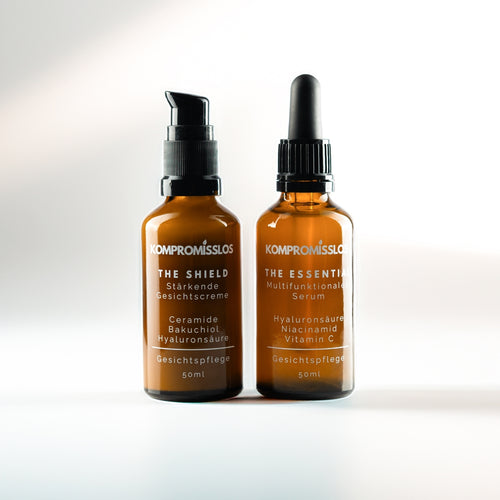
- Skincare first, and let it absorb. If you use The Duo of Essential serum and Shield cream in the morning, apply both to your face and neck, leave out your eyelids and wait a moment before your sun protection goes on.
- Sunscreen as the last step. Why this order applies is explained in the article sunscreen before or after moisturiser.
- Pat rather than rub: tap it in gently with your ring finger under the eye and along the eyebrows.
- Leave a narrow strip free along the lid margin and protect the upper lid with no more than a thin layer from a stick.
- Wash your hands before putting in contact lenses or touching your eyes.
- Leave the rest to sunglasses with UV protection and a hat or cap with a brim.
During exercise, a headband helps more than any formula, because it catches sweat before it runs over your eyebrows. Wipe sweat away from your eye towards the outside with a clean cloth, and top up with a stick rather than spreading fresh fluid over your forehead.
What should you do if sunscreen gets in your eye, and when should you see an eye doctor?
If sunscreen gets in your eye, rinse it out with clean, lukewarm water and don’t rub it. For splashes in the eye, Tox Info Suisse advises removing contact lenses and rinsing the eye for 10 to 15 minutes with clean, lukewarm, running water. Tilt your head towards the affected side so that nothing runs into the other eye, and hold the eye open with your fingers. Afterwards, wipe the skin around the eye with water so that no more cream runs in, and leave the eye area bare for the rest of the day. Stinging or watering that eases quickly after rinsing is the usual course. If you are unsure, for example with children or if a product has been swallowed, Tox Info Suisse can advise you on 145.
You should see an ophthalmologist if any of these signs remain after rinsing:
- pain that does not ease
- blurred vision that does not clear
- severe redness, swelling or sensitivity to light
- a feeling that something is in your eye that is still there the next day
Only a specialist can judge whether irritation, inflammation or an allergy is behind it. Redness, swelling or a rash on the skin around the eye should be seen by a dermatologist.
I deliberately made The Duo without SPF. Sun protection should remain a separate step that you are free to choose. If your eyes sting with a particular filter, you switch sunscreen and keep your skincare, rather than giving up both at once. On top of that, the serum and cream are fragrance-free and contain no essential oils, so that the layer under your sun protection does not add another source of irritation. What I have to be honest about: The Duo can do nothing about the stinging caused by the sunscreen itself. If octocrylene or sweat is the trigger, no skincare underneath will solve that. You can see everything that is not in it in the full list of our ingredients.
Frequently asked questions
Does mineral sunscreen sting your eyes?
Mineral sunscreen stings the eyes less often, but it can still happen. Zinc oxide and titanium dioxide are particles and are not dissolved in the formula, which is why many people with sensitive eyes get on better with them. Emulsifiers, fragrance or alcohol in the same cream can still irritate. So always check the whole ingredient list, not just the filters.
Does sunscreen sting your eyes more when you exercise?
Yes, sunscreen often stings more during exercise, because sweat carries it from your forehead over your eyebrows into your eyes. Warmth also softens the texture, so it runs more easily. A headband, more distance from the lid margin and a stick instead of a fluid for the eye area usually reduce the problem considerably.
Can I put sunscreen on my eyelids?
Yes, thinly and with a little distance from the lash line. A stick or a thicker cream that does not run works best. Many people prefer to protect the upper lid with sunglasses with UV protection. Whether the eye area needs its own skincare when you are not in the sun is covered in the article on whether you really need an eye cream.
Is a sunscreen stick better for the eye area?
Many people find a sunscreen stick more comfortable around the eyes, because the solid texture runs less than a fluid. It can also be applied precisely along the rim of the eye socket and topped up on the go without getting cream on your fingers. But the ingredients still decide: a stick with octocrylene or fragrance can sting just as much as a cream.
Can sunscreen in your eye cause damage?
Usually it goes no further than temporary stinging and watering, which eases after thorough rinsing with water. Don’t rub the eye, and take out contact lenses. If pain, blurred vision, severe redness or sensitivity to light persist, have the eye examined by an ophthalmologist.
Why does my sunscreen suddenly sting when I’ve used it for years?
Often the formula has changed, or the situation (more sweat, heat, wind), or the condition of your eyes. Compare the ingredient list with an older pack. Octocrylene can also trigger a photocontact allergy – according to a review, mainly in adults who have previously used ketoprofen products on their skin. If redness, swelling or a rash appear as well, see a dermatologist.
Can The Duo under sunscreen make stinging eyes worse?
That cannot be ruled out with any skincare, because the layer under your sunscreen can also travel towards the eye with sweat. The Duo is fragrance-free and contains no essential oils, no silicones and no ethanol or alcohol denat.; it does contain the conditioning fatty alcohol cetearyl alcohol. Apply The Duo to your face and neck, leave out your eyelids and let it absorb before your sunscreen goes on.
Sources
- Zhang T, Sun F, Liu Y, et al. Leveraging a TRPV1-overexpressing cell model: an integrated testing strategy for UV filter-induced ocular irritation. Cutaneous and Ocular Toxicology, 2026. Source
- Imane M, Rachid D, Habib BM. Assessment of ocular irritation potential of moisturizing and sunscreen cosmetic creams marketed in Algeria using the HET-CAM test. Toxicology in Vitro, 2026. Source
- de Groot AC, Roberts DW. Contact and photocontact allergy to octocrylene: a review. Contact Dermatitis, 2014. Source
- Tox Info Suisse. First aid: Eye spatter (Erste Hilfe bei Spritzern ins Auge). Source