PEGs in skincare: are these emulsifiers bad for your skin barrier?
NATURAL SKINCARE
Based on current evidence, PEGs in skincare are not bad for intact skin: they barely get through healthy skin, cause little irritation, and sensitisation is rare and mainly affects broken or chronically inflamed skin. Two other points are fair, though. Emulsifiers in general, with or without PEG, can have a measurable effect on the skin barrier. And traces of 1,4-dioxane can be left behind from manufacturing. If you have sensitive skin, you can choose PEG-free, but you do not need to do so out of fear.
What are PEGs in skincare, and how do you spot them on the ingredient list?
PEG stands for polyethylene glycol, a chain of ethylene oxide units that works in skincare mainly as an emulsifier, solubiliser, humectant or surfactant. On the INCI list, you can spot PEGs by three patterns: the abbreviation PEG followed by a number, as in PEG-100 Stearate; names ending in “-eth”, such as Ceteareth-20 or Laureth-7; and polysorbates such as Polysorbate 20. All three are made by ethoxylation, which means attaching ethylene oxide to a fat, oil or sugar building block. The number after PEG tells you how many of these units are attached on average. The longer the chain, the more water-soluble the molecule becomes. The reason they are so widespread is practical: oil and water do not mix, and PEG emulsifiers hold a cream together in a stable, pleasantly light texture. A safety assessment in the journal Toxicology names solubility, viscosity and low toxicity as the reasons for their wide use. To understand how the rest of the list works, it helps to know how to read an ingredient list.
| Pattern on the INCI list | Examples | Typical job |
|---|---|---|
| PEG with a number plus a fatty acid | PEG-100 Stearate, PEG-40 Stearate | Emulsifier in creams and lotions |
| PEG with a number plus an oil | PEG-40 Hydrogenated Castor Oil | Solubiliser for fragrances and oils |
| Ending in “-eth” | Ceteareth-20, Steareth-21, Laureth-7 | Emulsifier |
| Surfactant with “-eth” | Sodium Laureth Sulfate | Cleansing agent in cleansers |
| Polysorbates | Polysorbate 20, Polysorbate 80 | Solubiliser and emulsifier |
PEG silicones such as PEG-10 Dimethicone are a special case. Chemically, they belong to a family of their own, which is covered in the article on silicones in skincare.
Are PEG compounds in skincare harmful?
For healthy skin, PEG compounds in skincare are not harmful according to the available evidence. The 2005 safety assessment in Toxicology concludes that PEGs, their ethers and their fatty acid esters cause little or no eye or skin irritation and have extremely low acute and chronic toxicity. After reviewing the available data, the author also saw no cause for concern regarding genetic damage, cancer risk or reproduction. A second review in Toxicological Research from 2015 likewise rates PEG-40 and PEG-60 Hydrogenated Castor Oil as safe for cosmetic use. The important caveat is in the same 2005 assessment: PEGs and their derivatives should not be applied to damaged skin. The few reported cases of sensitisation mainly involved people who had been exposed to PEGs through medicines or on broken or chronically inflamed skin.
Immediate-type allergies to PEG do exist, but they are rarely described. A review in Clinical & Experimental Allergy brings together 37 reported cases since 1977, most of them linked to medicines, and at the same time stresses that such reactions are often not recognised as reactions to PEG and are therefore probably underestimated. The article on which warning lists for harmful ingredients hold up explains why a substance can end up on a warning list even when the everyday risk is small.
Do PEG emulsifiers make your skin more permeable?
PEG emulsifiers do not make intact skin more permeable across the board, but emulsifiers can change the barrier measurably – and that is not limited to PEGs. Their reputation for making skin “leaky” has two roots. First, hydrophilic PEGs are deliberately used as penetration enhancers in topical dermatological preparations, as the review in Toxicological Research notes. Second, a team at Uppsala University Hospital tested nine emulsifiers in the International Journal of Pharmaceutics, including stearic acid, glyceryl stearate, PEG-2, PEG-9, PEG-40 and PEG-100 stearate, and several steareths. On normal skin, five of the emulsifiers increased transepidermal water loss, meaning the amount of water that evaporates through the skin. On previously damaged skin, by contrast, three of them unexpectedly reduced it. As an explanation, the researchers suggest that the emulsifiers are absorbed into the lipid layers of the stratum corneum, the skin’s outermost layer.
The test conditions matter when you weigh this up: 5% emulsifier in an oil-and-water mixture, 48 hours under covered test chambers, which is far more intensive than simply applying a cream. And the list also included emulsifiers without PEG. The honest reading is therefore that emulsifiers are not neutral fillers, but the abbreviation PEG alone does not decide the matter. If you want to know how to recognise a damaged skin barrier, the condition of your skin tells you more than any single name on the ingredient list.
Is there any truth in the claim that emulsifiers wash out your skin’s own lipids?
There is a plausible kernel of truth in the criticism, but direct evidence from everyday use is lacking. The idea behind this so-called wash-out effect is that emulsifiers left in the skin after applying a cream could carry away some of the skin’s own lipids together with water the next time you wash, much like a mild surfactant. As an isolated effect of individual emulsifiers, this has hardly been measured. What is established is something more general. In a randomised study in the British Journal of Dermatology, 78 volunteers treated one forearm for seven weeks with simplified test creams, a lipid-free gel or an ordinary cream containing 5% urea. The simplified creams and the gel increased water loss and the skin’s reaction to the irritant surfactant SLS, while the ordinary cream had the opposite effect. The researchers conclude that the composition of a moisturiser shifts the barrier function of healthy skin – in both directions. The study explicitly left open which ingredients are responsible.
What this means for you: a cream does not automatically strengthen your barrier just because it moisturises. Whether a formula contains PEGs is one criterion among several, not the deciding one.
What about impurities such as 1,4-dioxane and ethylene oxide?
1,4-Dioxane and ethylene oxide are not added ingredients but possible residues from ethoxylation, the process used to make PEGs. Ethylene oxide is the basic building block of the chain, and 1,4-dioxane is a by-product of the reaction. The International Agency for Research on Cancer (IARC) classifies ethylene oxide as carcinogenic and 1,4-dioxane as possibly carcinogenic, and neither may be intentionally added to cosmetics. So this is about traces. That is why the safety assessment in Toxicology, alongside its positive overall verdict, sets out a clear requirement: manufacturers of PEGs and PEG derivatives must keep up their efforts to remove these impurities and by-products. The real problem for you as a buyer is that the INCI list shows none of this. A carefully purified PEG emulsifier and one with higher residues carry the same name. You can rely on manufacturers and market surveillance, or choose formulas without ethoxylated raw materials. This uncertainty is an understandable reason to avoid PEGs. It is not evidence that any particular product is harmful.
Cosmetic ingredient apps often flag PEGs in colour as questionable. That tells you a substance is on a list, not how high the risk is in your specific product. What counts for your decision is the condition of your skin and the formula as a whole.
When is it worth choosing PEG-free for sensitive skin, and which emulsifiers does natural skincare use instead?
Choosing PEG-free is worth it above all if your skin is currently irritated, cracked or inflamed, if you react to lots of products or if natural skincare criteria matter to you. With damaged skin, exactly the caveat from the safety assessment applies. With eczema, open patches or a known PEG allergy, the choice of products belongs with a dermatologist, and skincare then plays only a supporting role. The major natural cosmetics standards exclude ethoxylated raw materials and therefore PEGs. A separate article explains how the natural skincare certifications that really count in Switzerland handle this in detail. Instead of PEGs, such formulas work with emulsifiers made from sugars, fats and plants:
- Glucosides such as Cetearyl Glucoside or Coco-Glucoside, made from sugar and fatty alcohol.
- Sugar esters such as Sucrose Stearate, made from sugar and fatty acid.
- Lecithin, a phospholipid from soya or sunflowers.
- Glyceryl Stearate, made from glycerin and fatty acid.
- Polyglyceryl esters such as Polyglyceryl-3 Diisostearate.
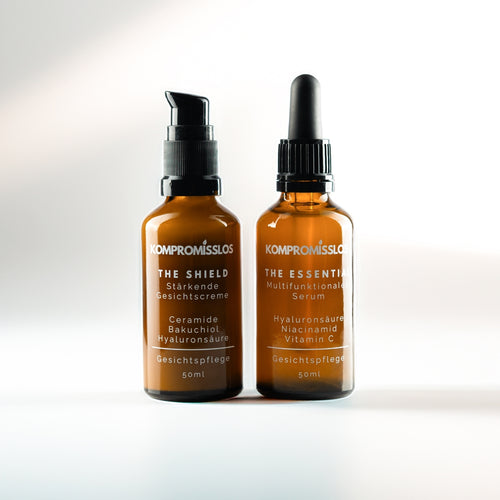
These alternatives are not automatically gentler. Glyceryl stearate was also on the test list in the Uppsala study, and sugar derivatives can cause irritation in individual cases too. With sensitive skin, the formula as a whole, fragrance and the number of products you use usually matter more than any single emulsifier – there is more on this in the article on sensitive skin: causes, care and what to leave out. One example you can check for yourself is The Duo of serum and cream: its published INCI list contains no PEG compound. Among the emulsifiers used are Cetearyl Glucoside, Sucrose Stearate and Lecithin, plus Cetearyl Alcohol as a fatty alcohol. The Shield cream also contains ceramide NP, squalane and jojoba oil, which support the skin barrier.
It mattered to me that for The Duo you don’t just learn what is left out, but get to see the complete INCI list. You can’t verify a list of things that are missing. You can verify a complete ingredient list. If you want to avoid PEGs, you will find every emulsifier named on our page listing all ingredients from A to Z, from Cetearyl Glucoside to Lecithin. I am not claiming that PEGs are harmful – the research does not support that for intact skin. What I can say is that the formula is fragrance-free and silicone-free, and you don’t have to take my word for it, because you can read it for yourself. We give percentages for the key active ingredients, such as 5% niacinamide, but not for emulsifiers. What no ingredient list can show you is how your own skin will react.
Frequently asked questions
What does the number after PEG mean?
The number after PEG tells you how many ethylene oxide units the molecule contains on average. PEG-8 is a short chain, PEG-100 a long one. The length mainly changes the solubility and the job the ingredient does in the formula. You cannot derive a safety verdict from the number alone: the assessment in Toxicology considers PEGs safe in cosmetics across a wide range of molecular sizes.
Is PEG-40 Hydrogenated Castor Oil safe?
For intact skin, PEG-40 Hydrogenated Castor Oil is not considered a concern according to the available assessments. It is an ethoxylated, hydrogenated castor oil and is mostly used as a solubiliser for fragrances and oils. Severe allergic reactions are known from PEG castor oils in intravenous medicines. On the skin, this is not considered a risk, because the substance is not expected to reach the bloodstream through the skin in any significant amount. On broken skin, though, you are better off avoiding it.
Are PEGs allowed in natural skincare?
In certified natural cosmetics, PEGs are not allowed under the common standards, because ethoxylated raw materials are excluded. Without a certification, that does not automatically apply. The term natural cosmetics is not legally protected in Switzerland, so for products without a certificate it is worth checking the INCI list.
Are PEGs the same as microplastics?
No. PEGs are water-soluble polymers, not solid plastic particles. The EU restriction on microplastics targets solid synthetic polymer particles, but some environmental guides still count liquid and dissolved polymers as well. That explains why PEGs sometimes turn up under microplastics. For your skin, this is a separate question from the environmental one.
Are sugar-based emulsifiers automatically gentler?
No, not automatically. Sugar-based emulsifiers are considered mild, but as surface-active substances they also interact with the skin’s surface, and some people react to them. What matters is the formula as a whole, the concentration and the condition of your skin. A mild emulsifier does not turn a heavily perfumed cream into a low-irritation one.
Are PEGs less relevant in a rinse-off cleanser than in a cream?
Generally yes, because a cleanser only stays on the skin briefly and is rinsed off. A cream stays on for hours, and that is where the possible absorption of emulsifiers into the outer layer of skin plays a bigger role. With a cleanser, what matters most is how strongly the surfactants strip oil. Whether one of them is ethoxylated, like Sodium Laureth Sulfate, is secondary.
Does The Duo contain PEGs?
No, The Duo’s published INCI list contains no PEG compound and no ethoxylated emulsifier. Among the emulsifiers used are Cetearyl Glucoside, Sucrose Stearate and Lecithin. You don’t have to rely on a “free from” label: you can check the complete list yourself before you decide on The Duo of serum and cream.
Sources
- Fruijtier-Pölloth C. Safety assessment on polyethylene glycols (PEGs) and their derivatives as used in cosmetic products. Toxicology, 2005. Source
- Jang HJ, Shin CY, Kim KB. Safety Evaluation of Polyethylene Glycol (PEG) Compounds for Cosmetic Use. Toxicological Research, 2015. Source
- Bárány E, Lindberg M, Lodén M. Unexpected skin barrier influence from nonionic emulsifiers. International Journal of Pharmaceutics, 2000. Source
- Buraczewska I, Berne B, Lindberg M, Törmä H, Lodén M. Changes in skin barrier function following long-term treatment with moisturizers, a randomized controlled trial. British Journal of Dermatology, 2007. Source
- Wenande E, Garvey LH. Immediate-type hypersensitivity to polyethylene glycols: a review. Clinical & Experimental Allergy, 2016. Source