Is pentylene glycol safe? What it does in your moisturiser and who should avoid it
NATURAL SKINCARE
Yes, pentylene glycol is safe in the amounts normally used in cosmetics, based on current evidence. The expert panel of the Cosmetic Ingredient Review has assessed the 1,2-glycols, the group it belongs to, as safe in present practices of use. It holds moisture, dissolves other ingredients and supports preservation. The one real catch: in rare cases, pentylene glycol can trigger a contact allergy. If you have a confirmed reaction to it, you should avoid it.
Is pentylene glycol safe?
Pentylene glycol is safe for the vast majority of people, and the evidence points to a well-tolerated supporting ingredient. In 2012, the Cosmetic Ingredient Review, an expert panel that assesses cosmetic ingredients in the US, reviewed the group of 1,2-glycols, including pentylene glycol, in the International Journal of Toxicology. The experts note that although these substances are absorbed into the skin, the data on oral toxicity and genotoxicity support their safety. Their conclusion: safe in present practices of use and concentration. A later study in Regulatory Toxicology and Pharmacology, carried out by the research department of a skincare manufacturer in Egerkingen, reached the same result for a sunscreen containing pentylene glycol: no safety concerns with daily use at the recommended amount. A side finding of these measurements on pig skin: part of the pentylene glycol evaporates from the skin’s surface, with the amount recovered falling from 98 per cent after one hour to 29 per cent after 24 hours.
The key is to distinguish between toxic and allergenic. According to these assessments, pentylene glycol is not toxic in the sense of harming the body. It can be allergenic, like practically any ingredient – just rarely. If you want to know more generally which warning lists about skincare ingredients hold up and which mainly spread uncertainty, it is worth looking at the methods behind such lists. For pentylene glycol, the picture is fairly clear: not a harmful substance, but one that some individuals can be allergic to.
What is pentylene glycol and what does it do in a moisturiser?
Pentylene glycol is a short-chain glycol, chemically 1,2-pentanediol – a molecule with five carbon atoms and two alcohol groups. In a moisturiser, it does three jobs at once: it binds water in the surface of the skin, it helps dissolve other ingredients evenly and it makes it harder for microbes to grow. A case report in the journal Contact Dermatitis accordingly describes it as a preservative, solvent and humectant. The Cosmetic Ingredient Review also explicitly names pentylene glycol as a substance that has a preservative effect.
It is precisely this combination that makes it attractive for formulations without classic preservatives. As a rule, it does not work alone but complements an actual preservative while also holding moisture. In its role as a humectant, it is similar to glycerin in skincare, which it often appears alongside in an ingredient list. The overview of preservatives in natural skincare explains what the rest of a preservative system in natural cosmetics looks like, including which substances are used and which limits apply. Pentylene glycol plays a supporting role there, not the lead.
How is pentylene glycol different from propylene glycol and butylene glycol?
Propylene glycol, butylene glycol and pentylene glycol are related glycols that differ mainly in the length of their carbon chain: three, four and five carbon atoms. Propylene and pentylene glycol carry their two alcohol groups in the same position and belong to the 1,2-glycols, while butylene glycol is chemically 1,3-butanediol. The properties change with chain length: according to modelling that the Cosmetic Ingredient Review relies on, longer-chain 1,2-glycols penetrate the skin less. Propylene glycol is the shortest member of the group and is found in many cosmetics and topical medicines. Butylene glycol is used mainly as a humectant and solvent. Pentylene glycol also plays a part in preservation.
An analysis from Antwerp University Hospital, published online in Contact Dermatitis in 2026, looked at 1979 people who were patch tested with at least one glycol between 2021 and 2024. Of these, 2.79 per cent reacted to propylene glycol. The authors consider cross-reactions to be limited and most likely between structurally similar short-chain glycols. What this means for you: a known allergy to propylene glycol is a reason to be careful with pentylene glycol, but it does not automatically rule it out.
| INCI name | Carbon atoms | Typical jobs | Allergy data (Antwerp 2021–2024) |
|---|---|---|---|
| Propylene Glycol | 3 | Humectant, solvent | 55 of 1979 people tested (2.79 per cent) |
| Butylene Glycol | 4 | Humectant, solvent | Not reported in the abstract |
| Pentylene Glycol | 5 | Humectant, solvent, supports preservation | 6 of 89 people tested for it (6.74 per cent) |
| Caprylyl Glycol | 8 | Supports preservation, conditioning | 0.77 per cent (test concentration 5%) |
Even so, pentylene glycol is not a preservative in the classic sense, like parabens or phenoxyethanol. If you want to know how concerning phenoxyethanol really is, there is a separate article on it. Pentylene glycol can be part of a preservative system that does without phenoxyethanol.
How common is a pentylene glycol allergy?
Allergies to pentylene glycol are rare, judging by the cases published so far, but experts are watching it as a possible emerging cosmetic allergen. A paper from the University of Ferrara in Contact Dermatitis carries the title ‘Pentylene glycol: An emerging cosmetic allergen?’ and describes a 44-year-old woman who developed severe facial eczema in reaction to an anti-ageing day cream. In patch testing, she reacted to pentylene glycol at 5% and 10% concentration, while 15 healthy controls showed no reaction. The authors list only a few earlier case reports, mostly involving eczema on the face, and describe the substance as a weak irritant and a weak allergen.
In the Antwerp analysis, 6 of 89 people tested for pentylene glycol reacted to it, or 6.74 per cent. That sounds like a lot, but it is not a figure for the general population: the people tested had already been referred to a specialist clinic with a suspected contact allergy, and the group was small. Four of these six also reacted to propylene glycol. The Ferrara team also points out that pentylene glycol is often used in products for sensitive and atopic skin. In other words, that is exactly where frequent exposure meets skin that is already easily irritated.
Redness, itching or eczema after a new cream should be seen by a dermatologist. Only a patch test shows which ingredient is actually responsible. A guess based on the ingredient list is no substitute for proper testing.
Is pentylene glycol natural or synthetic, and is it allowed in natural skincare?
Pentylene glycol is always a manufactured substance: whether it counts as natural or synthetic depends solely on the raw material it is made from. It can be produced from fossil feedstocks. But it can also be obtained from biomass: a paper in the journal Nanomaterials describes how 1,2-pentanediol is made from furfural, a starting material derived from biomass, with the aim of replacing fossil raw materials. The molecule is identical in both cases. The INCI list only ever says ‘Pentylene Glycol’, so you cannot see its origin there.
Whether it is permitted in certified natural cosmetics therefore depends on the standard and on the origin of the raw material used, not on the name. Without a certification label, ‘natural cosmetics’ is not a protected term, and then all you can do is ask the manufacturer. A more honest question than ‘natural or synthetic’ is whether the substance is well studied and tolerated at the amount used. For pentylene glycol, the answer for most people is yes.
How can you tell from the INCI list how much pentylene glycol a product contains?
You cannot read the exact amount of pentylene glycol from the INCI list, only a rough order of magnitude from its position. On the packaging, ingredients are listed in descending order of quantity, but those under 1 per cent may follow in any order. If pentylene glycol is near the top, straight after water and glycerin, it makes up a significant part of the formulation. If it appears in the last third, next to fragrances or preservatives, the proportion is small. How to apply this logic to the whole list is explained in the article on how to read an ingredient list.
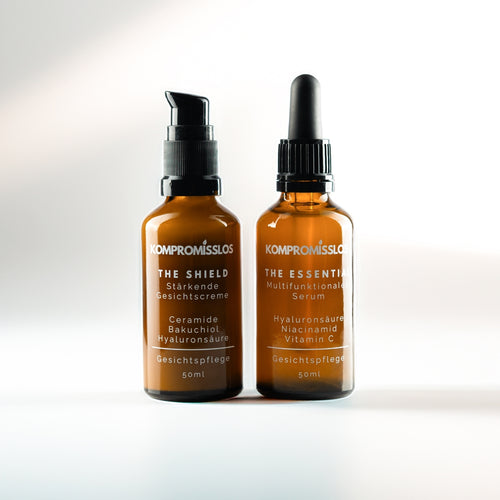
Overview pages that list ingredients alphabetically, like our ingredients page, are a special case. There, the position says nothing about the amount; the list serves as a reference. What matters is that the substance is named at all. If you are allergic to pentylene glycol, you need this information, and you can only find it if a manufacturer also discloses the supporting ingredients. That is why pentylene glycol is listed openly in The Duo of serum and cream, alongside glycerin, sodium benzoate and sodium levulinate. In a review on Judge.me, J.D. writes: ‘[…] and also by the whole concept and the great transparency about ingredients etc. Simply great!’ (review translated from German). That transparency is exactly what matters with a supporting ingredient like this one.
- Near the top, shortly after Aqua: a significant proportion, usually as a humectant.
- In the middle, next to glycerin and emulsifiers: the typical supporting role.
- Towards the end, next to preservatives: a small amount, often to support preservation.
- Alphabetical list: the position tells you nothing about the amount.
I have disclosed the full INCI list of The Duo, including supporting ingredients such as pentylene glycol, because ‘free from’ lists on their own tell you little about a product. The Duo is fragrance-free and contains neither phenoxyethanol nor parabens. It is preserved with sodium benzoate and sodium levulinate, supported by pentylene glycol and glycerin. I deliberately do not sell it as ‘naturally preserved’, because sodium benzoate is synthetic, and our website says so too. And there is a limit I should be clear about: if you have a confirmed allergy to pentylene glycol, The Duo is not for you, even if you like the rest of the formulation. You can look up every single substance on the page with all our ingredients from A to Z.
Frequently asked questions
Is pentylene glycol an alcohol that dries out the skin?
No. Chemically, pentylene glycol is an alcohol, but a diol with two alcohol groups that binds water rather than stripping oil like Alcohol Denat. It is classed as a humectant. How the different groups differ is explained in the article on which alcohols dry your skin and which care for it. On very sensitive skin, pentylene glycol can still cause mild irritation.
Is pentylene glycol a preservative?
Partly. Pentylene glycol inhibits the growth of microbes, which is why the Cosmetic Ingredient Review also lists it as a substance with a preservative effect. In many formulations, including The Duo, it works together with an actual preservative. It supports preservation while also acting as a humectant.
Is pentylene glycol suitable for sensitive skin?
For most people with sensitive skin, yes – it is in fact often used in products for this skin type. However, the scientific literature describes it as a weak irritant and a weak allergen. If your skin reacts to many products, it is worth getting it checked by a dermatologist rather than avoiding individual substances on suspicion.
Is pentylene glycol safe during pregnancy?
The safety assessments cited here make no specific statement about pregnancy. They generally classify pentylene glycol as safe in normal use, and their summaries contain no indication of a particular risk. If you are unsure, discuss your skincare with your gynaecologist.
What do ‘skin-identical’ and ‘multifunctional’ mean for pentylene glycol?
Multifunctional means that pentylene glycol does several jobs: binding moisture, dissolving ingredients and supporting preservation. It is not skin-identical, though. It is not one of the substances the skin barrier is made of, such as ceramides or fatty acids. If it is marketed that way, that is more marketing than chemistry.
How do I test whether I react to pentylene glycol?
Only a patch test at a dermatology practice, in which pentylene glycol is applied on its own, can tell you for sure. Testing a cream on your forearm at most shows whether you tolerate the whole product, not which substance triggers a reaction. Eczema or severe redness should be assessed by a professional, not investigated through trial and error.
Why does The Duo contain pentylene glycol?
Pentylene glycol holds moisture and, together with glycerin, supports preservation by sodium benzoate and sodium levulinate. This allows The Duo to do without phenoxyethanol and parabens. Even so, we do not call it ‘naturally preserved’, because sodium benzoate is synthetic. If you have a confirmed allergy to pentylene glycol, you should not use The Duo.
Sources
- Johnson W Jr, Bergfeld WF, Belsito DV, Hill RA, Klaassen CD, Liebler D et al. Safety assessment of 1,2-glycols as used in cosmetics. International Journal of Toxicology, 2012. Source
- Steiner A, Kugarajan K, Wullimann M, Ruty B, Kunze G. Margin of safety of pentylene glycol derived using measurements of cutaneous absorption and volatility. Regulatory Toxicology and Pharmacology, 2017. Source
- Corazza M, Schenetti C, Schettini N, Zedde P, Borghi A. Pentylene glycol: An emerging cosmetic allergen? Contact Dermatitis, 2022. Source
- Kanokrungsee S, Dendooven E, Aerts O. Contact Allergy and Allergic Contact Dermatitis From Propylene Glycol and Related Glycols: Cosmetic Skin Sensitisers After All? Contact Dermatitis, 2026. Source
- Bruna L, Cardona-Farreny M, Colliere V, Philippot K, Axet MR. In Situ Ruthenium Catalyst Modification for the Conversion of Furfural to 1,2-Pentanediol. Nanomaterials, 2022. Source