Face cream for women over 80: what very mature skin needs day to day
SKIN OVER 40
A face cream for a woman over 80 does not need any new wonder ingredients – it needs two things: lipids and humectants for skin that is drier and recovers more slowly, and packaging that works without strength or fine finger control. In practice, that means fragrance-free, a short ingredient list, a pump dispenser instead of a small screw cap, and no more than two steps. Whether you apply it yourself or a daughter helps, sticking to it every day does more than any extra product on the shelf.
What does skin over 80 need from a face cream?
Above all, skin over 80 needs a face cream that provides reliable basic care: lipids that top up the skin barrier and humectants that bind water in the outer layer of the skin. A systematic review in the International Journal of Nursing Studies analysed studies on basic skincare in older people. Its conclusion: gentle cleansing and lipid-replenishing leave-on products with humectants help with dry skin and improve the skin barrier in old age. That sounds unspectacular, and that is precisely the point. At 80, what matters is not the latest launch on the label but whether the cream actually gets used every day. The criteria to check when buying are covered in detail in the article on face cream over 70, and little about them changes at 80.
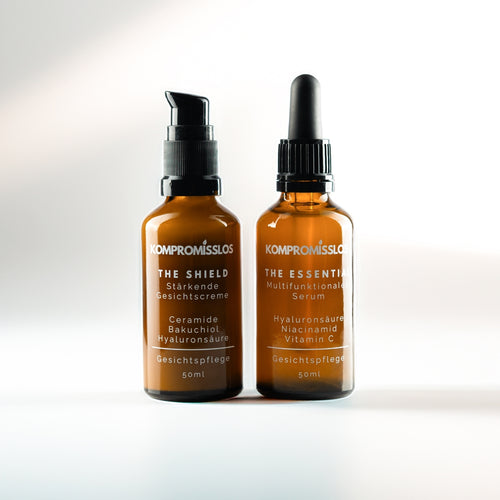
At 80, very practical questions come into play: can she open the packaging on her own? Can she see how much cream ends up in her hand? Does the product smell so strong that it ends up left on the shelf? At Kompromisslos, the routine consists of a serum with a dropper and a cream from a pump dispenser, with ceramide NP, squalane and hyaluronic acid, and no fragrance. The Duo of serum and cream is deliberately built around two steps, so the routine still holds up when someone else helps with applying it.
How is skin over 80 different from skin at 70?
Biologically, going from 70 to 80 is not a sudden break, but the skin is usually even drier, is more easily thrown off balance and takes longer to recover. How wide the gap to young skin is can be seen in a study in the Journal of Clinical Investigation. It compared the skin barrier of 20- to 30-year-olds with that of people over 80. In the older group, the barrier was disrupted more easily and recovered much more slowly: 24 hours after the challenge, 50 per cent had been restored in the young group, compared with 15 per cent in the over-80s. At rest, on the other hand, the older skin looked largely unremarkable – the difference only showed under stress. In everyday terms, this means that a hot flannel, a new exfoliant or a heavily perfumed product can affect very old skin for longer than it used to.
At this age, dry skin is the rule rather than the exception. In a study in ten Berlin nursing homes, published in BMJ Open, the 223 residents had an average age of 83.6 years, and 99.1 per cent were found to have dry skin (xerosis cutis). The second difference lies less in the skin itself than around it: hands that can no longer grip firmly, eyes that can no longer read small print, and sometimes help from family or care staff. If what concerns you most is why skin becomes thinner, you will find the background in the article on thin skin on the face. And whether switching from her current cream is worth it at all comes down to the same concrete signs as with face cream for women over 65.
Which ingredients make sense in a face cream over 80?
In a face cream over 80, the ingredients that make most sense are those that resemble the skin’s own substances or bind water, while those that irritate or are designed to intervene strongly are ones you can do without. Skin-identical lipids such as ceramides and squalane top up the lipids between the skin cells, and glycerin and hyaluronic acid hold moisture in the outer layer of the skin. Fragrances and essential oils do nothing for the skin but can trigger reactions, and in skin that recovers more slowly, irritation lasts longer. High-strength acids and retinoids are not off limits at 80, but they do not belong in a routine that is meant above all to be simple and reliable. If you already use a serum, there is no need to stop; whether it adds anything alongside the cream is covered in the article on serum over 70.
| Ingredients | Job | Verdict over 80 |
|---|---|---|
| Ceramides, squalane, plant oils | Top up the skin’s lipids | Cornerstone of any cream |
| Glycerin, hyaluronic acid, panthenol | Bind moisture | Cornerstone, ideally with a cream on top |
| Niacinamide in moderate amounts | Supports the skin barrier | Possible, introduce slowly |
| Fragrances, essential oils | Scent | You can do without them |
| AHAs, high-strength retinol | Speed up skin renewal | Only with experience or after talking to a dermatologist |
Try a new product on a small area along the jawline for a few days first, before using it on the whole face. If the skin is very dry, a little more cream is fine. Why a rich texture on its own is often still not enough is explained in the article on dry skin with age.
Pump, jar or tube: which is easier day to day?
For many hands over 80, a pump dispenser is the easiest option, because it can be used with one hand, dispenses an even amount and has no lid to unscrew. A jar has the advantage of a wide opening, but needs a firm grip on the screw lid, and your fingers go into the product every time. A tube needs pressure from the fingers and is hard to dose when the cream is thick. Small pipettes and dropper bottles are the trickiest once fine motor skills decline. There is a simple way round this: instead of putting the drops straight onto the face, put them into the palm of your hand first and then spread them. That is also how the instructions for the Kompromisslos serum describe it.
| Packaging | Advantage | Everyday hurdle |
|---|---|---|
| Pump dispenser | One-handed, even amount, hygienic | Needs a short, firm press |
| Jar | Wide opening, contents easy to see | Screw lid, fingers in the product |
| Tube | Light, handy for a handbag | Needs finger strength, small cap |
| Pipette or dropper | Precise amount for runny serums | Fine motor skills, better to drip into the hand |
Eyesight matters too. If labels are printed in small type, a large sticker with “1” on the serum and “2” on the cream helps get the order right without glasses. In her review on Judge.me, Sigrid P. writes: “Facial care that is straightforward to use, pleasant to apply […]” (review translated from German). At 80, this kind of simplicity becomes the most important criterion.
How can you help your mother or a relative with facial skincare?
The best way to help your mother or a relative is to agree on a fixed, short routine with her and let her do as much as possible herself. Facial skincare is something very personal. Many women have used the same cream for decades and do not want to be patronised about it. So ask first what she likes and what bothers her before you buy anything new. If you help with applying it, these points matter more than the choice of brand:
- Choose a fixed time, for example after washing in the morning or before going to bed.
- Use lukewarm rather than hot water, and pat the skin dry afterwards instead of rubbing.
- Warm the product briefly in your hands and smooth it on gently from the centre of the face outwards, without pulling at the skin.
- Include the neck and leave out the area immediately around the eyes.
- Keep an eye out: when applying cream, you will often notice redness, stinging or new patches before she does.
If your mother lives in a care home, agree on her facial skincare with the nurse responsible and label the products with her name. The authors of the Berlin nursing home study point out that not every skin finding needs immediate dermatological treatment and that much can be managed with targeted skincare. But care staff need the knowledge to make the right call. Good coordination between you and the care team is therefore worth more than an expensive product.
If your mother applies a prescribed ointment to her face, the order of application should be agreed with her doctor or at the pharmacy. A face cream does not replace prescribed treatment.
When should skin changes over 80 be seen by a doctor?
Skin changes over 80 should be seen by a doctor if they are new, change, bleed or do not heal. Wounds, cracks and persistent itching belong with a doctor or nurse, not under a face cream. In the Berlin nursing home study, findings ranged from very common dry skin to infections and skin cancer. On a face that has been exposed to the sun for decades, it is especially worth taking a close look. Contact your GP or dermatologist if you notice any of these signs:
- a spot that is new, growing, changing colour or bleeding
- a rough or crusty patch that does not go away over several weeks
- an open sore, a crack or a wound, even a small one
- itching that persists despite regular skincare or disturbs sleep
- redness, burning or swelling after a new product that does not settle once it is stopped
A face cream can keep dry skin more supple and support the skin barrier. It does not replace a medical check-up, and the older the skin, the more worthwhile it is simply to mention any changes at the next appointment.
I built Kompromisslos on two products instead of eight, and skin over 80 shows particularly clearly why. When a daughter or a nurse helps with applying skincare, what counts is a routine you can remember without instructions: first a few drops of serum, then the cream from the pump dispenser. Both are fragrance-free, because fragrance is not care and sensitive skin gets nothing from it. What the cream cannot do: it contains no sun protection factor. Anyone who spends time outdoors therefore needs a separate sunscreen, even at 80. And it does not care for wounds or cracks – that belongs in professional hands. How much serum and cream to use, and the fact that once a day is also an option, is set out in how to use the serum and cream.
Frequently asked questions
Is applying face cream once a day enough over 80?
Yes, applying cream once a day is fine over 80 and, for many, the more realistic routine. What matters most is that it happens every day. If the skin is very dry, twice a day or a little more cream in the evening is fine. Whether that calls for a separate night cream is answered in the article on whether you really need a night cream or one cream for day and night is enough.
Does skin over 80 still need sun protection?
Yes, skin over 80 still needs sun protection whenever it is outdoors, for example on a walk, in the garden or on the balcony. A face cream without a sun protection factor does not replace it. If applying an extra product is a struggle, a wide-brimmed hat and staying in the shade around midday help keep the effort to a minimum.
Is retinol still worthwhile over 80?
Retinol is not off limits over 80, but it is rarely the step with the greatest benefit, because very dry skin that regenerates slowly is quicker to become irritated. If you have tolerated it well for years, there is no need to stop; starting it for the first time is better discussed with a dermatologist. What age really decides when it comes to retinol is covered in the article on when to start retinol.
Why does skin feel tight after washing in old age?
In old age, skin feels tight after washing because water and cleanser strip away even more of its already scarce lipids and the barrier recovers more slowly – more on this in the article on tight skin.
Can I use the same cream on my face and neck?
Yes, using the same cream on the face and neck makes sense, as long as the neck tolerates it well. With The Duo, the neck is already part of the routine: serum and cream are massaged in from the centre of the face outwards and down over the neck. Whether you still need a separate neck cream is covered in the article on neck and décolleté care.
Is a face cream a good gift for a woman over 80?
A face cream is a good gift for a woman over 80 if it suits her skin and her hands: gentle, easy to open and without complicated instructions. Find out discreetly beforehand which skincare she uses now and whether she likes fragrance. How to recognise a set that actually gets used is explained in the guide to skincare gift ideas for women.
Is The Duo suitable for very mature skin over 80?
The Duo can suit very mature skin over 80 if you are looking for a simple, fragrance-free routine. The serum with hyaluronic acid and niacinamide comes with a dropper, the cream with ceramide NP and squalane comes from a pump dispenser, and for very dry skin a little more is fine. The Duo of serum and cream does not replace sun protection or the care of wounds. With a 100-day return policy, there is time to find out at your own pace whether the skin takes to it.
Sources
- Lichterfeld-Kottner A, El Genedy M, Lahmann N, Blume-Peytavi U, Büscher A, Kottner J. Maintaining skin integrity in the aged: A systematic review. International Journal of Nursing Studies, 2020. Source
- Ghadially R, Brown BE, Sequeira-Martin SM, Feingold KR, Elias PM. The aged epidermal permeability barrier. Structural, functional, and lipid biochemical abnormalities in humans and a senescent murine model. The Journal of Clinical Investigation, 1995. Source
- Hahnel E, Blume-Peytavi U, Trojahn C, Dobos G, Jahnke I, Kanti V, et al. Prevalence and associated factors of skin diseases in aged nursing home residents: a multicentre prevalence study. BMJ Open, 2017. Source