Face cream for women over 65: when a switch is worth it and when it isn’t
SKINCARE BY AGE
Choose a face cream for women over 65 based on the condition of your skin, not your year of birth. Three things matter: skin-identical lipids such as ceramides and squalane, a moisture binder such as hyaluronic acid, and a short, low-irritation formula. A switch is only worth it once your current cream leaves specific signs unanswered.
For the general criteria, whatever your decade: the best face cream for mature skin.
What skincare does skin need over 65?
Skin over 65 needs lipids, moisture and a routine you actually use twice a day. In terms of ingredients, skincare over 65 differs very little from what made sense five years earlier: ceramides, squalane and plant oils as the lipid base, hyaluronic acid as a moisture binder, and niacinamide to support the barrier. If you know the criteria for a face cream over 60, you already know most of the answer. What shifts at 65 is not the ingredient list but tolerance. Your skin is slower to forgive a wrong choice, reacts more noticeably to fragrance and to over-exfoliating, and the difference between summer and the heating season is more pronounced than it used to be. So the most important decision at this age is rarely which new product to add, but which step to drop. A simple routine that your skin has tolerated well for years almost always beats a new one with more active ingredients.
How can you tell your current cream is no longer enough?
Your cream is no longer enough if, despite daily use, your skin shows signs that persist for two to three weeks. Five of them are clear-cut. First: your skin feels tight again two hours after moisturising, even though you applied enough. Second: fine flakes on your cheeks, the sides of your nose or your forehead come back after every wash. Third: sunscreen or make-up settles into fine lines because the surface is drying out unevenly. Fourth: your skin stings shortly after application, even with products you used to tolerate without problems. Fifth: redness on your cheeks and chin lingers longer than it did two years ago. A single sign is usually down to the time of year. Two or more over several weeks are a reason to check the formula. Other signs of a compromised skin barrier are covered in a separate article.
| What your skin is telling you | What is usually behind it | What to change first |
|---|---|---|
| Tightness two hours after moisturising | Too few lipids in the cream | Check the formula for ceramides and squalane |
| Fine flakes after washing | Your cleanser is stripping too much oil | Change your cleanser rather than your cream |
| Stinging with products you used to tolerate | The barrier is currently more permeable | Leave out acids and exfoliants for four weeks |
| The cream is enough in the evening but not in the morning | A question of quantity | Apply more generously in the morning |
What to check on a face cream over 65 in one minute
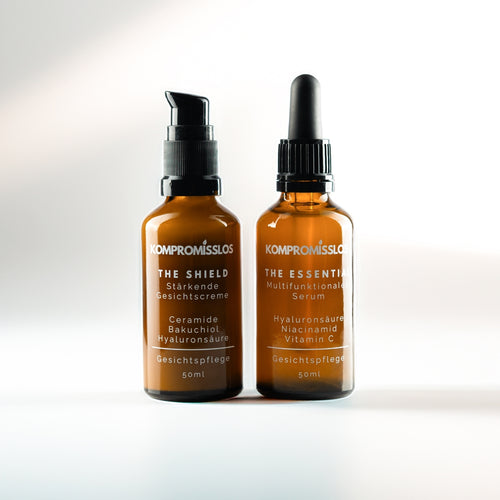
You can assess a face cream for women over 65 by looking at four points in the ingredient list, no expert knowledge needed. First, the first five positions: alongside water, there should be at least one oil or ester and one humectant, not just thickeners and emulsifiers. Second, alcohol: if Alcohol Denat. is near the top, the cream is rarely the right choice for dry skin at this age. Third, lipids: look specifically for ceramides, squalane, jojoba oil or shea butter, because these are exactly the building blocks that go missing when sebum production slows down. Fourth, length: a list of more than forty ingredients generally brings more potential for irritation than extra benefit, especially for sensitive skin. The Duo of The Essential serum and The Shield cream contains 2% hyaluronic acid, 5% niacinamide, 2% vitamin C as 3-O-ethyl ascorbic acid and 0.3% bakuchiol, plus ceramides, squalane, panthenol, jojoba oil and vitamin E without a stated percentage.
All percentages refer to the Duo as a whole and never to a single product. You will find the full breakdown under the ingredients of our two products.
How to introduce a new cream over 65 without overwhelming your skin
Over 65, introduce a new cream over four weeks and change nothing else in your routine during that time. The reason is practical: at this age, the skin barrier takes longer to recover after being stressed. If you switch cleanser, cream and serum all at once and your skin reacts, there is no way of telling afterwards what caused it. So start using the new cream in the evening and keep your usual cleanser. Apply it while your face is still slightly damp after washing, because that gives the moisture binder something to bind. Expect tightness and flaking to ease noticeably after two to four weeks at the earliest, because that is how long the outermost layer of skin takes to renew itself. Anything that is still stinging or causing redness after six weeks isn’t right for your skin.
- Week 1: new cream in the evening only, leave all other steps unchanged.
- Week 2: also apply the cream in the morning, keep pausing exfoliants.
- Week 3: adjust the amount, 3 to 6 pumps depending on how tight your skin feels.
- Week 4: take stock, and only then change anything else.
Our routine: first 3 to 6 drops of serum, then 3 to 6 pumps of cream, morning and evening. That is what our two-step routine is built for; one bottle lasts 2 to 4 months. The order is explained on our page on how to use the serum and cream.
Why 65 isn’t a biological threshold – and what you therefore don’t need to change
65 is an administrative date, not a turning point for your skin. In women, the big drop in sebum production happens much earlier. A review in Clinical and Experimental Dermatology describes the sebaceous gland as ageing in its own right: its activity depends on androgens, peaks in young adults and changes both structurally and functionally with chronological ageing. So the decline is gradual and linked to hormones, not to a birthday. That leads to an inconvenient but useful conclusion: if your skin isn’t tight, itchy or flaky, you don’t need a new product at 65. A cream your skin has tolerated well for years has a value that no new formula can replace overnight. Age labels on packaging are a marketing decision, not a formulation boundary, and switching products alone won’t win back a decade of change.
What is worth doing instead doesn’t cost an extra product: sun protection during the day and a cleanser that doesn’t strip your skin. What comes later is more about handling, as our article on facial skincare over 70 shows. If your whole body feels dry, our overview of dry skin in later life can help.
When skincare isn’t the right answer
Cosmetics care for your skin, but they are no substitute for a medical assessment. Make an appointment with a dermatologist if your skin has been itching for weeks despite consistent care, if fine cracks or weeping patches appear, if a spot won’t heal, if a mark changes in colour, size or the shape of its edge, or if the dryness coincides with starting a new medication. Changes like these need to be checked by a doctor, not covered up with more skincare. Over 65 there is also the fact that other health conditions and medications can change your skin without anything being wrong with your skincare. If in doubt, take the ingredient lists of your products along to the appointment – that helps more there than any product description. If a specialist prescribes a particular basic skincare product, it takes priority over any cosmetic. And if you are starting from scratch, the basic routine for mature skin is the easier place to begin.
When someone in this age group writes to me, it is almost never about the best cream, but about whether a switch is needed at all. My answer is always the same: first tell me what your skin is doing, then we can talk about products. That’s why we don’t have a version for over-60s or one for over-70s. Between 55 and 75, the sensible formula hardly changes; what changes is the amount you use and how well your skin tolerates it. That is why I chose 0.3% bakuchiol instead of retinol – thinner skin often pays the price for retinol with flaking – and why the cream comes in a pump dispenser rather than a jar.
Frequently asked questions
What skincare does skin need over 65?
Skin over 65 needs a lipid-rich basic moisturiser, a moisture binder and sun protection during the day. In practice, that means ceramides, squalane and plant oils in the cream, plus hyaluronic acid and niacinamide as active ingredients. More products rarely bring more results, but they do more often bring more irritation.
Do I need to change my face cream at 65?
No, a switch is only necessary if your skin shows signs that last for two to three weeks. These include tightness shortly after moisturising, recurring fine flakes, stinging with familiar products or persistent redness. If your skin stays calm, your current cream is still the right one.
What ingredients should a face cream for over-65s contain?
Skin-identical lipids such as ceramides and squalane, a moisture binder such as hyaluronic acid and a barrier-supporting active ingredient such as niacinamide all make sense. The Duo of serum and cream contains 2% hyaluronic acid and 5% niacinamide, based on both products together. Alcohol near the top of the ingredient list is a poor sign.
Is a serum worth adding to your cream over 65?
Yes, as long as the cream and serum do different jobs. The serum carries water-soluble active ingredients such as hyaluronic acid and niacinamide into the upper layers of the skin; the cream provides the lipids and keeps the moisture there. Two products are enough; a longer routine brings no additional benefit.
How long does it take for a new cream to make a difference over 65?
Allow two to four weeks for tightness and flaking to ease noticeably, as that is how long the outermost layer of skin takes to renew itself. A more even complexion tends to show after eight to twelve weeks. If your skin is still stinging after six weeks, the product isn’t right for you.
Is retinol still worth it over 65?
Retinol remains a well-researched active ingredient, but it is more often poorly tolerated on thinner skin. Bakuchiol is considered a gentler alternative and is in the Duo at 0.3%, based on the serum and cream together. If you have tolerated retinol well for years, there is no reason to stop using it.
Is a more expensive face cream worth it over 65?
The price tells you little about whether a cream suits you; the ingredient list and how long it lasts tell you a lot. The Duo costs CHF 109.90 and lasts 2 to 4 months, which makes a monthly comparison more honest than the shelf price. What matters most is whether you use it every day.
Sources
- Zouboulis CC, Boschnakow A. Chronological ageing and photoageing of the human sebaceous gland. Clinical and Experimental Dermatology, 2001. Source