Skincare for men: what is actually different and what isn’t
SKINCARE FOR MEN
Skincare for men differs less from everyone else’s than the shelves suggest. Men’s skin is thicker and oilier on average, but the biggest difference day to day is shaving. That is why you do not need a separate product line, just gentle cleansing, moisture, a supported barrier and daily sun protection. Four steps instead of eight.
Is men’s skin really different from women’s skin?
Yes, in measurable ways – and no, in almost all the ways that affect your skincare. The differences are well documented: in a reference study in the British Journal of Dermatology, collagen content and dermal thickness were measured in a large number of healthy people. Collagen content decreased with age and was lower in women at every age, and there was a direct relationship between collagen content and skin thickness. So men’s skin is, on average, thicker and richer in collagen. On top of that comes higher, androgen-dependent sebum production, which many men know as shine on the forehead and nose. That sounds like a reason for separate products, but it is not. Thickness and the amount of sebum change nothing about what binds water, what supports the barrier and what protects against UV. Why the condition of your skin matters more than any fixed category is explained in the article on the subject. What matters is how your skin is reacting today, not which sex is on your passport.
What does shaving do to your skin?
With every stroke, shaving removes part of the uppermost layer of the skin and so briefly weakens the skin barrier. That is exactly what has been measured: in an exploratory study in Skin Research and Technology, ten healthy men shaved their forearm, cheek and neck with an electric razor for 60 seconds. Twenty minutes later, transepidermal water loss was significantly increased, accompanied by greater blood flow, although the extent varied from one area of skin to another. After 24 hours, most values were back to baseline. That explains two everyday observations at once: why your skin feels tight and stings straight after shaving, and why it recovers on its own if you let it. It only becomes a problem if you shave every day and follow it with an alcohol-based aftershave. Then the barrier never gets a chance to settle. What a weakened skin barrier means in practice is explained in the article on the subject.
A customer wrote to me that he wet-shaves every day and had had red, burning skin on his neck afterwards for years. He assumed it was simply part of shaving. What changed things for him was not mainly the product but the order: rinse with cool water, drop the alcohol-based aftershave, apply moisture straight away and seal it with a cream on top.
It is important to distinguish between an irritated shaving area and genuine blemishes. Ingrown hairs on the neck look similar to spots but are caused mechanically. What lies behind blemish-prone skin is explained in the article on the subject.
Do men need their own skincare products?
No. No active ingredient works differently on men’s skin than on women’s, and no formula knows who is applying it. What sets men’s skincare on the shelf apart from other skincare almost always comes down to three things: fragrance, packaging and texture. The fragrance is more austere, the bottle darker, the texture lighter. The first two are marketing. The third at least makes sense, because oilier skin often copes better with a light texture than with a heavy cream. But a light texture is not a men’s issue, it is a skin issue, and oily skin exists in every sex. The real difference is rarely the formula but the willingness to apply anything at all. That is why a short routine you stick with achieves more than a perfectly tailored product left in the cupboard. We list exactly which substances are in ours under ingredients in detail.
| What men’s skincare often says | What is behind it | What actually matters |
|---|---|---|
| Specially for tougher male skin | A reference to skin thickness that does not change the formula | Whether the formula provides moisture and supports the barrier |
| Refreshing menthol kick | A cooling sensation from irritating substances | Whether your skin is calmed rather than irritated after shaving |
| 2 in 1, shower gel and face wash | A surfactant system made for the body, not the face | A gentle cleanser that does not strip lipids |
| Non-greasy, mattifying | Light texture, often with alcohol to help it evaporate | Whether the light texture manages without drying additives |
What does a minimal skincare routine for men look like?
Four steps are enough for the vast majority: cleanse, apply moisture, seal, and protect against UV during the day. You only need more if there is a specific reason. This order works whether you shave every day, wear a beard or alternate between the two. The most common mistake in men’s skincare is not the wrong product but going straight from cleansing into the day with nothing in between. The skin is washed, stripped of lipids and then left to its own devices. The second most common mistake is using shower gel on your face: it is made for the skin on your body and strips the thinner skin of the face of more lipids than it can replace in the short term. The third is a high-alcohol aftershave on freshly shaved skin. All three cost nothing to drop. Which cleanser really suits your skin is explained in the article on the subject. This is what the order looks like in practice:
- In the morning, wash with lukewarm water and a gentle cleanser.
- If you shave: rinse with cool water afterwards, no alcohol-based aftershave.
- Apply a serum to skin that is still slightly damp, three to six drops.
- On top, a cream, three to six pumps, to seal everything in.
- Sun protection during the day, all year round and not just in summer.
- In the evening, the same order without sun protection.
Why you need both steps is explained in the article comparing serum and cream side by side. Amounts are given on the page on how to use the two products.
Why the Duo is deliberately formulated to be gender-neutral
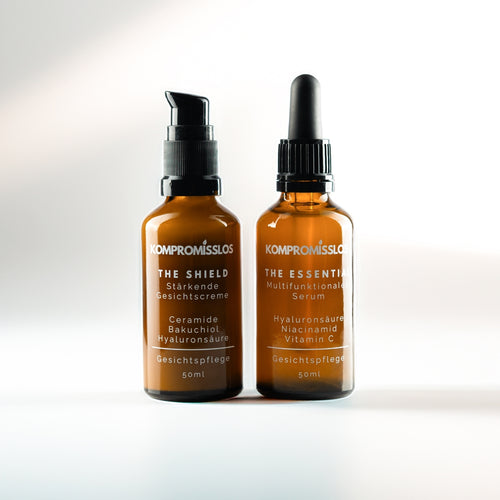
Because there is no sensible line to draw that would not be arbitrary. Kompromisslos has two products, the Duo of serum and cream for CHF 109.90, and both are intended for any skin that needs moisture and a stable barrier. The concentrations are disclosed and refer to The Duo as a whole, not to an individual product: 5 per cent niacinamide, 2 per cent hyaluronic acid, 2 per cent vitamin C as 3-O-ethyl ascorbic acid, 2 per cent edelweiss extract, 2 per cent gentian root extract, 1 per cent zinc and 0.3 per cent bakuchiol. In addition there are ceramides, squalane, panthenol, jojoba oil, aloe vera, vitamin E and tamarind seed extract, with no stated proportion. None of these substances behaves differently on oily skin just because it belongs to a man. What niacinamide does for the skin is explained in the article on the active ingredient. Depending on how often you use it, one bottle lasts two to four months.
When skincare is not enough and a professional is the better choice
Cosmetics can influence how your skin looks; they replace neither diagnosis nor treatment. There are situations in which a cream is the wrong tool. These include persistent redness with visible broken capillaries, weeping or very itchy patches, deeply inflamed nodules that leave scars, recurring ingrown hairs with painful bumps on the neck, and any mole that changes in colour, size or outline. The last point is particularly relevant for men, because the back and the nape of the neck are hard to check yourself and a second pair of eyes sees more there. In all these cases, your skin should be checked by a dermatologist, and before any new skincare is added. That applies even if the area does not hurt. An acutely irritated phase is not a good time to start either: if your skin is currently burning or flaking, calm it down first. What sensitive skin really needs is described in the article on the subject.
I am regularly asked whether I would like to launch a men’s line. The answer is no, and the reason is an uncomfortable one: I would have nothing to change in the formula, only on the label. That is exactly what I did not want. When I developed the Duo, the brief was that two products had to work for very different skin, because I did not want to stock six variants. What I did instead was keep the texture of the cream lighter than a pure dry-skin product would have needed. Oilier skin benefits from that too, without me having to print a second label. My father uses the same Duo as my mother, and for me that is the most honest test.
Frequently asked questions
Do men need their own facial skincare?
No. No active ingredient works differently depending on sex, and no formula knows who is applying it. What sets men’s skincare apart on the shelf is usually fragrance, packaging and a lighter texture. It makes sense to choose according to the condition of your skin: oily skin copes better with a light texture, dry skin with a richer one.
Is men’s skin really thicker than women’s?
On average, yes. In a reference study in the British Journal of Dermatology, collagen content was lower in women at every age, and collagen content and skin thickness are directly related. For skincare this changes little: moisture, a supported barrier and sun protection remain the basics, whatever the thickness of your skin.
What helps with irritated skin after shaving?
Rinse with cool water, avoid alcohol-based aftershave and apply moisture straight away while your skin is still slightly damp. Then seal it with a cream on top. Measurements show that water loss increases after shaving and usually returns to normal within 24 hours, as long as the skin is not irritated further.
How many products does a man need for his face?
Four steps are enough for the vast majority: a gentle cleanser, a serum for moisture and active ingredients, a cream to seal it all and sun protection during the day. More only makes sense if there is a specific reason. A short routine that happens every day achieves more than an elaborate one that fizzles out after two weeks.
When should men start using skincare?
As soon as you notice something that does not go away on its own: tightness after washing, redness after shaving, shine on the forehead and nose, or dehydration lines in the morning. There is no particular age. Sun protection is the only step that is worth taking every day, regardless of any concerns.
Is a moisturiser enough for men?
For moisture and protection, often yes. As soon as you want to change something about how your skin looks, it is no longer enough, because creams can only carry a limited amount of active ingredients at meaningful concentrations. That is when a serum underneath comes in. Without a specific goal, the cream on its own remains the more sensible and cheaper choice.
Sources
- Shuster S, Black MM, McVitie E. The influence of age and sex on skin thickness, skin collagen and density. British Journal of Dermatology, 1975. Source
- Chaturvedi P, Kroon W, Zanelli G, Worsley PR. An exploratory study of structural and microvascular changes in the skin following electrical shaving using optical coherence topography. Skin Research and Technology, 2024. Source