Skin cycling: is the rotation method worth it or is a steady routine enough?
COMBINING ACTIVE INGREDIENTS
Skin cycling is a rotation plan for your evening routine: one night of exfoliation with an acid, one night of retinoid, then two nights of nothing but hydration and barrier care, after which the cycle starts again. It makes sense above all if you already use a retinoid and an exfoliating acid and want your skin to tolerate both better. Without these active ingredients, there is nothing to rotate. In that case, a steady, low-irritation routine, morning and evening, that you stick to consistently is enough.
What is skin cycling?
Skin cycling is a fixed evening schedule in which strong active ingredients are not used every evening but on separate nights, broken up by nights given over purely to recovery. The term does not come from research but from social media, where it spread as a skincare trend. The idea behind it is easy to follow: retinoids and exfoliating acids are among the best-researched active ingredients in cosmetics, but they are also the most likely to cause irritation. A review in Clinical Interventions in Aging notes that irritant reactions such as burning, scaling or dermatitis limit how well retinoids are accepted, although retinol and retinaldehyde are considerably less irritating than tretinoin or tazarotene. Skin cycling spreads this strain across the week instead of repeating it every evening.
A search of the medical literature database PubMed for the term skin cycling turns up no study that examines the scheme as a whole (as of October 2026). The individual building blocks are well researched, but the rhythm of exactly four nights is a rule of thumb, not a finding from comparative studies. Viewed objectively, skin cycling is therefore neither an active ingredient nor a method in its own right, but a calendar. It can help you avoid overdoing things. What it cannot do is make a retinoid any more effective than it already is.
How does the four-night skin cycling plan work?
The classic skin cycling plan repeats every four nights: night 1 is for exfoliation, night 2 for the retinoid, and nights 3 and 4 are for recovery. Nothing changes in the morning – cleansing, moisturising and sun protection stay the same every day. On exfoliation night, you apply an acid product after cleansing and finish with a moisturiser. Which acid is right for this depends on your skin, and that is exactly what the overview of AHA, BHA and PHA and which acid suits which skin type explains. On retinoid night, cleansing is followed by a small amount of retinoid and then a cream, leaving out the sensitive areas around the eyes and the corners of the mouth. On the two recovery nights, you only use products that bind moisture and support the skin barrier – no acid and no retinoid. The heart of the plan therefore lies less in the active nights than in the breaks between them.
| Night | Focus | Typical products | What to watch out for |
|---|---|---|---|
| Night 1 | Exfoliation | Acid serum or acid toner, followed by a moisturiser | No additional exfoliant, no retinoid on the same night |
| Night 2 | Retinoid | Retinol, retinal or a prescription retinoid, followed by a cream | A small amount; avoid the corners of the eyes and mouth |
| Night 3 | Recovery | Hydrating serum, cream with lipids such as ceramides or squalane | No exfoliating active ingredients |
| Night 4 | Recovery | As night 3 | If you notice burning or flaking, add further recovery nights |
The plan is not set in stone. Many people extend the recovery phase to three or four nights or drop the acid night altogether. Which active ingredients can sit alongside it on retinoid night and which cannot is covered in detail in the article on what to mix with retinol.
Who is skin cycling worth it for?
Skin cycling is worth it for you if you use, or want to use, a retinoid and an exfoliating acid and your skin reacts to frequent use with dryness, flaking or burning. For this group, the calendar is a useful tool: it reliably separates the two most irritating steps and builds in breaks without you having to decide afresh every evening. A second benefit concerns routines that have grown over time. If you have five or six products with active ingredients in your bathroom, it is easy to lose track of what goes on when. A fixed rhythm brings some order to that. The downside of complex routines is shown by a survey of 168 Dutch dermatologists and dermatology trainees in the journal Clinical, Cosmetic and Investigational Dermatology: 88.1 per cent regularly see skin problems linked to skincare products, with retinoids and exfoliating acids among those frequently named. Only 12.5 per cent actively recommended multi-step routines.
Skin cycling is unlikely to be worth it if you use neither a retinoid nor an acid. Most other skincare active ingredients do not need rest nights, as the overview on combining skincare ingredients shows. Introducing a calendar for products your skin tolerates every day anyway makes your routine more complicated without improving anything.
Is skin cycling a good idea for mature or sensitive skin?
For mature skin, skin cycling can make sense, whereas for sensitive skin the classic plan is often already too packed. Mature skin is often drier and recovers more slowly. If you want to use a retinoid on mature skin, the built-in recovery nights work in your favour, but it is better to stretch the cycle than to shorten it. Sensitive skin is a different matter. Writing in Acta Dermato-Venereologica, a working group of the International Forum for the Study of Itch defines sensitive skin as a syndrome with unpleasant sensations such as stinging, burning, pain, itching or tingling in response to stimuli that should not normally provoke such sensations. For this kind of skin, an acid and a retinoid within four days are often too much. A more realistic approach is to drop the acid night, plan several recovery nights after each retinoid night and only shorten the gap once your skin has stayed calm for weeks. How to tell that your skin is no longer just adjusting but overwhelmed is explained in the article on retinol side effects and warning signs. If you have been diagnosed with rosacea or have persistent redness, discuss retinoids and acids with a dermatologist first.
Keep a short skin diary for the first four weeks: which night, which product and how your skin feels the next morning. If even a plain moisturiser burns when you apply it, that is a sign to extend the recovery phase, not to push through.
Does skin cycling work without retinol?
Without retinol, skin cycling works on paper, but it loses its main purpose. The plan was designed to separate two groups of active ingredients that are prone to causing irritation. Take away the retinoid and you are left with one acid night and three recovery nights. That is simply the long-standing advice to exfoliate only occasionally rather than every day, under a new name. Some people replace the retinoid night with a vitamin C serum or a niacinamide product. That does not usually need rotating either, because most skin types tolerate these active ingredients every day. Bakuchiol is considered a gentler alternative: in a randomised study in the British Journal of Dermatology with 44 participants, 0.5% bakuchiol twice daily and 0.5% retinol once daily over 12 weeks reduced wrinkle surface area and pigmentation with no statistically significant difference between them, but the retinol group reported scaling and stinging more often (more on this in the comparison bakuchiol or retinol for sensitive skin). The simple rule still applies: an active ingredient your skin tolerates every day does not need rest nights. Skin cycling without a retinoid is therefore usually a calendar with nothing to do.
When is a steady routine the better choice?
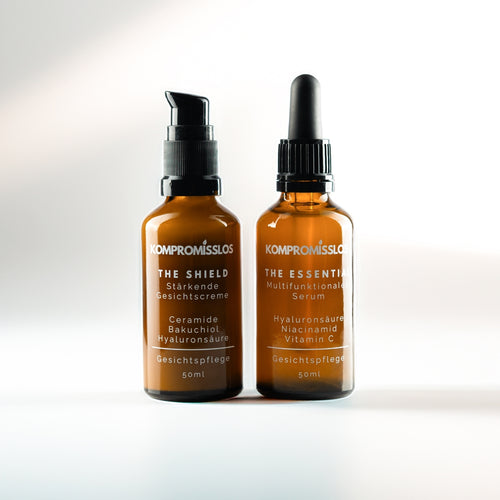
A steady routine is the better choice if you use neither a retinoid nor an acid, if your skin is sensitive, or if a calendar stresses you out more than it helps. Skincare works through repetition. A routine that looks the same every morning and every evening is easy to keep up even on evenings when you are tired, when travelling or during hectic weeks. A four-night plan, on the other hand, requires you to know which night you are on, and it tempts you to double up after a missed night. Our article on a minimalist skincare routine explains how few products you need for this, and a separate article covers which skincare step goes where in the morning and evening. The Duo of serum and cream is designed as exactly this kind of alternative: two products, used the same way morning and evening, with no retinoid or acid nights. In a review on Judge.me, Silas writes: “The skincare routine is super simple and therefore ideal for me, as I don’t feel like spending a lot of time in the bathroom” (review translated from German).
- You use neither a retinoid nor an acid: a steady routine, no rotation plan needed.
- You use a retinoid but no acid: a retinoid night plus several recovery nights, otherwise the same skincare every day.
- You use both and your skin does not tolerate them well: skin cycling as a framework, with recovery nights planned generously.
- Your skin burns even with gentle skincare: cut back on active ingredients first and get it checked, then build up again.
I made a conscious decision to use bakuchiol instead of retinol in The Shield cream and not to include an exfoliant in our range. That has a consequence I am open about: The Duo does not need a rotation plan, it needs consistency. Both products are made for daily use, morning and evening, so there is no night that has to be kept free. What the Duo cannot do: it does not replace a retinoid your dermatologist has prescribed, nor an acid if you want to exfoliate in a targeted way. If you use both, skin cycling is a sensible framework, and the Duo has its place in the morning and on recovery nights. We disclose which active ingredients the two products contain and at what concentrations.
Frequently asked questions
Do I need new products for skin cycling?
No, as a rule you do not. Skin cycling is a calendar for products you already own: a retinoid, optionally an exfoliating acid, and a gentle moisturiser for the recovery nights. Special skin cycling sets are not necessary. If you do not have a retinoid, first work out whether you need one at all before you go shopping for a trend.
Can I use bakuchiol instead of retinol?
Yes, but then the rotation plan loses part of its point. Bakuchiol is considered better tolerated and was applied twice daily in the comparative study mentioned above. An active ingredient that suits daily use does not need a night of its own. Which active ingredients go well alongside it and which you should use at different times is covered in the article on combining bakuchiol.
What do I do on recovery nights?
On recovery nights, you cleanse gently and only apply skincare that binds moisture and supports the skin barrier. Typical choices are a serum with humectants and a cream with lipids such as ceramides or squalane. Acids, retinoids and exfoliants stay off your skin on these nights. You do not need anything more – not even an extra mask.
Does skin cycling make sense in the morning too?
No, skin cycling only applies to the evening. In the morning, your routine stays the same every day: cleansing, skincare and sun protection. If you use retinoids or acids in particular, you should not skip sun protection. A second rotation in the morning only makes the routine harder to stick to.
How long does skin cycling take to work?
Skin cycling itself does not do anything – it simply spreads out active ingredients. How quickly you see results depends on the retinoid, and that takes patience. The comparative study in the British Journal of Dermatology followed retinol over 12 weeks. So allow around three months before you judge the plan.
Is skin cycling too much for skin prone to redness?
Often, yes – at least in its classic form with an acid and a retinoid within four nights. For skin that reddens easily, it makes more sense to drop the acid night and plan considerably more recovery nights. If the redness persists or your skin burns even with gentle skincare, have it checked by a doctor before you try any further active ingredients.
Does The Duo work with skin cycling?
Yes, as skincare for the morning and for recovery nights, because the Duo contains no retinoids and is not an exfoliant. If you use neither a retinoid nor an acid, however, you do not need a rotation plan: simply use The Duo the same way morning and evening. It does not contain sun protection, so add a separate sunscreen during the day.
Sources
- Mukherjee S, Date A, Patravale V, Korting HC, Roeder A, Weindl G. Retinoids in the treatment of skin aging: an overview of clinical efficacy and safety. Clinical Interventions in Aging, 2006. Source
- Poelhekken M, van der Bent SAS. Dermatologists' Perspectives on Skincare Routine Trends. Clinical, Cosmetic and Investigational Dermatology, 2026. Source
- Misery L, Ständer S, Szepietowski JC, Reich A, Wallengren J, Evers AW et al. Definition of Sensitive Skin: An Expert Position Paper from the Special Interest Group on Sensitive Skin of the International Forum for the Study of Itch. Acta Dermato-Venereologica, 2017. Source
- Dhaliwal S, Rybak I, Ellis SR, Notay M, Trivedi M, Burney W et al. Prospective, randomized, double-blind assessment of topical bakuchiol and retinol for facial photoageing. British Journal of Dermatology, 2019. Source