Serum vs ampoule vs essence: what’s the difference and what do you actually need
ROUTINE
Serum vs ampoule vs essence: the difference lies mainly in packaging, texture and how you use them, not in a fixed amount of active ingredient. Ampoule, booster, essence, concentrate and serum are not protected terms. An ampoule is usually a serum in small portions for a short course, a booster is a concentrate for mixing into other products, and an essence is a thin, watery layer that goes on before your serum. Only the active ingredients and their disclosed concentrations tell you whether a product can do more. For most routines, one well-formulated serum is enough.
Serum, ampoule, booster or essence: what’s the difference?
The difference between an ampoule, a booster, an essence and a serum lies in the format and the intended use, not in any binding strength. A serum is a light, usually watery or gel-like skincare product containing active ingredients, applied after cleansing and before your cream. An ampoule is essentially the same thing, just filled into small, often individually sealed portions and intended for a limited period. Hydrating ampoules for the face are therefore usually nothing more than hydrating serums in course format. A booster is a small bottle containing one or a few active ingredients that you mix into your cream or serum. An essence is best known from Korean and Japanese skincare and sits somewhere between water and serum in consistency. And ‘concentrate’ is a catch-all word for anything that is meant to sound like more. The categories overlap considerably: a concentrate can contain less active ingredient than an ordinary serum, and an essence can do more than an ampoule. The table shows how the terms are most commonly used by retailers.
| Term | Typical format | Intended use | What the name does not guarantee |
|---|---|---|---|
| Serum | Bottle with a dropper or pump | Daily, morning and evening, before your cream | A specific amount of active ingredient |
| Ampoule | Single doses or small glass vials | A course lasting a few days or weeks | A higher concentration than a serum |
| Booster | Small bottle holding a few millilitres | A few drops mixed into cream or serum | That the mixture has been tested as such |
| Essence | Watery liquid, often in a larger bottle | A thin layer after cleansing | An active ingredient of its own |
| Concentrate | Varies | Varies | Anything specific at all |
Are these terms regulated or just marketing?
The terms are not regulated: no rule specifies how much active ingredient an ampoule, a booster or a serum has to contain. They are marketing categories that describe a type of packaging and an idea of how to use it. The rules the EU has laid down for cosmetic claims come in at a different point. Under Regulation No 655/2013, if a product is advertised with an ingredient, that ingredient must be deliberately present. Anyone who attributes an ingredient’s properties to the finished product needs evidence to back that up – the regulation cites proof that the substance is present at an effective concentration as one example. What gets scrutinised, then, is the claim about the active ingredient, not the word on the box. Whether a manufacturer calls its product an ampoule, an elixir or a concentrate tells you nothing about that.
The sheer number of names is mainly down to the logic of product ranges. Every new category is a new step, and every step is another product in your bathroom cabinet. This is particularly visible in Korean routines, where essence, ampoule and serum are applied one after the other. The guide to Korean skincare and what the 10-step routine does and doesn’t do takes a closer look at which of those steps actually pull their weight.
What is an ampoule treatment, and does it do more than a serum?
An ampoule treatment does not automatically do more than a serum, because at its core it is simply a serum used in single portions over a limited period. Its real advantage lies in the packaging. Some active ingredients are sensitive to air and light, the best-known example being pure vitamin C. A review in the Journal of Cosmetic Dermatology describes how the instability of this water-soluble vitamin and the difficulty of getting it into the skin pose problems for formulators. A freshly opened, airtight single dose is one answer to that. Another is a more stable form of vitamin C that works in an ordinary serum.
The catch is the timescale. Studies on active ingredients measure their effects over weeks and months, not over a single week. In a study in Dermatologic Surgery, 50 women applied 5% niacinamide to one half of the face twice a day for 12 weeks, with measurements taken at four-week intervals. What a course of a few days can noticeably deliver is moisture: your skin feels smoother and looks plumper. Once you stop, the effect fades again. A course is therefore no substitute for skincare you use consistently.
What is a booster for?
A booster is meant to add a single active ingredient to your existing skincare, for example a few drops of niacinamide or vitamin C stirred into your cream. That sounds flexible, but it has two weak points. First, you do not know the final concentration. How much active ingredient reaches your skin depends on how many drops you mix into how much cream. Second, you change the formulation. A review in the International Journal of Cosmetic Science shows that the type of emulsion, the emulsifier and the emollient oils can influence how well an active ingredient gets into the skin. Mix two products and you create a third one that neither manufacturer has tested in that form.
A booster makes sense if your cream suits you well and you are missing just one particular active ingredient. If you are missing several, a serum that contains them together from the outset is usually the simpler solution. The underlying question is how many products your skin really needs, and the answer is rarely ‘just one more’.
Do you need an essence if you already use a serum?
If you already use a serum, in most cases you do not need an essence. An essence mainly delivers humectants in a very thin layer. If your serum already contains glycerin, hyaluronic acid or similar humectants and is followed by a cream, that combination already does the job. The essence then mainly adds texture and one more ritual, but no new function. The article on whether you really need both serum and cream explains whether the two are enough for you on their own.
There is one exception: if your serum consists almost entirely of a single active ingredient and contains hardly any humectants, an essence can fill that gap. Often, though, a different serum is a better choice than an extra product. And if you do apply several layers, the rule is thinnest to thickest. Exactly where each step belongs is explained in the overview of which skincare step goes where in the morning and evening.
How can you tell whether a product really contains more active ingredient?
The only way to tell whether a product really contains more active ingredient is from disclosed percentages and the ingredient list, not from the product name. Five checks will help you:
- Percentage per active ingredient: ‘5% niacinamide’ is a verifiable claim, ‘highly concentrated’ is not.
- Position in the ingredient list: under the EU Cosmetics Regulation, ingredients are listed in descending order of weight. Substances below 1 per cent may follow in any order. If an active ingredient appears far down the list, it is usually present only in a small amount – exactly how much, the list does not reveal.
- Comparison with studies: is the stated concentration within the range used in research?
- Stable form and suitable packaging: sensitive active ingredients need a stable variant or packaging that keeps out air and light.
- Price per application rather than per pack: small bottles look cheap but often cost considerably more per millilitre.
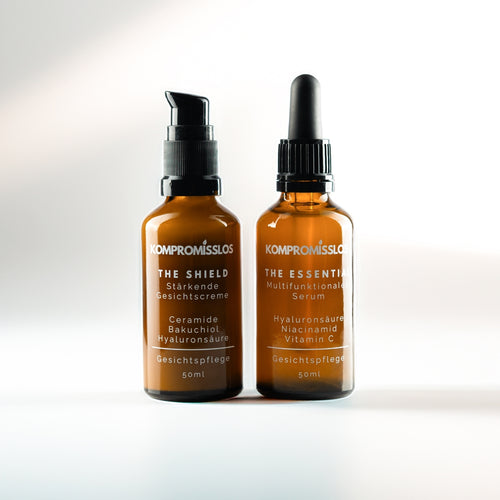
One example of a serum with several active ingredients is The Essential, the serum in the Duo. It combines niacinamide, vitamin C in the stable form 3-O-Ethyl Ascorbic Acid, and zinc PCA. For The Duo of serum and cream as a whole, the concentrations are disclosed: 5% niacinamide, 2% vitamin C as 3-O-Ethyl Ascorbic Acid and 1% zinc PCA in total. That is not a promise of results, but it is a figure you can compare with studies like the one mentioned above. In her review on Judge.me, Andrea G. writes about the two products: ‘Just two products that bring together everything you need’ (review translated from German). How to judge a serum against criteria like these is shown in the guide on how to recognise the best serum for mature skin.
Before you buy another bottle, line up the products you already own and mark the active ingredients on their ingredient lists. Anything that appears twice, you do not need a third time. Whatever is missing is the only gap worth buying a new product for.
I could easily have turned our serum into three products: an ampoule treatment, a niacinamide booster and an essence. I deliberately decided against it. Kompromisslos consists of two products instead of eight, a serum and a cream, and the concentrations are out in the open: 5% niacinamide, 2% vitamin C and 1% zinc PCA, calculated for The Duo as a whole. For the vitamin C, I chose the stable 3-O-Ethyl form. What I cannot promise you is that two products will answer every question. The Duo does not contain sun protection, so you need that separately during the day. What each individual ingredient does is explained on our page listing all active ingredients and their concentrations.
Frequently asked questions
Are ampoules more concentrated than serums?
Not necessarily. The term ampoule is not tied to any minimum concentration; it mainly describes packaging in single portions and use as a short course. Some ampoules contain more active ingredient than a typical serum, others less. Products can only be compared on the basis of disclosed percentages and the ingredient list, not by their name.
Can I combine a serum and an ampoule?
Yes, as long as the active ingredients do not double up and your skin stays calm; the thinner product goes on first. How to go about it and when one is enough is explained in the article on layering multiple serums.
Is an essence the same as a toner?
Not quite: an essence is usually slightly thicker and is meant to deliver moisture or active ingredients, whereas a classic toner is more about removing residue – although the two categories overlap these days. Whether you need an in-between step like this is covered in the article on when a toner is worth it and when it’s a wasted step.
Is an ampoule treatment worth it before a special occasion?
A course can be pleasant for a few days of noticeably more moisture, but you should not expect more than that. Your skin looks plumper for as long as you use it. Do not try out a new product just before the occasion, though: if your skin reacts with redness, there is no time left for it to calm down. Skincare you already know is the better choice.
Why are ampoules often more expensive per millilitre?
Ampoules are often more expensive per millilitre because each small portion comes with its own packaging, frequently made of glass or with an airtight seal. On top of that, positioning them as a course makes a higher price seem plausible. So always work out the price per application or per month before comparing them with a serum.
Are boosters suitable for sensitive skin?
Boosters tend to be tricky for sensitive skin, because you set the final concentration yourself and mix two formulations that have not been tested together. Introduce new active ingredients one at a time and watch how your skin responds over a few weeks. If redness or burning persists, or if you have a known skin condition, the question belongs with a dermatologist.
Do I need ampoules or boosters if I use The Duo?
No. The Duo is designed so that two steps follow cleansing: serum and cream, morning and evening. Niacinamide, vitamin C and zinc PCA are already in the serum, with disclosed concentrations for the Duo. An extra ampoule or booster would lengthen your routine and double up on active ingredients without adding anything essential to the Duo.
Sources
- Bissett DL, Oblong JE, Berge CA. Niacinamide: A B vitamin that improves aging facial skin appearance. Dermatologic Surgery, 2005. Source
- Stamford NP. Stability, transdermal penetration, and cutaneous effects of ascorbic acid and its derivatives. Journal of Cosmetic Dermatology, 2012. Source
- Otto A, du Plessis J, Wiechers JW. Formulation effects of topical emulsions on transdermal and dermal delivery. International Journal of Cosmetic Science, 2009. Source
- Europäische Kommission. Verordnung (EU) Nr. 655/2013 zur Festlegung gemeinsamer Kriterien zur Begründung von Werbeaussagen im Zusammenhang mit kosmetischen Mitteln. Amtsblatt der Europäischen Union, 2013. Source
- Europäisches Parlament und Rat. Verordnung (EG) Nr. 1223/2009 über kosmetische Mittel, Artikel 19. Amtsblatt der Europäischen Union, 2009. Source