Beauty advent calendar: when it’s worth it and when two full-size products do more
SWISS BUYING GUIDE
A beauty advent calendar is worth it if you enjoy unwrapping something every day and want to try new products with no commitment. As a skincare purchase, it is rarely worth it. The stated value is a projection based on full sizes you would never have bought, and many minis only last a few days with daily use. That is too short to judge a product fairly. If you are looking for a routine that does something for your skin over weeks, two full-size products you actually use up add up to the more honest calculation.
Is a beauty advent calendar really worth it?
A beauty advent calendar is worth it mainly as an experience and only rarely as an investment in your skin. What you are buying is a ritual: 24 little surprises at the darkest time of the year. It is fine for that to be worth something to you. Just do not confuse it with skincare. A typical calendar mixes make-up, body care, hair care, fragrance and a few face products. In the end, only a small part of that counts for your skin, and even that part usually comes in a size that is enough for a first impression, but not for a routine. So the useful question is not whether the calendar is worth the money, but how many of the 24 doors you would also have bought individually. If the answer is three or four, the rest of your money goes on packaging and anticipation. That is a legitimate decision, as long as you make it deliberately. The overview below helps you work out where you stand.
| Your situation | The better fit | Why |
|---|---|---|
| You look forward to unwrapping something every day | Advent calendar | The ritual is the real value, not the quantity |
| You want to get to know textures and brands | Advent calendar | Minis are enough for a first impression |
| You are looking for skincare for dry or sensitive skin | Two full sizes | Tolerance takes days, visible results take weeks |
| You react to fragrance | Two fragrance-free full sizes | Mixed calendars often contain fragranced products |
| Your routine already works | Neither | Here, new products mostly just unsettle things |
How meaningful is the stated value?
The stated value tells you roughly what the contents would cost in full size, but not how useful they are to you. The total usually includes products you would never have bought: the lipstick in the wrong shade, the hair mask for a different hair type, the shower gel with a scent you do not like. On paper, they are part of the value; in practice, they end up in a drawer. On top of that, a high stated value comes from the number of doors, not from the amount per product. How much is actually in each little bottle is rarely printed as prominently on the box as the total value. For an honest calculation, turn the perspective round and ask what is left once you only count what you really need:
- Cross out every product you would not use even if it were free.
- For face care, only count what suits your skin type.
- Compare millilitres rather than doors, meaning the amount you actually apply.
- Check whether a product is even available in full size, in case you like it.
What is left after this calculation is the value it actually has for you. It is almost always well below the value printed on the box. The same scepticism is worth applying to crossed-out prices, for example with Black Friday skincare.
Can you tell from minis whether a product suits your skin?
With most minis, you can judge the texture, the scent and your first impression, but not whether a product suits your skin. That comes down to the amount. In its guidance on the safety assessment of cosmetics, the EU’s Scientific Committee on Consumer Safety works with 1.54 grams of face cream per day. At that rate, a 5-millilitre mini is empty after about three days. That is tight even for the question of tolerance. In the so-called repeated open application test, which dermatologists use to check for contact allergy under everyday conditions, the authors of the foundational paper in the journal Contact Dermatitis applied the substances twice a day for seven days, unless a reaction appeared earlier.
When it comes to visible changes in your complexion, the time falls even further short. Studies on active ingredients run for weeks: in a study in Dermatologic Surgery, 50 women applied a formula with 5% niacinamide twice a day for twelve weeks to one half of the face, while the other half received the same base without niacinamide. There is also a practical problem: if you open a different product every day in December, you can no longer attribute redness or a better skin feel to any single one of them.
What should you look out for in an advent calendar if you have sensitive skin?
If you have sensitive skin, the first things to check in an advent calendar are fragrance and how many new products end up on your face at the same time. Fragrances are among the known triggers of contact allergy. A study in the British Journal of Dermatology patch-tested around 3,100 randomly selected adults from five European countries and conservatively estimated the prevalence of fragrance contact allergy at 1.9 per cent, with rates in women about twice as high as in men. That sounds like very little, but it affects precisely the people who are most unlucky with a calendar full of fragranced surprises. A fragrance-free advent calendar is therefore the better choice if your skin reacts easily. You can read more about the causes in our guide to sensitive skin. Here is how to check a calendar before you buy it:
- Look up the ingredient lists of the individual products, if the brand publishes them.
- Highlight parfum, fragrance and essential oils, as well as individually declared fragrance ingredients such as limonene, linalool or citronellol.
- Set aside fragranced face products straight away, or use them on your hands and body.
- In December, start no more than one new face product, not a different one every day.
Natural skincare is not automatically fragrance-free. Essential oils can contain the same fragrance ingredients that are also found in synthetic perfumes, such as limonene or linalool. What matters is the ingredient list, not the label on the calendar.
What happens to the products you do not use?
The products you do not use usually end up in a drawer, get passed on or are eventually thrown away, and that is exactly where the maths of an advent calendar falls apart. Opened minis only keep for a limited time, and unopened samples are rarely used up as quickly as you intend to in December. Then there is the packaging: 24 separate containers, lids and boxes for a few millilitres of product per door. Anyone who looks into sustainable natural skincare sooner or later arrives at the same conclusion: the biggest lever is not better packaging, but buying fewer products and using them up. In her review on Judge.me, Jacqueline writes: “And the bathroom cabinet is no longer a jungle of products” (review translated from German). If you are wondering how many products your skin really needs, the answer is usually smaller than an advent calendar would suggest.
What is the alternative if you want to treat yourself?
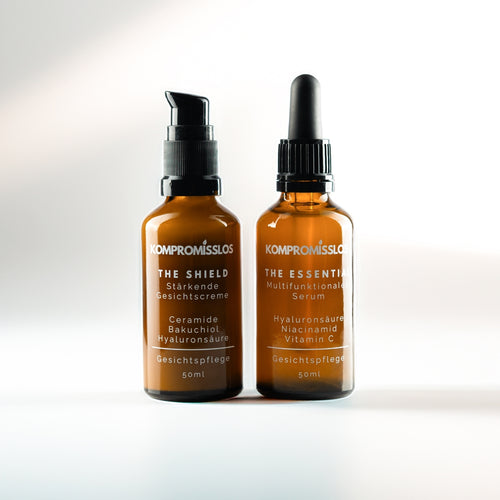
If you want to treat yourself, two full-size products that you use consistently for weeks will do more for you than 24 minis. For many skin types, a combination of serum and cream is all it takes: the serum delivers water-binding active ingredients, while the cream holds in moisture and protects. That is exactly how The Duo with serum and cream is put together, as the counter-model to the calendar: two products you actually use up, fragrance-free and with disclosed concentrations, including 5% niacinamide, 2% vitamin C as 3-O-Ethyl Ascorbic Acid and 1% zinc PCA. Used twice a day, the two together last around two months, which is long enough to see how your skin responds to a skincare routine.
And you can keep the ritual you like about the calendar: those few minutes in the morning and evening are a small break too, just without the cardboard. If the skincare proves itself, the question of restocking comes up later. Whether a subscription or a one-off purchase suits you better then depends on how much you use; there is more on this in our guide skincare subscription or one-off purchase.
I deliberately chose two products instead of eight, and for the same reason I do not offer a sample box. Minis are too small to judge a skincare product fairly. A few millilitres show you a texture, but not how your skin feels after a few weeks. That is why The Essential and The Shield come in full size, both fragrance-free, together with a 100-day return policy, so that you can test them at your own pace. To me, that is more honest than 24 doors, many of which go unused. I disclose which active ingredients are in them and in what concentration, on our page about all the active ingredients in The Duo. What I do not promise you is that two products will make every skin happy. But you can try them for long enough to judge for yourself.
Frequently asked questions
Are advent calendars good for skincare beginners?
An advent calendar is only of limited use as a way into a routine. It shows you lots of textures, but no sequence of products that work together, and only a few days with each one. If you are just starting out, you will learn more from two products designed to work together that you use morning and evening for a few weeks.
How long do samples last once opened?
Opened samples last as long as the symbol with the open jar and the number of months on the packaging indicates. If there is no symbol or you are unsure, our guide to skincare shelf life after opening will help.
Is a natural skincare advent calendar gentler on the skin?
Not automatically. Natural skincare often does without synthetic fragrances, but frequently uses essential oils instead, which can contain the same allergenic fragrance components. For sensitive skin, what counts is therefore not the label, but the ingredient list of each individual product. A product without perfume or essential oils is the calmer choice.
What is the best way to test minis one after another?
Only ever test one new face product at a time, and give it several days before adding the next one. If you start on a small area, you will see a reaction before your whole face is affected. Our guide on how to patch test skincare shows you how to do this at home, step by step.
Is an advent calendar a good gift?
An advent calendar makes a good gift if the person receiving it enjoys trying things out and does not have sensitive skin. For someone with an established routine or clear needs, a single, well-chosen product usually goes down better. What to look out for is covered in our guide to a skincare gift that actually gets used.
Can I combine calendar products with my routine?
Yes, as long as you do not change your whole routine at once. You can easily try body care, hand cream or make-up. For face care, replace no more than one step with the mini and keep the rest as it is. Be careful with acids, retinol or exfoliants if your routine already contains similar active ingredients.
Is The Duo an alternative to an advent calendar?
Yes, if what you care about is your skin rather than 24 surprises. The Duo consists of a full-size serum and a full-size cream, fragrance-free and with disclosed concentrations. Used twice a day, it lasts around two months, which is enough time to judge fairly whether the two products in The Duo suit your skin.
Sources
- Diepgen TL, Ofenloch R, Bruze M, Cazzaniga S, Coenraads PJ, Elsner P, et al. Prevalence of fragrance contact allergy in the general population of five European countries: a cross-sectional study. British Journal of Dermatology, 2015. Source
- Hannuksela M, Salo H. The repeated open application test (ROAT). Contact Dermatitis, 1986. Source
- Bissett DL, Oblong JE, Berge CA. Niacinamide: a B vitamin that improves aging facial skin appearance. Dermatologic Surgery, 2005. Source
- Scientific Committee on Consumer Safety (SCCS). The SCCS Notes of Guidance for the Testing of Cosmetic Ingredients and their Safety Evaluation, 12th Revision (SCCS/1647/22). European Commission, 2023. Source