Black Friday skincare deals: what’s actually worth buying and how to spot fake discounts
SWISS BUYING GUIDE
Black Friday skincare deals are only worth it if you buy a product you already know, that suits your skin and that you will use up in the foreseeable future. Then a genuine discount is money saved. With new products, large stockpiles and sets full of things you do not need, a bad buy quickly cancels out the discount. You can tell whether a discount is genuine from the prices in the weeks before, not from the crossed-out price. In 2026, Black Friday falls on Friday 27 November.
Are Black Friday skincare deals worth it at all?
Black Friday skincare deals are worth it for products that already have a fixed place in your routine, and hardly for anything else. The reason has less to do with the discount than with you: a cream you put aside after two weeks is too expensive even at a third off. A cream you would buy again anyway genuinely becomes cheaper with a real price reduction. On top of that, the sale day itself is not automatically the cheapest moment of the year. The British consumer organisation Which? tracked the prices of 175 home, tech and health appliances at eight retailers over a whole year. 83 per cent of the products were the same price or cheaper at least once outside the four-week Black Friday sales period. Cosmetics were not part of this analysis, and the figures come from the UK. Even so, the underlying pattern carries over: many retailers run recurring promotions all year round, and November is simply the loudest of them.
This question often gets mixed up with another one: whether a higher regular price means better skincare in the first place. For that, it is worth looking at what you are really paying for in a face cream.
How can you spot a fake discount on skincare?
You can spot a fake discount when the crossed-out price is not the price you would actually have paid in the weeks before. The crossed-out price is the strongest sales argument on any promotion page. A meta-analysis in the Journal of Retailing pooled studies on price presentation and shows that the way a discount is presented changes the perceived saving, regardless of how much you actually save. A displayed regular price is one of the elements that make an offer look more attractive. That is exactly why it pays to check the reference price rather than simply believe it. Skincare comes with a few tricks of its own, such as a supposed retail value for sets that is calculated on full-size products. How misleading that can be becomes especially clear when you ask whether a beauty advent calendar is worth it.
- The reference price is a recommended retail price that shops hardly ever charge.
- The discount is “up to” a percentage that only a single product reaches.
- The set has a high stated value but contains items you would never buy.
- The pack size is smaller than the standard product, so the price per millilitre is barely lower.
- A countdown or “only 3 left” pushes you to buy before you have had a chance to compare.
What are the rules for crossed-out and reference prices in Switzerland?
In Switzerland, a shop may only show one of its own earlier prices as a reference price if it actually offered the product at that price. This is set out in Article 16 of the Price Disclosure Ordinance (PBV), and SECO explains the rules in an information sheet on what is known as self-comparison. There are two variants. Under the older halving rule, the reference price may be shown for at most half as long as it previously applied, and for no more than two months. Since 1 January 2025, there has also been the 30-day rule: if a shop has offered a product at the same price for at least 30 consecutive days, it may use that price as a comparison indefinitely and for all further, consecutive price reductions. If it raises the price again after a reduction, it has to drop the reference price. At the request of the cantonal enforcement authority, the seller must credibly demonstrate that the conditions are met. A recommended retail price is only permitted as a reference price if most other sellers actually sell the product at that price. For you, this means a crossed-out price can be entirely lawful and still not have applied for months. This is context for your shopping, not legal advice.
A control campaign by SECO and the cantons in 2021 shows why it is worth taking a closer look. In online shops, 644 items from the areas of home furnishings, sporting goods and consumer electronics were checked, and 13 cases were reported to the authorities. Of the comparisons with a recommended retail price, 119 out of 163 were classed as incorrect or not credibly substantiated.
| What the shop shows | What it can mean | What you check |
|---|---|---|
| “Was” price (halving rule) | The price applied immediately before, and the promotion is limited in time | What the product cost in the weeks before the promotion |
| “Was” price (30-day rule) | The price once applied for at least 30 days, but that may have been a long time ago | Whether you have ever seen the crossed-out price in the shop yourself |
| Recommended retail price | A manufacturer’s price, not a price charged by this shop | What the same product costs at other retailers |
| Stated value of a set | Individual prices added up, often based on full sizes | What the items you would actually use cost |
Which skincare should you avoid buying on Black Friday?
On Black Friday, it is better not to buy skincare you have never used, experimental active ingredients or quantities you will not use up before they expire. With a new product, you do not know whether your skin will tolerate it. The discount tempts you to go straight for the large pack, or two at once, and that is precisely the most expensive combination if your skin reacts with irritation. If you do want to try something new, you can patch test a new face product at home before using it on your whole face every day. High-strength acids or retinoids that you only pick up because of the price, even though your routine does not need them, are just as risky. If your skin does not tolerate them, they end up half full in the cupboard. Skincare for a skin problem that really needs to be checked out is not a good sale purchase either: persistent redness, inflammation or eczema are a question for a dermatologist, not for your shopping basket.
Also check whether you can return a product at all. In Switzerland, for opened cosmetics, that depends on the shop’s terms. So before you click “buy”, you should know your real rights when returning skincare bought online.
Is it worth stocking up on skincare?
Stocking up on skincare is only worth it in quantities you will safely use up within the shelf life, and only for products you have been using for some time. There are two kinds of shelf-life information to look for on the packaging. According to an information sheet from the Cantonal Laboratory of Bern, a product with a minimum durability of less than 30 months must carry a best-before date. If the minimum durability is more than 30 months, this date is not mandatory. Instead, there is a symbol in the shape of an open jar with a number, for example 6M or 12M. It indicates how long the product can be used safely after opening. For a stockpile, this means unopened packs usually keep for a long time, but the clock starts ticking the moment you open them.
So before you buy, work out how many packs you realistically need. If you use a cream twice a day, it runs out faster than if you use it once a day, and serum and cream are used up at different rates. You can find out how to calculate this properly in the article on how long 50 ml of face cream lasts. A stockpile for more than a year is rarely worth it for facial skincare, because your skin changes too: what suits it in winter may be too rich in summer.
Write the opening date on the pack with a waterproof pen. Store unopened packs somewhere cool and dry, out of direct sunlight, not in a humid bathroom next to the shower.
How do you prepare your Black Friday shopping so it genuinely pays off?
The best way to prepare your Black Friday shopping is two to three weeks in advance, with a list and with prices written down. If you only compare on the day itself, you are comparing against the shop’s crossed-out price, not against the price you saw yourself. Start in the bathroom: what is sitting there half used, and what do you genuinely need to replace? This stocktake is usually more sobering than any price research. If your routine consists of two products, you do not need a basket full of individual items on Black Friday, at most refills of those two. In her review on Judge.me, Gabriela K. writes about her routine: “I really appreciate not having to use umpteen creams” (review translated from German). If you look at customer reviews for a new product, it helps to know which star ratings are worth trusting.
- Check what you have: what is open, what is unopened, and what have you not touched for months?
- Write a list: only products you know, that suit your skin and that you use up.
- Note down prices: at the start of November, record the current price and pack size of each product.
- Compare the price per millilitre, not the percentage discount.
- Read the returns policy before you pay.
- Set a budget and stop once the list is done, even if the basket keeps making suggestions.
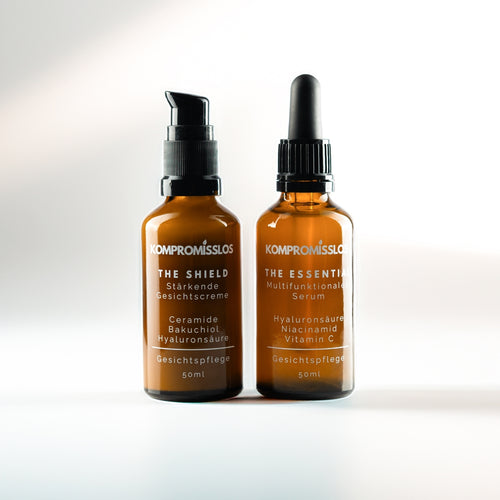
If you want to simplify your routine anyway, you do not have to tie that to a sale day. The Duo of serum and face cream is exactly that kind of two-product routine. Because it comes with a 100-day right of return, you can try it without time pressure and decide at your own pace.
I built Kompromisslos on two products instead of eight, and that applies in November too. I do not want you to buy stockpiles or sets on Black Friday with products you do not need. To be honest, The Duo cannot do everything either: I do not sell a toner, an exfoliant or a sunscreen. So you still need a separate sunscreen. Rather than working with time pressure, I opted for a 100-day right of return, so that you do not have to decide on a single Friday whether a product suits your skin. And before you reorder, it is worth checking how long the two products last in your routine. Depending on how you use them, that is two to four months.
Frequently asked questions
When is Black Friday 2026 in Switzerland?
In 2026, Black Friday falls on Friday 27 November and Cyber Monday on Monday 30 November. Many shops start their promotions days earlier and stretch them over the weekend or longer. So note down your comparison prices at the start of November, before the first sale pages go live.
Are discounts on sets better than on individual products?
Discounts on sets are only better if you actually use every item in the set. Compare the set price with the total of the individual products you would have bought anyway, not with the stated value. A set with two products you need is often better value than one with five, three of which go unused.
Does a Black Friday discount on a new product make sense?
A discount on a new product only makes sense if you can return it or if a bad buy is something you can live with. In that case, buy a single pack rather than a stockpile and test the product on a small patch of skin first. Whether it suits your skin only becomes clear after a few weeks, not in your shopping basket.
Can I return Black Friday purchases?
That depends on the shop, not on the sale day. In Switzerland, there is no general statutory right of return for online purchases; what counts are the retailer’s terms. Some do not take back sale items or opened cosmetics. So read the returns policy before you pay, not once the parcel has arrived.
Are discounts in foreign online shops cheaper than in Switzerland?
Not necessarily, because with orders from abroad, Swiss VAT and the parcel service’s customs clearance fees may be added, depending on the value of the goods. So compare the final price delivered to your door, not the sale price shown in the foreign shop.
What is a realistic discount on skincare?
There is no fixed figure, and the percentage says little. What matters is the gap to the price you saw yourself in the weeks before. A small discount on a genuine regular price is worth more than a large one on a reference price that was hardly ever charged. So look at the final price, not the percentage.
Is The Duo worth buying on Black Friday?
The Duo is worth it if you want a streamlined routine of serum and face cream and need the refill anyway. If you are new to it, there is no need to start on a sale day, because with a 100-day right of return you can test it at your own pace. Sunscreen, cleanser and exfoliant are not included. You will find the active ingredients and formulation on The Duo product page.
Sources
- Staatssekretariat für Wirtschaft SECO. Informationsblatt Preisbekanntgabeverordnung (PBV; SR 942.211) – Selbstvergleich. SECO, Bern. Source
- Staatssekretariat für Wirtschaft SECO. PBV-Kampagne 2021: Preisvergleiche im Online-Warenhandel – Ergebnisse. PBV-Tagung, 2021. Source
- Krishna A, Briesch R, Lehmann DR, Yuan H. A meta-analysis of the impact of price presentation on perceived savings. Journal of Retailing, 2002. Source
- Which?. Don’t believe the hype: most Black Friday deals the same price or cheaper at other times of the year. Which? Policy and Insight, 2025. Source
- Kantonales Laboratorium Bern. Kennzeichnung von Kosmetika. Merkblatt KL 3.1.25, Version 2, 2021. Source