Combining panthenol: which active ingredients go with it and which order matters
INGREDIENT COMBINATION
Combining panthenol works with practically every common skincare ingredient. Niacinamide, vitamin C, hyaluronic acid, ceramides, squalane and bakuchiol can all be used in the same routine, because panthenol is water-soluble, doesn’t compete for any receptor and doesn’t need to be separated in time. The only thing that matters is the order: light textures first, rich ones last.
Combining panthenol: why there is almost never a conflict
Panthenol is one of the least problematic partners in skincare, because it doesn’t exfoliate, doesn’t shift the pH and doesn’t compete with other active ingredients for the same target. It sits in the water phase of a formulation, binds moisture in the outermost layer of the skin and supports the barrier’s recovery. This effect is documented, among other sources, in a review in the Journal of Dermatological Treatment, which summarises a study in which a cream with 5 per cent dexpanthenol was applied twice a day for seven days to experimentally damaged skin and measurably improved barrier function and the moisture content of the outer skin layer compared with the base cream alone. What else panthenol does for your skin is covered in our article on what panthenol does and how to use it. For combining, that means: nothing to separate, nothing to alternate, no rest days. The only open question is the order of textures. How the other active ingredients get on with each other is explained in our overview of ingredient combinations.
| Combined with panthenol | In the same routine | What to watch |
|---|---|---|
| Niacinamide | Yes | Both water-soluble, often in the same formulation |
| Vitamin C | Yes | Vitamin C serum first, panthenol product on top |
| Hyaluronic acid | Yes | Both bind water; a lipid layer on top is part of the deal |
| Ceramides | Yes | Panthenol first, the lipid-rich layer afterwards |
| Squalane | Yes | Squalane as the last layer, otherwise nothing else gets through |
| Bakuchiol | Yes | No need to separate them in time |
| AHA and BHA | Yes, one after the other | Acid first, then panthenol as the caring layer |
Can you use niacinamide and panthenol together?
Yes, niacinamide and panthenol are one of the most straightforward pairings of all, and they appear side by side in many formulas anyway. Both are water-soluble, both sit in the same phase of a formulation, and there is no known interaction between them. In terms of what they do, they divide the work neatly: niacinamide acts on oil production, pores and evenness, panthenol on hydration and the barrier. That is also why sensitive skin often tolerates this pairing better than niacinamide on its own. If your skin tingles slightly while it gets used to it, panthenol is rarely the cause. You don’t need separate products for this, and if both are in the same formula, the question of order disappears altogether. If you apply two products, the usual logic applies: the lighter one first, the richer one on top. Separating them in time, as with some acid combinations, is neither necessary nor sensible here. What the active ingredient can do in detail, and how long it takes, is covered in our article on what niacinamide does.
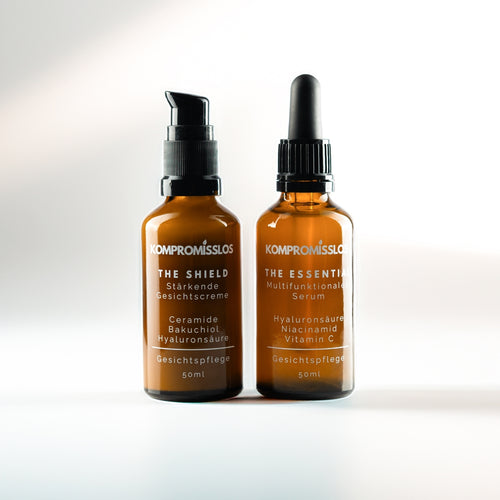
In The Duo of The Essential serum and The Shield cream, 5% niacinamide and panthenol are already part of the same routine. All percentages refer to the Duo as a whole, not to a single product.
Can you use vitamin C and panthenol together?
Yes, vitamin C and panthenol can be used in the same routine without any problem, and the order is: light vitamin C serum first, panthenol product on top. On the skin, the two don’t deactivate each other. The warning about this combination that you often read comes from formulation, not from application: pure ascorbic acid needs a much more acidic environment than a normal cream, and in such an environment panthenol is less stable over months. That is an issue for the manufacturer putting both into the same bottle, not for you when you apply two products one after the other. Stabilised forms are more relaxed on this point, because they don’t depend on a strongly acidic environment. How 3-O-ethyl ascorbic acid differs from pure ascorbic acid is broken down separately. In practice, panthenol is actually helpful alongside vitamin C, because it softens the feeling of tightness some people notice in the first few weeks.
Can you use hyaluronic acid and panthenol together?
Yes, but this combination adds less than its popularity suggests, because both ingredients do the same job. Hyaluronic acid and panthenol are both humectants: they draw water into the upper layers of the skin and hold it there. Two humectants on top of each other don’t double this effect; they only add to it slightly. If your skin still feels tight despite a hyaluronic acid serum, what is usually missing is the layer on top that stops the bound water from evaporating again. A second hydrating product won’t solve that. In dry, centrally heated air, a routine of two humectants without a lipid-rich final layer can even make the tightness worse. So the pairing only makes sense as a three-step chain: offer moisture, bind moisture, seal moisture in. In the Duo, 2% hyaluronic acid and panthenol sit side by side, complemented by lipids that take care of the third step. The full list of active ingredients shows what else is in it.
Can you combine ceramides and squalane with panthenol?
Yes, and this is the most sensible combination for panthenol of all, because it brings together two different jobs rather than the same one twice. Panthenol binds water in the outer layer of the skin; ceramides and squalane slow down how quickly that water is released again. Without the second part, some of the first is wasted. The order follows from the texture and is not up for negotiation: panthenol is usually in the water-based serum and goes on first, followed by the lipid-rich product with ceramides or squalane. The other way round, the light product can barely get through the layer of fat. There is no need to separate them in time, and no need to alternate between days either. Apply the serum to skin that is still slightly damp, because panthenol binds water that has to be there in the first place. In very dry indoor air, this point matters more than any additional product. What squalane does on the surface of your skin is described separately.
Both partners have their own articles, because they are in turn combined with a great many things: which active ingredients go with ceramides and which partners bakuchiol works with. The logic of the order is the same in both cases as it is here.
When you don’t need panthenol, and when to see a professional
You don’t need panthenol if your skin doesn’t feel tight after washing, isn’t rough and takes new products in its stride. A stable barrier doesn’t become more stable because another humectant is added. It also makes little sense to buy an extra panthenol product when your serum and cream already contain the ingredient, because then you are paying twice for the same job. And there is a clear line where dermatology takes over: persistent redness, weeping or heavily flaking patches, itching that disturbs your sleep, and skin changes that alter in shape or colour need to be checked by a doctor rather than handled with a skincare routine. The same applies if you suspect a contact allergy or already have a skin condition under medical care, in which case a professional decides what else can go on your skin. Cosmetics care for the appearance of your skin and support the skin barrier, but they replace neither diagnosis nor treatment.
Panthenol would have been the most obvious product extension I could have made. A soothing add-on serum, easy to formulate, easy to sell, and nobody would have objected. I decided against it, for exactly the reason behind this article: panthenol is the ingredient that causes the fewest headaches when it comes to combining. That also makes it the weakest reason to bring a third product into a routine. It belongs in the foundation, not in an extra. How the two layers follow each other day to day is explained in the guide to using our products.
Frequently asked questions
Can you use bakuchiol and panthenol together?
Yes, bakuchiol and panthenol go together without restriction and don’t need to be separated in time. Both are insensitive to pH and work in different places. Panthenol alongside it takes the edge off the adjustment phase, should tightness occur after all. In the Duo, 0.3% bakuchiol and panthenol are already part of the same routine.
Do you need to separate panthenol and retinol in time?
No, and the combination is actually particularly useful. In the first few weeks, retinol makes the outer layer of the skin more permeable; dryness and fine flaking are typical. Panthenol cushions exactly that. Apply retinol first to dry skin and the panthenol product on top – on the evenings without retinol, too.
In what order do you apply panthenol in your routine?
Panthenol goes on early, because it is usually in the water-based serum. The order is: cleanse, serum on skin that is still slightly damp, then the richer cream. In the morning, finish with sun protection. If the panthenol is in your cream rather than your serum, nothing changes in this logic.
Can you combine panthenol with AHA or BHA?
Yes, one after the other in the same routine. Apply the acid first, leave it briefly to work and then follow with the panthenol product. The other way round, a caring layer would sit between the acid and your skin. If your skin feels irritated after the peel, panthenol is a better companion than another active ingredient.
Is D-panthenol better than DL-panthenol?
For the physiological effects, yes. According to BASF’s technical information, only D-panthenol is converted into vitamin B5 in the body, which is why the racemic DL mixture only achieves half the activity there. For the pure moisture-binding effect, both forms are considered equivalent. The INCI list often simply says panthenol.
Does an extra panthenol product help if your serum and cream already contain it?
Usually not. Panthenol doesn’t depend on the dose to such an extent that a third layer does noticeably more. An additional product makes sense at most for specific spots, such as very dry areas or after a cosmetic treatment. A routine with few steps rarely gets better with an extra product.
Is panthenol in cosmetics vegan?
Panthenol used in cosmetics is made synthetically; BASF’s technical information explicitly states a synthetic origin as its raw-material basis. So no animal-derived starting materials are involved. Even so, the formula as a whole is what counts, because a product with vegan panthenol may contain beeswax or lanolin elsewhere.