Tranexamic acid vs niacinamide: what tranexamic acid does for dark spots and when to use which
ACTIVE INGREDIENTS
Tranexamic acid in a cream or serum can soften the look of dark spots by damping down the signals UV light uses to switch on pigment production. The evidence is encouraging but thin, and it comes almost entirely from studies on one particular pigmentation disorder that is partly driven by hormones. Tranexamic acid is not a replacement for niacinamide, but a different point of attack, and the two can be combined. Without daily sun protection, every one of these active ingredients is swimming against the tide.
What does tranexamic acid do in a cream?
Tranexamic acid in a cream steps in early in pigment production: it slows down the messengers the skin uses after UV exposure to drive pigment cells to make melanin. The ingredient started out as a medicine, a synthetic derivative of the amino acid lysine that stops blood clots from breaking down. It does this by inhibiting the formation of the enzyme plasmin – and plasmin also plays a role in the skin. As early as 1998, a study in the Journal of Photochemistry and Photobiology B showed that 2% and 3% solutions prevented or reduced pigmentation in guinea pigs after UV exposure. The authors’ explanation: less plasmin activity means fewer prostaglandins, so the pigment cells miss part of their start signal. A later study in humans also found that the messenger endothelin-1 was downregulated with tranexamic acid.
One thing to bear in mind: despite its name, tranexamic acid is not an exfoliating acid. It does not loosen dead skin cells and it does not bleach the skin. Rather than removing existing pigment, it cuts down the supply of new pigment. That is why it works slowly, and only for as long as you keep using it.
Is tranexamic acid good for your face?
Yes, tranexamic acid is suitable for the face, as long as you see it as an add-on and not as a substitute for sun protection. Because it does not exfoliate, it is considered one of the less complicated ingredients for pigmentation. Problems tend to come not from the ingredient itself but from the formula around it: fragrance, a lot of alcohol or a combination with strong acids in the same routine. If you have sensitive skin, try a new product on a small area for a few days first, for example along the jawline.
So the more honest question is not whether tranexamic acid is good for your face, but whether it suits your kind of spots. Freckles, sun spots, marks left behind by blemishes and larger, partly hormonal patches of discolouration are all different things. The overview of dark spots on the face explains which type you are dealing with. With clearly defined age spots after decades of sun, it is realistic to set your expectations of any cream low – including one with tranexamic acid.
What do studies show about tranexamic acid for dark spots?
Studies show that tranexamic acid applied to the skin can measurably reduce pigment, but mostly in small groups and in one particular, partly hormonal pigmentation disorder that is managed by a doctor. There is considerably less data for ordinary sun spots and age spots. In a study in Clinical and Experimental Dermatology, 23 participants applied a formulation containing 2% tranexamic acid to the whole face for twelve weeks. In 22 of the 23, the severity score improved significantly, and tissue samples showed less melanin in the epidermis. No comparison group without the active ingredient is described, and most participants had only a mild form.
A network meta-analysis published in the Journal of Cosmetic Dermatology in 2024 rests on a broader base. It compared tranexamic acid taken as a tablet, injected into the skin, combined with microneedling and applied topically. Compared with placebo, topical use showed a statistically significant difference from week 8, the tablet from week 4. In the long term, according to the authors, the effect of tranexamic acid on its own did not depend on how it was given. For you, that means allowing plenty of time and not expecting dramatic results after two weeks. How to recognise a sound formula is covered in the checklist for choosing a cream for dark spots.
Tranexamic acid vs niacinamide: which should you use when?
Tranexamic acid and niacinamide are not competitors, because they act at different points in the same chain. Tranexamic acid damps down the signal that starts pigment production. Niacinamide steps in later: it slows the transfer of finished pigment packages, the melanosomes, from the pigment cells to the surrounding skin cells. That is how a study in the British Journal of Dermatology describes it. In a cell model, niacinamide inhibited this transfer by 35 to 68 per cent. In a clinical test series within the same paper, 18 women used a moisturiser containing 5% niacinamide alongside a comparison cream without the active ingredient, and after four weeks niacinamide had reduced hyperpigmentation significantly more.
The practical difference lies elsewhere: niacinamide has been studied more widely and also supports the skin barrier, which matters particularly for sensitive skin. What else the ingredient can do is covered in the article on niacinamide benefits. Tranexamic acid is more of a targeted add-on if spots keep darkening again after sun exposure. A third approach is alpha arbutin, which acts directly on the enzyme tyrosinase.
| Active ingredient | Where it acts | Strength | Limitation |
|---|---|---|---|
| Tranexamic acid | Damps down the start signal for pigment production after UV exposure | Targeted at spots that keep darkening again | Small studies, mostly on one particular pigmentation disorder |
| Niacinamide | Slows the transfer of pigment to the skin cells | Widely studied, supports the skin barrier | Works slowly, effect tends to be moderate |
| Vitamin C | Antioxidant, influences melanin production | Also protects against oxidative stress | Pure form is unstable, stable derivatives needed |
Tranexamic acid or vitamin C: which makes more sense?
The one that makes more sense is the one that suits your routine and your skin: alongside its effect on pigment, vitamin C brings antioxidant protection, while tranexamic acid is more specifically focused on pigment production. A review in the Indian Dermatology Online Journal describes vitamin C as a potent antioxidant that is used topically against signs of photoageing and also for hyperpigmentation. But it also names the core problem: vitamin C is unstable and difficult to deliver in the right dose to the deeper layers of the skin, which is why researchers are looking for more stable compounds.
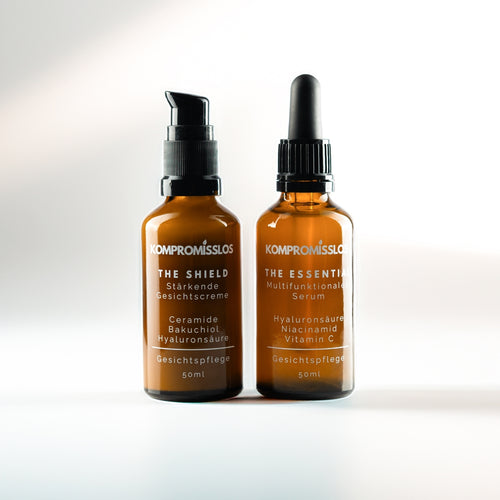
That gives you a simple rule of thumb. If you already use a serum with stable vitamin C and niacinamide, you do not necessarily need a third ingredient for pigmentation. Only if spots remain clearly visible despite consistent sun protection and a few months of patience is it worth trying tranexamic acid as an add-on. The Duo of serum and cream contains 5% niacinamide and 2% vitamin C as stable 3-O-Ethyl Ascorbic Acid in total, both for a more even-looking complexion. How to tackle an uneven complexion as a whole is covered in the article on uneven skin tone.
- Sort out sun protection first: every day, in a sufficient amount, even in winter when the light is bright.
- Then choose a well-researched core ingredient: niacinamide or stable vitamin C.
- Monitor for at least eight to twelve weeks, taking photos in the same light.
- Only then add something targeted, such as tranexamic acid.
When should you see a dermatologist about dark spots?
You should see a dermatologist about dark spots if they change, appear as larger symmetrical patches or if you are not sure what they are. A spot that grows, changes colour or shape, itches or bleeds needs to be checked before you try any cream. Larger, often symmetrical patches of discolouration on the cheeks, forehead or upper lip point to melasma. It is triggered by hormones, for example during pregnancy or while taking the pill, as well as by light, and it comes back easily.
This is exactly where most of the research on tranexamic acid comes from. The meta-analysis mentioned above found the strongest effect for tranexamic acid tablets combined with topical products. But tablets are a medicine that acts on blood clotting and belong in medical hands. With melasma, skincare can play a supporting role at most. The treatment plan is for the dermatologist to decide.
If you are starting with tranexamic acid, introduce only one new product for pigmentation at a time and take a photo in daylight beforehand. That way, after three months you will be able to see whether anything has changed – and you will also know which product was responsible.
There is no tranexamic acid in The Duo, and I am saying so openly because the ingredient is very much in demand right now. I chose niacinamide and vitamin C because both are well researched for a more even-looking complexion and can do more than just address pigment. I use vitamin C in its stable 3-O-Ethyl form, and I disclose the concentrations: 5% niacinamide and 2% vitamin C for The Duo as a whole. What the cream deliberately does not contain is an SPF. Sun protection belongs on your skin separately and in a sufficient amount, because without it your skin keeps producing new pigment. You will find the complete list under all the ingredients in The Duo.
Frequently asked questions
Is tranexamic acid available in Switzerland?
Yes, serums and creams with tranexamic acid are sold as cosmetics in Switzerland, both in shops and online. Check whether the concentration is stated, because without it a product can hardly be compared with the studies. Tablets, on the other hand, are a medicine and call for a medical consultation, not a shopping basket.
Can I combine tranexamic acid with niacinamide?
Yes, the two combine well because they act at different points in pigment production. Tranexamic acid damps down the start signal, while niacinamide slows the transfer of pigment to the skin cells. Many serums contain both ingredients. Apply the lighter product first and the richer one afterwards.
Is tranexamic acid suitable for sensitive skin?
Usually yes, because tranexamic acid does not exfoliate and is considered a comparatively uncomplicated ingredient for pigmentation. Irritation is more often caused by the formula than by the ingredient, for example by fragrance, a lot of alcohol or additional acids. Test a new product on a small area for a few days before using it on your whole face.
How long does tranexamic acid take to work?
Expect eight to twelve weeks. In a meta-analysis in the Journal of Cosmetic Dermatology on a partly hormonal pigmentation disorder, topically applied tranexamic acid showed a significant difference compared with placebo from week 8. Because the ingredient mainly slows the formation of new pigment, existing spots only fade as quickly as your skin renews itself.
Is tranexamic acid in skincare the same as in tablets?
It is the same molecule, but not the same use. In skincare, tranexamic acid works locally in the skin. As a tablet, it acts on blood clotting throughout the body and is therefore a medicine that is prescribed and monitored by a doctor. Tablets are not something to experiment with for dark spots.
Do I need sunscreen with tranexamic acid?
Yes, absolutely. Tranexamic acid damps down the pigment production that UV light triggers, but it does not keep UV light out. Without daily sun protection, new pigment keeps forming and the ingredient can hardly keep up. With dark spots, sun protection is the biggest lever – any serum comes second.
Does The Duo contain tranexamic acid?
No, The Duo does not contain tranexamic acid. For a more even-looking complexion, it relies on 5% niacinamide and 2% vitamin C in the stable 3-O-Ethyl form. If you want to use a tranexamic acid serum as well, apply it before the cream. During the day, add a separate sunscreen in any case, because The Duo does not contain an SPF.
Sources
- Maeda K, Naganuma M. Topical trans-4-aminomethylcyclohexanecarboxylic acid prevents ultraviolet radiation-induced pigmentation. Journal of Photochemistry and Photobiology B, 1998. Source
- Kim SJ, Park JY, Shibata T, Fujiwara R, Kang HY. Efficacy and possible mechanisms of topical tranexamic acid in melasma. Clinical and Experimental Dermatology, 2016. Source
- Liang R, Luo H, Pan W, Yang S, Peng X, Kuang B et al. Comparative efficacy and safety of tranexamic acid for melasma by different administration methods: A systematic review and network meta-analysis. Journal of Cosmetic Dermatology, 2024. Source
- Hakozaki T, Minwalla L, Zhuang J, Chhoa M, Matsubara A, Miyamoto K et al. The effect of niacinamide on reducing cutaneous pigmentation and suppression of melanosome transfer. British Journal of Dermatology, 2002. Source
- Telang PS. Vitamin C in dermatology. Indian Dermatology Online Journal, 2013. Source