Alpha arbutin: what it does for dark spots, how it compares with niacinamide and why face creams are capped at 2%
ACTIVE INGREDIENTS
Alpha arbutin inhibits tyrosinase, the enzyme your skin needs to make melanin, and can therefore soften the appearance of dark spots. The evidence for this comes mainly from cell cultures and skin models; studies in people using alpha arbutin as the only active ingredient are largely missing. At the permitted amounts it is considered safe. Because the molecule contains hydroquinone, the amount is capped: in the EU and in Switzerland, face creams may contain no more than 2 per cent alpha arbutin.
What does alpha arbutin do for your skin?
Alpha arbutin slows down the formation of new pigment by inhibiting tyrosinase, the key enzyme pigment cells use to produce melanin. Chemically, it is a hydroquinone molecule with a glucose molecule attached. The most frequently cited study comes from the research laboratory of a Japanese manufacturer and was published in Biological and Pharmaceutical Bulletin in 2004: in cultured human melanoma cells, 0.5 mM alpha arbutin reduced melanin production to 76 per cent of the level in untreated cells. In a three-dimensional skin model, the melanin content after treatment was 40 per cent of the control, without any damage to the cells.
These are laboratory figures, not measurements taken on real faces. A 2021 review in the journal Antioxidants also notes that studies disagree on whether alpha arbutin or classic arbutin inhibits tyrosinase more strongly. The author points to different enzyme sources, purity levels and test conditions as possible reasons. The only human studies the review lists for alpha arbutin combine it with other active ingredients or with laser treatment. Realistically, that means alpha arbutin is a plausible ingredient that has been well studied in the lab and mainly dampens the formation of new pigment. How much it lightens existing spots on its own has barely been studied in people.
Is alpha arbutin harmful?
At the permitted concentrations, alpha arbutin is not considered harmful. In January 2023, the EU’s Scientific Committee on Consumer Safety (SCCS) confirmed that it is safe at up to 2 per cent in face creams and up to 0.5 per cent in body lotions. This is set out in the recitals of Regulation (EU) 2024/996. The real concern behind the question is hydroquinone. Arbutin can partly break down into hydroquinone during storage and use. The review in Antioxidants names microorganisms on the skin and UV radiation as triggers and therefore recommends caution in the manufacture and use of products containing arbutin.
The regulation draws a clear conclusion from this: the hydroquinone content of products containing alpha arbutin must be kept as low as possible and must not exceed unavoidable traces. According to the same review, skin reactions are rare but do occur, including allergic reactions. If your skin burns, itches or turns red after a new product, stop using it and have the reaction looked at by a doctor rather than carrying on.
Why is alpha arbutin capped at 2 per cent?
Alpha arbutin is capped at 2 per cent because the SCCS confirmed its safety in face creams up to exactly that amount, and the European Commission turned this into a binding upper limit. Until 2024, neither alpha arbutin nor arbutin was regulated in the EU Cosmetics Regulation at all. Regulation (EU) 2024/996 of 3 April 2024 added both to Annex III, the list of substances that are only permitted with restrictions. The reasoning is stated plainly: above certain concentrations, their use poses a potential risk to human health. Since 1 February 2025, no new products exceeding the limits may be placed on the EU market. Since 1 November 2025, such products may no longer be made available there either.
| Substance (INCI) | Product type under the regulation | Maximum concentration | Additional condition |
|---|---|---|---|
| Alpha-Arbutin | Face cream | 2% | Hydroquinone only in unavoidable traces |
| Alpha-Arbutin | Body lotion | 0.5% | Hydroquinone only in unavoidable traces |
| Arbutin | Face cream | 7% | Hydroquinone only in unavoidable traces |
For Switzerland, this is more than a footnote. In Article 54, the Swiss Ordinance on Foodstuffs and Utility Articles explicitly refers to Annex III of the EU Cosmetics Regulation for restricted substances – in the version currently binding in the EU. The new limits therefore also apply to cosmetics sold here.
What does arbutin have to do with hydroquinone?
Arbutin and alpha arbutin are both hydroquinone with a sugar molecule attached. The only difference is the spatial form in which the glucose is bound. According to the review in Antioxidants, classic arbutin, also known as beta arbutin, occurs naturally in plants such as wheat, pears and bearberry. Alpha arbutin is made from hydroquinone by enzymatic or chemical means. Hydroquinone itself, at concentrations of 2 to 5 per cent, is prescribed as the main medical therapy for hyperpigmentation such as melasma. Arbutin has been seriously studied as an alternative for around 30 years.
What remains open is how much of the effect comes from the arbutin molecule itself and how much from small amounts of hydroquinone that form from it. The review states that most of the evidence points to arbutin having an effect of its own, but it does not rule out a contribution from hydroquinone. For you, the practical consequence matters more than the theory: according to the review, how much hydroquinone forms in a product also depends on its formulation and storage. A stably formulated product that you keep cool and dark and use up quickly is therefore the better choice.
Which dark spots is alpha arbutin worth using for?
Alpha arbutin is most likely to be worthwhile for flat, light brown spots caused by the sun or by healed inflammation that sit in the upper layers of the skin. How quickly anything changes depends very much on the spot; with dark spots on the face, you always need to allow several months. Melasma is a separate condition with a hormonal component and belongs with a dermatologist; cosmetics can at most play a supporting role.
- Worthwhile: sun spots and age spots, if you want to slow down further darkening.
- Worthwhile: brownish marks left by blemishes or irritation that are no longer inflamed.
- Not very worthwhile: deep, greyish-blue discolouration that cosmetics barely reach.
- Not something to tackle yourself: moles and spots that grow, itch, bleed or change colour. These belong with a specialist.
If what bothers you is an uneven skin tone overall rather than individual spots, it is often more helpful to look at how to get a more even complexion without make-up. And if you are torn between several brightening ingredients: tranexamic acid works through a different mechanism and is an ingredient in its own right, with its own body of research.
How do you spot alpha arbutin in the INCI list, and how much does a product contain?
In the ingredient list, alpha arbutin simply appears as ‘Alpha-Arbutin’ and classic arbutin as ‘Arbutin’. Bearberry leaf extract is listed as ‘Arctostaphylos Uva Ursi Leaf Extract’ and supplies arbutin via the plant, usually without a stated amount. As a rule, you have to look for the concentration itself on the front of the pack or in the product description, because the INCI list does not reveal it. The ingredients are listed in descending order of quantity, but the Swiss Ordinance on Cosmetic Products allows ingredients below 1 per cent by mass to be placed at the end in any order. If alpha arbutin appears near the end, that could mean 0.1 or 0.9 per cent.
If a facial product advertises more than 2 per cent alpha arbutin, a little scepticism is in order, because the SCCS has not confirmed higher amounts as safe for the face. With an alpha arbutin serum, also check whether it contains other brightening ingredients at the same time and whether the manufacturer states the concentration openly. What else to check in a cream for dark spots before you buy is a topic of its own.
Without daily sun protection, every pigment ingredient is working against the next dose of UV. If you want to try alpha arbutin, give it several months with consistent sun protection before you judge it.
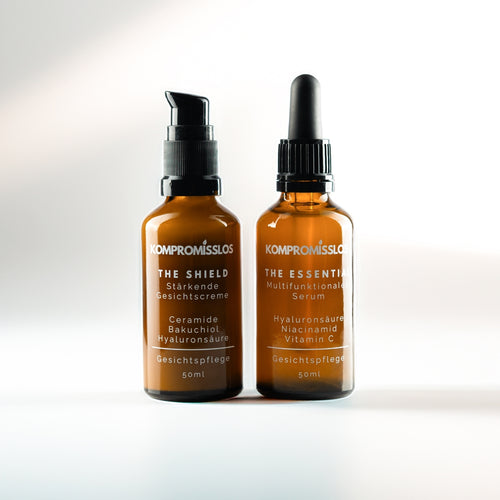
There is no alpha arbutin in the Duo – you can check that in the full list of our ingredients. For a more even-looking complexion, I chose two active ingredients whose amounts I can disclose: 5% niacinamide and 2% vitamin C, both figures for The Duo as a whole. For the vitamin C, I deliberately went for the stable form 3-O-Ethyl Ascorbic Acid, because an ingredient that breaks down in the bottle can no longer do anything on your skin. What the Duo does not have is a sun protection factor. That is intentional, but it also means you need a separate sunscreen during the day – otherwise you will not slow down new spots, whatever active ingredient your skincare contains.
Frequently asked questions
Alpha arbutin vs niacinamide: which is better?
Neither is better across the board; they work at different points. Alpha arbutin inhibits pigment production inside the pigment cell, while niacinamide, according to the studies so far, tends to slow the transfer of pigment to the surrounding skin cells and supports the skin barrier. The two can be combined. The Duo contains 5% niacinamide, but no alpha arbutin.
Can I combine alpha arbutin with vitamin C?
Yes, in principle there is nothing against it. Laboratory experiments summarised in a review even show that ascorbic acid can strengthen arbutin’s inhibition of tyrosinase, although this has not been confirmed clinically. If your skin is sensitive, it is better to introduce new active ingredients one at a time. Whether vitamin C should be your first step at all is covered in vitamin C or retinol: which should come first in your routine.
Is arbutin the same as alpha arbutin?
No. Both consist of hydroquinone and glucose, but the glucose is bound differently. Arbutin, also known as beta arbutin, occurs naturally in plants such as bearberry, whereas alpha arbutin is manufactured. Legally, too, they are two separate entries: arbutin is permitted in face creams at up to 7 per cent, alpha arbutin at up to 2 per cent.
Is alpha arbutin suitable for sensitive skin?
Usually yes; according to a review, skin reactions to arbutin are rare. They cannot be ruled out, though, and allergic reactions do occur. Test a new product on a small area, such as along your jawline, for a few days, and do not combine it on the same day with several other new active ingredients. If your skin reacts, stop using it.
Do I need sunscreen with alpha arbutin?
Yes – without daily sun protection, the effect largely fizzles out. UV radiation is the main trigger of new dark spots and, according to the review in Antioxidants, can also contribute to hydroquinone forming from arbutin. A broad-spectrum sunscreen in the morning is therefore a bigger lever than any brightening product in the evening.
Does the 2 per cent limit also apply in Switzerland?
Yes. The Swiss Ordinance on Foodstuffs and Utility Articles only permits restricted substances in cosmetics under the conditions of Annex III of the EU Cosmetics Regulation, in the version currently binding in the EU. This means the limits of 2 per cent alpha arbutin in face creams and 0.5 per cent in body lotions apply here too.
Does The Duo contain alpha arbutin?
No, it contains neither alpha arbutin nor arbutin. For a more even-looking complexion, The Duo relies on 5% niacinamide and 2% vitamin C as stable 3-O-Ethyl Ascorbic Acid, figures for both products together. It does not contain a sun protection factor, so you still need sunscreen during the day.
Sources
- Europäische Kommission. Verordnung (EU) 2024/996 der Kommission vom 3. April 2024 zur Änderung der Verordnung (EG) Nr. 1223/2009 hinsichtlich der Verwendung von Vitamin A, Alpha-Arbutin und Arbutin sowie bestimmter Stoffe mit potenziell endokrinschädigenden Eigenschaften in kosmetischen Mitteln. Amtsblatt der Europäischen Union, 2024. Source
- Schweizerischer Bundesrat. Lebensmittel- und Gebrauchsgegenständeverordnung (LGV), SR 817.02, Art. 54 Anforderungen an Stoffe. Fedlex, Stand 1. Juli 2025. Source
- Eidgenössisches Departement des Innern. Verordnung des EDI über kosmetische Mittel (VKos), SR 817.023.31, Art. 8 Liste der Bestandteile. Fedlex, Stand 1. Januar 2026. Source
- Boo YC. Arbutin as a Skin Depigmenting Agent with Antimelanogenic and Antioxidant Properties. Antioxidants (Basel), 2021. Source
- Sugimoto K, Nishimura T, Nomura K, Sugimoto K, Kuriki T. Inhibitory effects of alpha-arbutin on melanin synthesis in cultured human melanoma cells and a three-dimensional human skin model. Biological and Pharmaceutical Bulletin, 2004. Source