Temu and Shein skincare: what tests found and what to check before you buy
BUYING GUIDE SWITZERLAND
Skincare and cosmetics from Temu and Shein are not automatically unsafe, but you buy them without the safety net that applies to shops in Switzerland. If you order privately from abroad, the Swiss Federal Food Safety and Veterinary Office (FSVO) says the product falls outside Swiss foodstuffs legislation – the law that also regulates cosmetics – and the responsibility lies with you. How big the gap can be was shown in 2026 by a sample taken by the consumer programme Kassensturz and the Cantonal Laboratory of Basel-Stadt: not one of 15 products complied. The findings were clearest for children’s make-up, henna, nail gel and hair dye.
Is skincare from Temu and Shein safe?
Not every product from Temu or Shein is unsafe, but the samples tested so far show that far more non-compliant goods slip through when you order directly from budget marketplaces than in regular retail. The reason has less to do with the country of manufacture than with the question of who answers for a product. On both platforms, many listings come from third-party sellers, and according to Stiftung Warentest, Temu even operates exclusively as a marketplace for other companies. In a Swiss shop or online store, by contrast, a company based in Switzerland has to make sure that a product is safe and meets every requirement, and cantonal enforcement authorities check Swiss shops regularly. With a direct order, that layer disappears.
One thing matters for putting this in context: the well-known tests deliberately bought high-risk product groups. They show what can slip through, not what share of the whole range is affected. So you cannot draw a verdict on any single face cream from a marketplace – but you can conclude that you have to do the checking yourself that a retailer in Switzerland would otherwise take on. Whether Temu skincare is a reasonable risk for you therefore depends heavily on what you order.
What have authorities and consumer tests found in cosmetics from budget marketplaces?
A Swiss laboratory test of marketplace cosmetics failed across the board in 2026: of 15 products, not a single one complied with Swiss law. For this test, Kassensturz deliberately searched Shein, Temu, Aliexpress and Fruugo for cosmetics that might contain problematic ingredients and had them analysed by the Cantonal Laboratory of Basel-Stadt: four make-up kits, four henna tattoo kits, three gel nail polish kits and four hair dyes, all shipped from China. 14 products contained prohibited substances, limits were exceeded in more than half of them, and the labelling was wrong on 12. According to the report, the henna kits contained far too much benzyl alcohol, and the gel nail polishes from Temu and Aliexpress did not declare acrylates, which are strong allergens.
Face creams and serums were not part of the sample. For other product groups, there are larger surveys from abroad that confirm the pattern but cannot be applied directly to skincare.
| Study | What was tested | Result |
|---|---|---|
| Kassensturz with the Cantonal Laboratory of Basel-Stadt, 2026 | 15 cosmetics from Shein, Temu, Aliexpress and Fruugo, deliberately high-risk groups | No product compliant, 14 with prohibited substances |
| Stiftung Warentest with partner organisations from Belgium and Denmark, 2025 | 162 necklaces, USB chargers and baby toys from Temu and Shein | 110 failed to meet EU standards |
| Swedish Chemicals Agency (KemI), 2026 report | 139 products sold online (toys, jewellery, electronics, soft plastics) | Illegal levels in 64 per cent of marketplace goods, 26 per cent of goods from conventional online shops |
Why do more products slip through on marketplaces than in Swiss shops?
More slips through on marketplaces because, between the factory and your bathroom, there is nobody who is liable for compliance before the sale and who can be inspected by the authorities. A Swiss retailer or importer has to make sure that its products meet the requirements. The platforms, on the other hand, stressed to Kassensturz that they are intermediaries, do not make the products themselves and that the manufacturers are responsible for safety. After the enquiry, all the products in question had disappeared from the platforms; in some cases, according to the platforms, they had already been removed beforehand, and several announced that they would review similar listings.
Then there is the sheer volume. According to the FSVO, several hundred thousand parcels enter Switzerland every day, comprehensive checks are not feasible, a single check can cost several hundred Swiss francs depending on the product, and when sellers abroad face sanctions, they quickly carry on selling under a new address. The Swedish Chemicals Agency also found that details of the responsible company on goods sold online often look formally correct, but the named representative does not exist or the labelling cannot be traced. A low price is not the cause here, but it is a sign of cost pressure. If you want to understand what you’re really paying for in a face cream, it is worth looking at development, testing and labelling rather than at the brand. Counterfeit branded products, incidentally, are a separate problem – this article is about no-name goods.
What rules apply in Switzerland when you order cosmetics directly from China?
If you order cosmetics from China privately for your own use, Swiss foodstuffs legislation does not apply to that product, and nobody checks it systematically on your behalf. The FSVO states clearly that this legislation covers only commercial trade, not private imports for household use. Even if a cantonal laboratory detects banned substances in such a product, the authorities therefore cannot take any action. That is how Gregor McCombi of the Cantonal Laboratory of Basel-Stadt put it to Kassensturz. The FSVO recommends buying cosmetics from Swiss or EU online shops wherever possible, because comparable requirements apply there and the authorities monitor those shops. The Federal Council wants to improve the legal basis so that foreign online retailers with a link to Switzerland can be monitored more effectively and blocked in the event of serious violations.
Customs duty and VAT are a side issue for cosmetics parcels; what to look out for when importing directly from Asia is covered in detail using K-beauty as the example. When it comes to complaints and returns, you are also in a weaker position with a seller in the Far East than with a Swiss shop. Before you order, it is therefore worth knowing your real rights when buying skincare online.
How can you tell from the packaging whether a cheap cream meets the minimum labelling requirements?
A cream meets the minimum labelling requirements if the container and packaging show a responsible company with an address, a complete ingredient list, shelf life, batch number and any necessary warnings in one of Switzerland’s official languages. These obligations apply to cosmetics sold in Switzerland, as summarised, for example, in the information sheet from the St. Gallen Office for Consumer Protection and Veterinary Affairs. They are not binding for a direct order, but they are the best yardstick you have:
- Responsible company: at least a name, postcode, town and country – not just a brand name or a web address.
- Ingredient list under ‘Ingredients’, using INCI names in descending order of quantity – not just a few highlighted active ingredients.
- Shelf life: a best-before date or, for longer shelf lives, the open-jar symbol showing the period after opening.
- Batch number, so that a product can be identified in the event of a recall.
- No medicinal claims: references to healing, soothing or anti-inflammatory effects are prohibited on cosmetics.
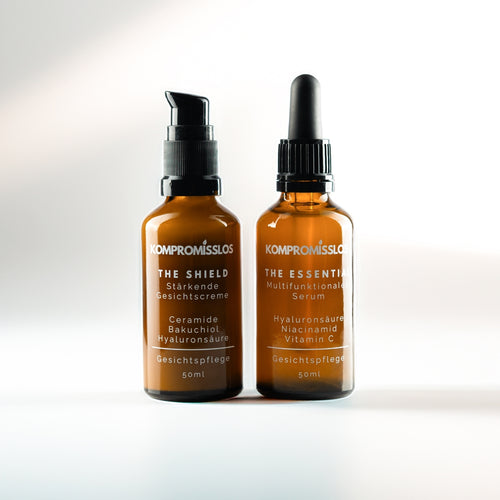
A complete label does not prove that the contents are right, though. In the Kassensturz test, the labelling was wrong on 12 of the 15 products – and, as you would expect, the banned substances were not listed. So check before you buy whether the listing shows the full list, and learn how to read an ingredient list properly. What complete information can look like is shown by The Duo, with its INCI and concentrations disclosed: 5% niacinamide, 2% vitamin C as 3-O-Ethyl Ascorbic Acid and 1% zinc PCA. In a review on Judge.me, J.D. writes of being delighted ‘with the whole concept and the great transparency about ingredients etc.’ (review translated from German).
Which products carry a particularly high risk, and where is it lower?
The risk is highest for products with colourants and reactive substances that stay on the skin, nails or lips for a long time: henna, hair dye, gel nail polish, children’s make-up and lipsticks. These are exactly the groups that failed the Kassensturz test. With henna, too much benzyl alcohol can trigger contact allergies, acrylates in nail gel are among the strongest allergens, and lipsticks are a particular concern for Urs Hauri, who led the test, because you practically eat them. For the children’s make-up, the verdict was clear: according to the report, none of the make-up kits in the test could legally be sold in Swiss shops.
Accessories that leave nothing on the skin, such as brushes or storage boxes, are generally less of a concern. Skincare sits somewhere in between: there is no reliable Swiss test data on cheap marketplace creams, but you wear a cream on your face every day for months. That is exactly where it counts whether there is a manufacturer with an address and complete labelling behind it. Rather than fearing individual substances from warning lists, it helps more to know which harmful ingredients are actually backed by evidence. A missing product label, on the other hand, is always a reason not to order.
If you do order from a marketplace, take a screenshot of the listing and keep the packaging and order confirmation. If you have a skin reaction or there is a recall, you will then know which product it was and who you bought it from.
I decided to disclose the full INCI and the concentrations of the key active ingredients, because trust in skincare comes from being able to check things, not from promises. On top of that, there are two products instead of eight, so that you know what you are putting on your skin every day, and they are developed and made in Switzerland. The honest limit: origin alone does not make a cream any better. You should judge a Swiss product, too, by whether the manufacturer and the ingredients are out in the open. The exact names of our ingredients are in the full list of ingredients from A to Z. If you find something there that does not agree with your skin, The Duo is not the right product for you – and that is a good outcome of checking.
Frequently asked questions
Is Temu allowed to sell cosmetics to Switzerland?
Yes, Temu delivers cosmetics to Switzerland, and you are allowed to order them for your own use. Because you are importing the product privately, however, Swiss foodstuffs legislation does not apply to it, according to the FSVO. So nobody systematically checks whether the goods meet Swiss requirements. According to the FSVO, the Federal Council wants to improve the monitoring of foreign online retailers with a link to Switzerland and make it possible to block them in the event of serious violations.
Who is liable if a Temu cream causes a skin reaction?
In practice, you bear the risk yourself. The FSVO states that with private orders from abroad, the responsibility for safety lies with you. The platforms refer to the manufacturers, who they say are responsible for safety. Enforcing a claim against a seller in China is likely to be difficult for private individuals. So document the product, the listing and the reaction.
Are skincare devices from Temu and Shein safe?
With devices, electrical risks come on top, and the test findings were particularly clear for chargers. In 2025, Stiftung Warentest found that 52 of 54 USB power adapters from Temu and Shein did not meet EU safety requirements, and some became too hot while charging. For devices that run on electricity and that you hold to your face, a retailer in Switzerland or the EU is the safer choice.
Where can I report a problematic cosmetic product in Switzerland?
If you bought it in a Swiss shop or online store, your canton’s food inspection authority is responsible, as it checks Swiss shops. With a direct order from abroad, the authorities can hardly intervene. In that case, report the product via the platform. In the tests by Kassensturz and Stiftung Warentest, the marketplaces removed the products in question after being alerted.
Are cosmetics from China worse in principle?
No, the country of manufacture alone says little about the quality of a cream. What matters is whether a company in Switzerland or the EU takes responsibility, has the product tested and labels it in full. That is exactly what is missing with many no-name direct orders. If origin matters to you, read up on how to tell where a product really comes from and why a company address and an ingredient list reveal more than a Swiss cross.
What should I do if I react to a cream I ordered?
Stop using the product immediately and rinse it off with water. Keep the packaging, the listing and your order. If redness or itching persists, have it checked by a dermatologist. If there is severe swelling, blistering or discomfort around the eyes or lips, the reaction needs to be seen by a doctor straight away.
How do I know who makes The Duo and what is in it?
The Duo comes from Kompromisslos, Dominic Bertschin’s brand, and is developed and made in Switzerland. The full INCI is published on the ingredients page, and the concentrations of niacinamide, vitamin C and zinc PCA are disclosed. There is also a 100-day return policy. You will find all the details directly on The Duo of serum and cream.
Sources
- Michel C, Muntwyler R. Im Test durchgefallen: China-Kosmetika aus Online-Shops sind wahre Schadstoffbomben. SRF Kassensturz, 2 September 2026. Source
- Bundesamt für Lebensmittelsicherheit und Veterinärwesen BLV. Kosmetika online einkaufen. Source
- Amt für Verbraucherschutz und Veterinärwesen St. Gallen. Info-Blatt CHE110: Kennzeichnung von Kosmetika. As of 4 November 2022. Source
- Stiftung Warentest. Temu und Shein: Gefährliche Schnäppchen. test.de, 30 October 2025. Source
- Kemikalieinspektionen. Tillsyn 1/26: Tillsyn av e-handel varor 2025. Kemikalieinspektionen, 2026. Source