Summer skincare routine: what to drop in the heat and what to keep
ROUTINE
A summer skincare routine is mainly about using less product, not more products. Heat increases sebum production, sweat sits on the skin and rich textures start to feel sticky more quickly. You can usually drop extra steps such as toner, face masks or a second serum. What should stay is a mild cleanser, a hydrating serum, a smaller amount of cream and, in the morning, a separate sunscreen if your skincare has no SPF.
Do you need different skincare in summer?
In most cases, you do not need completely different skincare in summer, but you do need to adjust the amount. Your skin does not change its type in July. It produces more sebum, sweats more and reacts to sun, wind and air conditioning, but its basic needs stay the same: holding on to moisture, supporting the skin barrier and being protected from UV radiation. A complete seasonal switch, on the other hand, carries a risk of its own. If you introduce a new gel cream, a mattifying fluid and a new serum all at once in May, you will hardly be able to tell what is behind any redness or blemishes. It makes more sense to go the other way: keep your existing routine, scale back the amount and cut any extra steps that put more strain on your skin in the heat than they give back. There is one exception. If your winter cream has a very heavy, occlusive texture, for example with a lot of petroleum jelly, a lighter cream may genuinely feel more comfortable in summer. But that is a change of texture, not a new routine.
What does heat do to facial skin: sweat, sebum and moisture?
Heat makes the sebaceous glands produce more and brings sweat to the surface of the skin, and both create a feeling of moisture that is not the same as well-hydrated skin. A study in Skin Research and Technology measured the amount of sebum at five sites on the face of the same participants over a whole year: summer was the season with the highest sebum production, and the forehead, nose and chin had higher levels than both cheeks. That is why the T-zone is often the first area to shine in summer, while the cheeks stay normal or even dry. Sweat, by contrast, consists largely of water and salts. It evaporates, cools the skin and tends to leave it feeling tight afterwards, especially if you keep wiping it away with tissues. So shiny skin in summer is no proof that skincare has become unnecessary. The article on why stripping oily skin makes the shine worse explains why you should not fight the shine with harsh products.
Another summer factor has little to do with the heat itself: chlorinated pool water and salt water often leave the skin feeling rough after swimming, so it is worth giving your face a quick rinse with clean water afterwards.
Which steps can you drop or cut back on in summer?
In summer, you can mainly drop steps that have no job of their own, and you should cut back on anything that puts extra demands on your skin. That includes toner as a mere in-between step, a second or third serum with overlapping active ingredients, rich overnight masks and frequent exfoliation. Exfoliation deserves a separate mention in summer: freshly exfoliated skin is more sensitive to the sun, and acids, sun and sweat can quickly add up to stinging and redness. For serum and cream, on the other hand, the rule is to reduce rather than remove. With these two, you adjust the amount, not whether the step exists at all. The principle behind this is the same as for a minimalist skincare routine in general: every step needs a job that no other step takes on. The table shows what that looks like in practice in summer.
| Step | Drop or cut back in summer | What stays |
|---|---|---|
| Cleansing | Extra washing at midday, strongly stripping products | Water or a mild cleanser in the morning, thorough cleansing in the evening |
| Toner | Dispensable as a mere in-between step | Only if it delivers an active ingredient of its own |
| Exfoliant | Less often, especially acid exfoliants | Gently if needed, with consistent sun protection |
| Serum | Several serums with similar active ingredients | One hydrating serum in a smaller amount |
| Cream | Heavy winter creams and overnight masks | One cream, applied more thinly |
| Face mist | Dispensable if the skincare underneath is right | At most as a quick refresher |
| Sun protection | Nothing | Every morning as the last step |
Which skincare stays even at 30°C?
Even at 30°C, three things stay: moisture that your skin can hold on to, a light final layer that supports the barrier, and sun protection. A serum with hyaluronic acid provides moisture without feeling greasy, and that is exactly what skin needs in the heat, despite the shine. The cream on top keeps this moisture in the skin for longer in air-conditioned rooms and gives the barrier back the lipids that frequent washing and wiping take away. Applied more thinly, it does not feel heavy even at the height of summer. The third step is not skincare in the strict sense, but in summer it is the most important one: if your serum and cream have no sun protection factor, you need a sunscreen for your face if your skincare has no SPF in the morning. That article covers in detail which strength and which amount make sense.
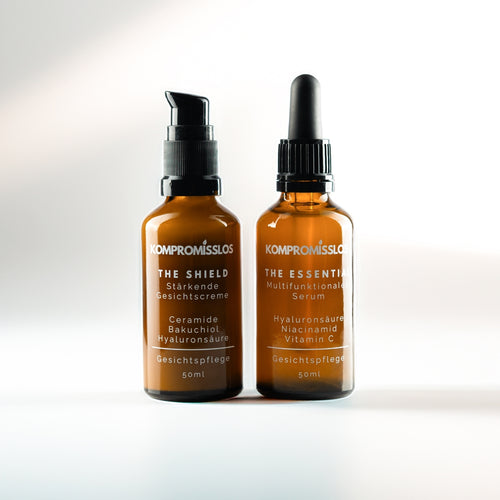
In our routine, that means: The Duo, made up of The Essential and The Shield, stays the same in summer as in winter. The Essential provides hyaluronic acid in three molecular sizes, niacinamide and zinc PCA, and The Shield adds ceramides, squalane and jojoba oil on top. In summer, you can go by the lower half of the dosage range, so closer to 3 than to 6 drops of serum and pumps of cream. After that comes a separate sunscreen, because the Duo contains no SPF. You do not need an extra gel cream for any of this.
What does a summer routine look like morning and evening?
A summer routine has three skincare steps plus sun protection in the morning and the same skincare steps without sun protection in the evening, and none of them is a summer product. The difference from a winter routine lies in the amount and in the fact that sun protection is never missing in the morning. In the evening, cleansing matters more than in winter, because it has to remove sunscreen, sweat and the day’s sebum. A mild cleanser is usually enough for this. Between serum and cream, it is worth waiting briefly until the serum has absorbed, otherwise the layers slide around more easily in the heat.
- Morning: refresh your face with water or a mild cleanser and gently pat it dry.
- Morning: apply a small amount of serum, let it absorb briefly, then apply a thin layer of cream.
- Morning: sunscreen as the last step, applied evenly and not too sparingly.
- Evening: remove sunscreen, sweat and sebum with a mild cleanser.
- Evening: serum and cream as in the morning, with a little more cream if your skin is dry.
After exercise or a hot commute, it is usually enough to rinse your face with lukewarm water instead of repeating the whole routine.
In summer, skincare products do not belong in a hot car or next to your sun lounger in blazing sunshine. Store them somewhere cool and dark, for example in a cupboard rather than on a sunny windowsill. And sunburn on your face does not call for extra active ingredients, but for shade and cooling.
Does mature or dry skin need less cream in summer?
Not automatically: mature or dry skin often gets by with slightly less cream in summer than in winter, but rarely with as little as oily skin. Sebum production falls over the years, and the summer increase that makes an oily T-zone shine is usually smaller in dry skin. On top of that, there are situations in which the air is dry despite the heat: air-conditioned offices and cars, aircraft cabins, wind by a lake or in the mountains. A review in the Journal of the European Academy of Dermatology and Venereology states that low humidity and low temperatures generally weaken the skin’s barrier function. The review mainly relates to winter, but it fits with the fact that skin can feel tight in summer too, after a long day in an air-conditioned office or after a flight.
In practice, this means: stay within the amount your skincare recommends, and go by how your skin feels in the afternoon rather than by the thermometer. If your skin feels tight after lunch, you used too little. If your whole forehead is shiny, you used too much. With The Duo, the range is 3 to 6 drops of serum and 3 to 6 pumps of cream. In her review on Judge.me, Irène S. writes: ‘I need very little of the products in summer’ (review translated from German). That is one person’s experience, not a guideline for everyone. If the dryness only really shows in September, the article on what your skin needs after summer covers the next step.
How do vitamin C, niacinamide and sunscreen fit into a summer routine?
Vitamin C and niacinamide fit well into a summer routine, but both are an addition underneath your sunscreen and never a replacement for it. Vitamin C is an antioxidant and can neutralise free radicals that form under UV radiation. A review in the Journal of Clinical and Aesthetic Dermatology therefore describes vitamin C as photoprotective and as a partner to vitamin E, but also notes that clinical studies on the effectiveness of topical vitamin C formulations are limited, partly because of stability and absorption into the skin. Vitamin C has no sun protection factor. Niacinamide is interesting in summer for a different reason: in a study in the Journal of Cosmetic and Laser Therapy, 2% niacinamide lowered the sebum excretion rate in Japanese participants. In Caucasian participants, the amount of sebum on the skin’s surface fell after six weeks, but the excretion rate did not fall significantly.
The order stays simple: active ingredients first, cream next, sunscreen last. How this works with day creams that contain a filter of their own is explained in the article on whether sunscreen goes before or after moisturiser. If new spots are your main concern in summer, the separate guide to dark spots on the face is worth reading, because sun protection makes more of a difference there than any serum.
I deliberately did not create a summer line or a lighter gel cream for July and August. The principle of two products instead of eight holds in the heat too: rather than switching with the seasons, you adjust the amount, within 3 to 6 drops of serum and 3 to 6 pumps of cream. Just as deliberately, The Shield has no sun protection factor. Skincare and sun protection are two different jobs, which is why a separate sunscreen belongs in your morning as the last step. That is one step I cannot take off your hands, and I do not sell sunscreen either. Both products are fragrance-free, which means one less possible source of irritation when sun and sweat come into play. You will not find a toner or a face mist in our range, because neither would have a job of its own in this routine. How the two steps work together is explained in the instructions for use.
Frequently asked questions
Is a serum without cream enough in summer?
For very oily skin, a serum on its own can be enough on hot days, but for dry, mature or sensitive skin it usually is not. The serum provides moisture, while the cream keeps it in the skin and supports the barrier. Rather than leaving out the cream completely, using a smaller amount is often the better compromise, especially in air-conditioned rooms.
Should I wash my face more often in summer?
No, twice a day is enough in summer too. Washing more often with cleansing products strips your skin even further and can make tightness and shine worse rather than better. On very hot days, it is enough to rinse your face with lukewarm water in between and gently pat it dry.
Can I use retinol in summer?
Yes, you can use retinol in summer too, as long as you apply it in the evening and use sun protection consistently in the morning. Retinoids can make the skin more sensitive, so a cautious rhythm makes sense. If your skin stings or flakes in the heat, use it less often rather than changing the rest of your skincare.
Why do I get more spots in summer?
In summer, more sebum, more sweat, dense layers of sunscreen and friction from hats or sunglasses all come together. This can make pores clog more quickly. From a cosmetic point of view, a thorough but mild evening cleanse and light textures help. Persistent or painful acne should be assessed by a dermatologist.
Should my evening skincare differ from my morning skincare in summer?
No, your skincare products can be the same morning and evening. The difference lies in the sequence: in the morning, sunscreen is added as the last step, and in the evening it is removed again with a mild cleanser. If you have dry skin, use a little more cream in the evening than in the morning.
What can I do if my cream looks shiny in the heat or pills under sunscreen?
Usually, it is simply too much product. Use less cream, spread it thinly and let each layer absorb for one to two minutes before applying the next. Pilling often happens when layers are rubbed over each other while they are still damp. Sunscreen is best patted in gently rather than rubbed in vigorously.
Do I need to use The Duo differently in summer?
No, the order stays the same: serum first, then cream, morning and evening. What you can adjust is the amount: in summer, the lower half of the 3 to 6 drops and pumps is often enough. In the morning, follow up with a separate sunscreen, because The Duo contains no SPF.
Sources
- Youn SW, Na JI, Choi SY, Huh CH, Park KC. Regional and seasonal variations in facial sebum secretions: a proposal for the definition of combination skin type. Skin Research and Technology, 2005. Source
- Engebretsen KA, Johansen JD, Kezic S, Linneberg A, Thyssen JP. The effect of environmental humidity and temperature on skin barrier function and dermatitis. Journal of the European Academy of Dermatology and Venereology, 2016. Source
- Al-Niaimi F, Chiang NYZ. Topical Vitamin C and the Skin: Mechanisms of Action and Clinical Applications. Journal of Clinical and Aesthetic Dermatology, 2017. Source
- Draelos ZD, Matsubara A, Smiles K. The effect of 2% niacinamide on facial sebum production. Journal of Cosmetic and Laser Therapy, 2006. Source