Sugar and skin ageing: what glycation does to your skin
SKIN OVER 40
Sugar contributes to skin ageing through glycation: sugar molecules such as glucose and fructose attach themselves to collagen and elastin in the connective tissue without the help of an enzyme. This produces what are known as AGEs (advanced glycation end products), some of which cross-link collagen fibres and make them stiffer. It happens in every body and increases with age; persistently raised blood sugar speeds it up. Glycation is one of several factors in visible skin ageing, and UV light remains the bigger lever. Once AGEs have formed, no cream can dissolve them again.
What is glycation, and what does it do to the collagen in your skin?
Glycation is a chemical reaction in which sugar binds to proteins without the help of an enzyme – in the skin, mainly to the collagen and elastin of the dermis. It starts as a loose bond, and over time this turns into stable end products: the AGEs. Writing in Clinics in Dermatology, the dermatologist Frank Danby describes the decisive step like this: sugar firmly cross-links two collagen fibres, and neither can then be easily repaired. Normally, collagen is a network of fibres that glide past one another and are constantly renewed. Fibres that are stuck together become stiffer and more brittle, and they are broken down less efficiently. A review by Nguyen and Katta in Skin Therapy Letter attributes typical features of aged skin, such as reduced resistance to mechanical stress and impaired wound healing, partly to glycation. Glycation is not a special case reserved for people who eat a lot of sugar, though. It goes on in every body for as long as sugar circulates in the blood. The question is not whether it happens, but how fast.
Collagen is particularly susceptible because it lasts so long. A study in the Journal of Biological Chemistry calculated a half-life of 15 years for skin collagen. The longer a protein stays in the tissue, the more time sugar molecules have to attach to it. Glycation is therefore one piece of the larger picture of sagging skin and fading firmness, but not its only cause.
Does sugar really cause wrinkles, or is that a myth?
That sugar causes wrinkles is neither a myth nor proven: the mechanism is well established biochemically, but there is no direct evidence in humans that eating more sugar in everyday life leads to measurably more wrinkles. What is established is that AGEs in skin collagen increase with age and that raised sugar levels speed up the reaction. Danby writes that the process runs faster in all tissues when sugar is elevated. What remains open is how much a slice of cake or a sugary drink a day changes the depth of wrinkles when your metabolism is healthy. Answering that would take controlled long-term studies spanning many years, and they do not exist. Nguyen and Katta explicitly describe the studies on dietary strategies against glycation-related skin ageing as preliminary. The term ‘sugar sag’ therefore describes a plausible hypothesis rather than a diagnosis. If you want to tackle existing wrinkles, asking whether anti-wrinkle creams actually work and which ingredients are proven will get you further than staring into the sugar bowl.
How much does sugar matter compared with sun exposure and age?
Compared with sun and age, sugar is the smaller lever: UV light is considered a far stronger driver of visible facial skin ageing than diet, and chronological ageing happens regardless. Nor does glycation sit apart from these factors; it is intertwined with them. Danby describes how UV light additionally stimulates glycation in the skin. A study in the Journal of Clinical Investigation on skin collagen from people without diabetes also showed that the late glycation products CML and pentosidine increased fivefold between the ages of 20 and 85, closely linked to chronological age. A large share of the AGEs in collagen is therefore simply a matter of time. How these factors weigh against each other, and how to slow down skin ageing according to the evidence, is covered in a separate article.
In everyday terms, this means that if you worry about sugar but expose your unprotected face to the sun, you are starting with the lesser factor. Daily sunscreen for your face remains the more effective habit. Sugar is more of an amplifier, much like the question of what chronic stress does to your skin: it plays a part, but rarely decides things on its own.
Which foods and cooking methods produce the most AGEs?
The most AGEs come from fatty, protein-rich animal foods cooked with dry heat, in other words grilled, fried, deep-fried or roasted. That may sound surprising at first, since the topic is sugar. But AGEs get into the body in two ways: the body forms them itself from sugar in the blood, and they form in food during cooking, as part of the browning reaction. A study in the Journal of the American Dietetic Association measured a large number of foods. Dry heat increased the formation of new AGEs by more than ten to a hundred times compared with the uncooked state. Carbohydrate-rich foods such as vegetables, fruit, wholegrains and milk, by contrast, contained relatively few AGEs, even after cooking. Nguyen and Katta likewise name grilling, frying and roasting as methods that produce considerably more AGEs than boiling or steaming. Whether AGEs from food reach skin collagen in any significant amount has not been established in humans, however. The table therefore shows where a lot of AGEs form, not what makes your skin age.
| Food or cooking method | AGEs | What lies behind it |
|---|---|---|
| Fatty, protein-rich animal foods, grilled, fried or deep-fried | High | Dry heat and plenty of protein promote the browning reaction |
| The same foods, boiled, steamed or braised | Considerably lower | Moist heat, lower temperatures, shorter cooking times |
| Vegetables, fruit, wholegrains, milk | Relatively low, even when cooked | Little new formation despite the carbohydrates |
| Marinades with lemon juice or vinegar | Slow down new formation | Acidic ingredients slow the reaction during cooking |
| Lots of added sugar | Acts inside the body | More sugar in the blood is available for the body’s own glycation |
The measurements point to a kitchen rule, not a skin treatment: moist heat, shorter cooking times, lower temperatures and acidic ingredients reduced the formation of new AGEs in food. Whether this shows in your skin has not been studied.
What does eating less sugar do for your skin, and what does it not do?
Eating less sugar reduces the amount available for new glycation, but it does not reverse AGEs that have already formed, and it is no substitute for sunscreen. With a healthy metabolism, the body keeps blood sugar within narrow limits anyway, so the effect of cutting back moderately on skin collagen is correspondingly hard to measure. Then there is the pace: with a half-life of 15 years, the fibre network renews itself so slowly that a change in diet would show over years, if at all, not over weeks. Before-and-after photos after a month without sugar therefore show barely any change in collagen; what they show is more likely different lighting, a different day or a differently hydrated skin surface. There is no study that puts a figure on how much younger skin looks after giving up sugar. If you do eat less sugar, the sensible reason is your general health, and questions about your blood sugar belong with your GP.
What eating less sugar cannot do for your skin:
- Undo collagen that is already cross-linked.
- Make up for UV-related skin ageing.
- Smooth out deep wrinkles or hollowed contours.
- Replace a medical check-up if your blood sugar is raised.
Can anti-glycation creams break down cross-linked collagen?
No, a cream cannot undo collagen that is already cross-linked. Glycation mainly affects the collagen in the dermis, and AGEs are stable, cross-linked compounds that the body itself breaks down only slowly, by replacing the collagen. Some substances are being discussed as possible brakes on AGE formation, but the data are mostly preliminary, and the evidence for applying them to the skin is limited. No cosmetic ingredient has been shown to break existing cross-links in the connective tissue. Even for diet, Nguyen and Katta speak only of promising candidates. An ‘anti-glycation cream’ is therefore mainly selling a promise. Much as with the question of whether collagen from a cream can actually get into your skin, the reach of skincare ends at the surface.
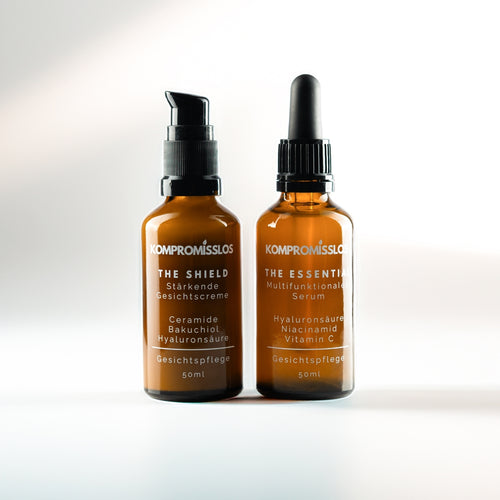
What skincare can realistically do is support how your skin looks. The Duo of serum and cream contains 5% niacinamide and 2% vitamin C as stable 3-O-Ethyl Ascorbic Acid; the serum adds hyaluronic acid in three molecular sizes, and the cream contains ceramide NP, squalane and bakuchiol. Together they provide moisture, support the skin barrier and help give a more even-looking complexion. There is no evidence that they inhibit glycation. What makes the bigger difference to the future of your skin is a separate sunscreen during the day.
The Duo comes with no anti-glycation promise, and that is deliberate. I could not back it up. Once AGEs have formed, they sit in the connective tissue, and no ingredient in a cream can dissolve them there. I chose two products instead of eight, and I chose to disclose the concentrations: 5% niacinamide, 2% vitamin C as stable 3-O-Ethyl Ascorbic Acid, 1% zinc PCA. That way you know what ends up on your skin and can judge for yourself what it can and cannot do. The cream deliberately has no SPF. You still need sunscreen, separately, because when it comes to skin ageing it is a more important lever than any skincare, ours included. The job of each individual active ingredient in the Duo is set out openly on our website.
Frequently asked questions
At what age does glycation start to matter?
Glycation goes on throughout life and does not start on a particular birthday. Because skin collagen is long-lived, the end products build up over decades. In the study in the Journal of Clinical Investigation, the early binding of sugar to skin collagen increased by only 33 per cent between the ages of 20 and 85, whereas the late glycation products increased fivefold. The older the collagen, the more has built up.
Is fructose from fruit as harmful as table sugar?
Both types of sugar are relevant to glycation itself: Danby names glucose and fructose as sugars that bind to collagen and elastin, and table sugar is made up of both. But whole fruit is a different food from added sugar, with water and fibre. There is no study showing that fruit harms the skin.
Can you see it in your skin if you give up sugar?
Hardly in the collagen, at least not after a few weeks. According to a study in the Journal of Biological Chemistry, skin collagen has a half-life of 15 years, so the fibre network renews itself slowly. Whatever changes in before-and-after photos after a short time usually has other causes. No study backs up promises such as ‘years younger by cutting out sugar’.
Is glycation reversible?
Only at the very beginning. The early intermediate stages between sugar and protein can still come apart; the later AGEs are stable, and some cross-link collagen fibres permanently. The body breaks down such collagen only slowly and replaces it. Neither diet nor cream undoes existing cross-links. At most, diet influences how much sugar is available for new glycation.
Are sweeteners better for your skin than sugar?
There are no reliable skin studies on this. Calorie-free sweeteners barely raise blood sugar and so supply no sugar for glycation. Whether your skin visibly benefits from this, however, has not been studied. It does not follow that you should replace sugar with sweeteners for the sake of your skin.
Does diabetes affect the skin?
Yes. In the study in the Journal of Clinical Investigation, the binding of sugar to skin collagen was three times higher in people with type 1 diabetes than in people without diabetes. Skin changes in diabetes belong with your GP, a diabetologist or a dermatologist, not in a skincare routine.
Do I need an anti-glycation cream if I use The Duo?
No. A cream does not dissolve AGEs once they have formed, whatever it is called. The Duo provides moisture, supports the skin barrier with ceramide NP and helps give a more even-looking complexion. There is no evidence that it works against glycation. If you want to do something extra for your skin, a separate sunscreen during the day is a more sensible addition than yet another jar.
Sources
- Danby FW. Nutrition and aging skin: sugar and glycation. Clinics in Dermatology, 2010. Source
- Nguyen HP, Katta R. Sugar Sag: Glycation and the Role of Diet in Aging Skin. Skin Therapy Letter, 2015. Source
- Dyer DG, Dunn JA, Thorpe SR, Bailie KE, Lyons TJ, McCance DR et al. Accumulation of Maillard reaction products in skin collagen in diabetes and aging. Journal of Clinical Investigation, 1993. Source
- Verzijl N, DeGroot J, Thorpe SR, Bank RA, Shaw JN, Lyons TJ et al. Effect of collagen turnover on the accumulation of advanced glycation end products. Journal of Biological Chemistry, 2000. Source
- Uribarri J, Woodruff S, Goodman S, Cai W, Chen X, Pyzik R et al. Advanced glycation end products in foods and a practical guide to their reduction in the diet. Journal of the American Dietetic Association, 2010. Source