Mandelic acid: how gentle this AHA really is and whether it suits sensitive skin
ACTIVE INGREDIENTS
Mandelic acid is an alpha hydroxy acid (AHA) that loosens dead skin cells on the surface and makes rough patches look smoother. It is considered gentler than glycolic acid because its molecule is about twice as heavy and works more slowly. In a direct comparison, it caused less redness. But gentler does not automatically mean well tolerated: mandelic acid can also make sensitive skin sting, it increases sensitivity to sunlight and, for most people, it is not an essential step.
What is mandelic acid and what does it do to your skin?
Mandelic acid is an alpha hydroxy acid that loosens the bonds between the outermost dead skin cells so that they come away from the skin more easily. Afterwards, the surface looks smoother and more even, because fewer loose flakes scatter the light. The name refers to the bitter almond, from which the acid was originally extracted. Chemically, it differs from glycolic acid in having a ring-shaped part to its molecule, which makes it considerably larger: according to the chemistry database PubChem, mandelic acid has a molecular weight of 152.15 g/mol, while glycolic acid has one of 76.05 g/mol. In research, mandelic acid appears mainly as a peel for blemishes and pigmentation disorders, usually at professional concentrations. There is little data on using it at home.
One of the few studies comes from the journal Facial Plastic Surgery: 24 people aged between 42 and 68 applied a mandelic acid formulation developed by the authors twice a day for four weeks. Afterwards, the skin on the lower eyelid showed 25.4 per cent higher elasticity. That is an indication, nothing more. Twenty-four people and four weeks are not enough to infer a general effect.
Is mandelic acid really gentler than glycolic acid, and what does molecule size tell you?
Yes, in a direct comparison mandelic acid works more slowly and causes less redness, but molecule size only partly explains why. The usual explanation goes like this: a molecule twice as heavy penetrates the outer layer of the skin more slowly and evenly, so less acid reaches the deeper layers at once. This is supported by a study in the Journal of Cosmetic Science, in which 10% glycolic acid caused faster shedding, stronger redness and greater sensitivity to light than mandelic acid, whose peeling action the authors describe as slower and safer. At least as important as the molecule, however, are the concentration and pH of the finished product. A strongly acidic mandelic acid product can irritate more than a mildly formulated glycolic acid product. ‘Gentler than glycolic acid’ is therefore a comparison between acids, not a statement about how your skin will react. How mandelic acid compares with BHA and PHA is a separate question, which the overview of the three acid groups answers.
| Feature | Mandelic acid | Glycolic acid |
|---|---|---|
| Acid group | AHA | AHA |
| Molecular weight according to PubChem | 152.15 g/mol | 76.05 g/mol |
| Shedding by comparison | slower | faster |
| Redness by comparison | milder | stronger |
| Sensitivity to light by comparison | lower | higher |
The three comparison rows come from the Journal of Cosmetic Science study mentioned above, in which glycolic acid was tested at 10%. Lower does not mean zero: mandelic acid also makes your skin more sensitive to light.
Can sensitive skin tolerate mandelic acid, or is ‘gentle’ mostly marketing?
Some sensitive skin tolerates mandelic acid well and some does not, and a ‘for sensitive skin’ label guarantees neither. ‘Gentle’ describes an acid compared with other acids. Sensitive skin, however, is often skin with a compromised barrier, and every exfoliant puts additional strain on a compromised barrier. The research on tolerability is thin. The Facial Plastic Surgery study describes mandelic acid as well tolerated, but it involved only 24 people. A Cochrane review of active ingredients for acne found just one small study comparing glycolic acid peels with salicylic-mandelic acid peels: there may be no difference in effect, and whether the side effects differ could not be determined because the evidence was of very low quality. So there are plausible reasons why mandelic acid is milder, but hardly any data that shows this specifically in sensitive skin. If your skin already stings, feels tight or reddens quickly without any acid, an acid is the wrong first step. In that case, it is worth looking first at what sensitive skin really needs and what to leave out before adding another product.
What concentration of mandelic acid makes sense at home, and how often should you use it?
For home use, products with no more than 10% mandelic acid are enough, starting with one or two evenings a week. The 10 per cent limit is not a Swiss regulation, but it is a useful guideline. As the US Food and Drug Administration (FDA) summarises, the expert panel of the Cosmetic Ingredient Review considers products with glycolic and lactic acid safe if the concentration is 10 per cent or less, the pH is 3.5 or higher and the skin is protected against the increased sensitivity to the sun. Mandelic acid was not assessed separately there, but the values work as a point of reference. The pH is rarely stated on the packaging, so the percentage on its own is only half the information. If you are new to acids, you are better off with a lower concentration than with the maximum. In any case, how often you use the acid matters more than its concentration:
- Start with one evening a week, on clean, dry skin.
- After two weeks without stinging or lasting redness, increase to two evenings. You rarely need more than every other evening.
- On the same evening, use no other acid, no retinoid and no scrub.
- Afterwards, apply your usual serum and cream, without any other exfoliating ingredients.
- Use sunscreen consistently the next morning and on the days that follow.
Professional peels work with much higher concentrations and belong in trained hands. What a professional AHA peel can do and when it is worth it is a different decision from the small bottle in your bathroom.
How can you tell that mandelic acid is too much for your skin?
It is too much if your skin burns for longer than a few minutes after you apply it, stays red for hours, or your usual cream suddenly starts to sting. A brief tingle is common with acids and is not a warning sign on its own. The signs to take seriously are those that persist or get worse with each application:
- Burning or stinging that does not fade after a few minutes.
- Redness that is still visible the next morning.
- Shiny, tight skin that looks as if it has been polished.
- Flaking or dry patches where there were none before.
- Burning when you apply products you have been using without any problems for months.
In that case, stop using the acid, stick to mild skincare and wait until your skin has calmed down. Only then should you try again, with fewer evenings or a lower concentration. New spots in the first few weeks are often put down to purging. Whether it is skin purging or a reaction depends on where they appear and how long they last, not on what it says on the bottle.
Test a new acid product on a small area first, for example along the side of your jaw, on two to three evenings. If the area stays calm, that is no guarantee for your whole face, but it does filter out the most obvious reactions.
Do you need mandelic acid at all, and when should you see a professional?
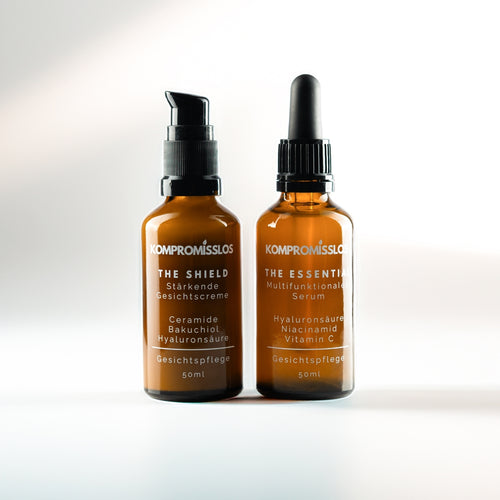
Most people do not need mandelic acid; at most, it makes sense for rough, thickened skin that does not become smoother with good basic skincare alone. Healthy skin renews itself, and an acid merely speeds up that process. Before you buy an acid product, it is therefore worth asking yourself honestly whether you need to exfoliate your face at all. If you want to use mandelic acid, you can add it on individual evenings and then continue with your usual skincare, for example The Essential serum with niacinamide and hyaluronic acid and The Shield cream with ceramide NP and squalane, available together as The Duo of serum and cream. The acid loosens; the skincare that follows provides moisture and supports the skin barrier. Neither can replace the other: The Duo is not an exfoliant and contains no mandelic, glycolic or lactic acid.
The topic belongs with a dermatologist if what is really behind your interest in mandelic acid is acne, rosacea or melasma. These call for a proper assessment and medical options that a cosmetic product cannot replace. The same applies if your skin stays irritated or starts to weep for days after using an acid.
I deliberately did not include an exfoliant or an acid product in our range. An exfoliant would have been the obvious third product, but many people with sensitive skin use that kind of product too often anyway. I wanted two products you can use morning and evening, rather than eight, one of which wears down the others. That is why you will find neither mandelic acid nor glycolic or lactic acid in our full ingredient list. It also means that if you want to smooth rough patches in a targeted way, The Duo cannot do that job, and I would rather say so openly. And because our cream has no SPF, you need a separate sunscreen during the day, all the more so when you use acids.
Frequently asked questions
Can I use mandelic acid every day?
If you have sensitive skin, probably not. Some low-strength products are designed for daily use, but most skin types do well with two to three evenings a week. Exfoliating every day increases the risk of straining your skin barrier without your complexion necessarily benefiting. Only increase the frequency if your skin stays calm for weeks.
Does mandelic acid make your skin sensitive to the sun?
Yes, like all AHAs. The US Food and Drug Administration reports that sensitivity to UV-induced reddening rose by 18 per cent after four weeks of AHA use and that one week after stopping, no significant difference could be measured any more. These measurements do not come from studies with mandelic acid, but the direction applies to AHAs in general. That is why sunscreen for your face is part of the routine until one week after your last application.
Can I combine mandelic acid with niacinamide or vitamin C?
With niacinamide, usually yes, most simply as the skincare that follows the acid or on acid-free days. With vitamin C, it is easier for sensitive skin to spread the two across different times of day: vitamin C in the morning, mandelic acid in the evening. If your skin becomes irritated, drop the acid first, not the skincare.
Is mandelic acid milder than PHA?
Usually not: PHAs such as gluconolactone have even larger molecules than mandelic acid and are therefore considered the mildest group of acids, although that does not guarantee tolerability either. How the groups differ and which one suits which skin type is covered in AHA, BHA and PHA compared.
Does mandelic acid help with dark spots?
Mandelic acid can make your complexion look more even because it loosens skin cells on the surface. Deeper pigmentation spots do not disappear as a result. Studies on pigmentation disorders mostly use professional peels at high concentrations. Melasma or newly appearing spots should be assessed by a dermatologist, and without consistent sun protection, no acid will achieve anything.
Can I use mandelic acid during pregnancy?
There is hardly any data that looks specifically at mandelic acid in pregnancy. You therefore cannot reliably conclude that it is safe from product descriptions or personal accounts. Talk to your gynaecologist or a pharmacist before you start using it. During this time, it is better not to try out new active ingredients on your own.
Do I need mandelic acid if I use The Duo?
No, not necessarily. The Duo is designed as complete skincare after cleansing and does not need an acid to work. If you have rough, thickened patches, you can add mandelic acid on individual evenings before your serum and cream. The Duo of serum and cream is not an exfoliant, however, and because it contains no SPF, you need a separate sunscreen during the day.
Sources
- Rizza L, Frasca G, Bonina C, Puglia C. Comparative in vivo study of the efficacy and tolerance of exfoliating agents using reflectance spectrophotometric methods. Journal of Cosmetic Science, 2010. Source
- Jacobs SW, Culbertson EJ. Effects of Topical Mandelic Acid Treatment on Facial Skin Viscoelasticity. Facial Plastic Surgery, 2018. Source
- Liu H, Yu H, Xia J, Liu L, Liu GJ, Sang H, et al. Topical azelaic acid, salicylic acid, nicotinamide, sulphur, zinc and fruit acid (alpha-hydroxy acid) for acne. Cochrane Database of Systematic Reviews, 2020. Source
- U.S. Food and Drug Administration. Alpha Hydroxy Acids. FDA, updated 2022. Source
- National Center for Biotechnology Information. PubChem Compound Summary: Mandelic Acid (CID 1292) and Glycolic Acid (CID 757). PubChem, accessed 2026. Source