Body lotion on your face: why body and hand cream don’t replace facial skincare
ROUTINE
Using body lotion on your face is fine in a pinch, but rarely a good idea in the long run. Body care is made for thicker, more robust skin and large areas: it is often perfumed, richer, or contains ingredients such as urea at levels that work well on your shins but can sting on the face or encourage blemishes. A face cream is designed for thinner, more sensitive skin and for targeted active ingredients. The other way round usually works without any problem – it is just expensive.
Can you use body lotion on your face?
Yes, you can use body lotion on your face, and a single evening on holiday will do most people no harm. The real question is whether it looks after your face well, and the answer is usually: not particularly. Body lotions are developed for the arms, legs and torso, which means skin with a thicker outer layer, fewer sebaceous glands and less exposure to sun, wind and make-up. Their job is to make large areas supple quickly and cheaply. To do that, many manufacturers rely on a noticeable fragrance, on rich lipids or on humectants in amounts intended for rough shins. On the face, that is exactly what can cause trouble: heavy lipids can congest the pores of blemish-prone skin, and high-dose urea can sting on thin skin. Fragrance also raises the question of allergies. A study in the British Journal of Dermatology tested 3,119 randomly selected adults in five European countries: the conservatively estimated prevalence of a relevant fragrance contact allergy was 1.9 per cent, and about twice as high in women as in men. If your skin is robust and the lotion is light and fragrance-free, you may not notice anything at all. If you are prone to redness or spots, body lotion on your face is the step you should skip.
What is the difference between face cream and body cream?
The difference between a face cream and a body cream lies mainly in the formulation, not the label. Both are cosmetic products, and it is the manufacturer’s formulation that makes a cream a face cream. The priorities are simply different. With body care, what counts is the price per millilitre, quick absorption over a large area and a pleasant scent. With facial skincare, what counts is how well thin skin tolerates it, a film that does not get in the way under sunscreen and make-up, and active ingredients at a concentration that makes sense on the face. Niacinamide, vitamin C or bakuchiol make sense on your face, but hardly on your calves. So the better question is not whether the tube says ‘face’ or ‘body’, but what the ingredient list says. You can see how this plays out in practice for a product made purely for the face, such as The Duo, in its openly published list of active ingredients.
| Criterion | Typical body lotion | Typical face cream | Why it matters on the face |
|---|---|---|---|
| Fragrance | Often noticeably perfumed | More often fragrance-free or subtle | Fragrances can trigger contact allergies, and the face reacts more quickly |
| Lipid content | Rich, for dry legs and arms | Matched to skin type | The face has more sebaceous glands, and heavy films can congest pores |
| Humectants | Sometimes in high doses, such as urea for rough patches | Usually more gently dosed | Thin skin is quicker to sting |
| Active ingredients | Rarely with a stated concentration | Often targeted, such as niacinamide or vitamin C | Your face is where you want to see an effect |
| Pack size | 200 to 500 ml | 30 to 50 ml | The area is smaller, the formulation more elaborate per millilitre |
Can you use hand cream on your face?
You can use hand cream on your face, but it is even less suited to the job than body lotion. Hands are a special case: the outer layer of skin on the palms is exceptionally thick, and the backs of the hands are constantly washed and disinfected. Hand creams are therefore meant to form a protective film that survives several washes, and to absorb quickly so that you can pick up your phone straight afterwards. To achieve this, many products contain a lot of glycerin, film-forming ingredients and, quite often, a strong fragrance. On the face, this soon feels sticky or heavy, and the scent sits right under your nose. If you do try hand cream on your face, choose a fragrance-free formulation that is as simple as possible, and use it only on dry areas such as the cheeks, not on the T-zone. It is no good as a permanent solution, because it is not matched to the sebaceous glands of the face and contains no active ingredients meant to do anything there.
Why is facial skin more sensitive than body skin?
Facial skin is more sensitive because its outer layer, the stratum corneum, is thinner and it is exposed to more stressors every day than the rest of the body. A study in the Archives of Dermatological Research counted the cell layers of the stratum corneum at various body sites in 301 people: on average there were 9 on the face, 10 on the neck, 13 on the torso, 15 on the arms and legs, and 47 on the palms and soles. The authors also describe how transepidermal water loss, meaning how much moisture evaporates through the skin, reflects the number of these cell layers. A thinner stratum corneum means less of a buffer for an ingredient to get through first.
Then there is the strain of everyday life. The face is exposed to sun, cold, wind, cleansing, make-up and, for men, shaving – there is more on that in the article on skincare for men. A position paper from an international expert group in the journal Acta Dermato-Venereologica defines sensitive skin as unpleasant sensations such as burning, stinging or itching in response to stimuli that should not normally cause them, and states that it can affect all parts of the body, especially the face. That is exactly where body lotion ends up when you use it for something it was not made for.
When can you make an exception and use body care on your face?
Body care on your face is acceptable as an exception when the formulation is so simple that it works for both anyway. Such products do exist: some fragrance-free lotions and creams are expressly labelled for face and body, often for very dry or sensitive skin. These products usually do without fragrance and without high doses of individual ingredients, but they do not deliver targeted active ingredients either. For robust, uncomplicated skin, that can be perfectly sufficient. If, on the other hand, you want a more even-looking complexion, fewer fine lines caused by dryness or a more resilient barrier, an all-purpose cream gives you basic care rather than proper facial skincare. A few points tell you whether a product is the exception:
- The packaging expressly says ‘for face and body’, not just ‘for the body’.
- The ingredient list contains neither parfum nor essential oils, a topic explained in more detail in the article on fragrance-free moisturiser.
- Urea, salicylic acid or fruit acids are not near the top of the list, as they would be in a product designed for rough patches.
- The texture sinks in rather than leaving a noticeable film, especially if you are prone to blemishes.
- You have tested it on a small area along your jaw before using it on your whole face.
Marketing terms are of little help here. What lies behind promises such as ‘free from’ is explained in the article on Swiss skincare without additives.
If you are on holiday without your face cream, a fragrance-free body lotion is a better choice for a few days than nothing at all. Keep it away from the eye area and apply it thinly, rather than replacing your usual amount of facial skincare with a handful of lotion.
And the other way round: can you use face cream on your body?
Yes, you can use face cream on your body without any concerns – it just rarely makes sense. Whatever thinner facial skin tolerates is certainly no problem for your arms or legs. The catch is the quantity: a face cream usually comes in 30 or 50 ml, a body lotion often in 200 to 500 ml. Applying face cream all over your body is therefore mainly an expensive habit. Taking your facial skincare further down makes sense in two places: on the neck, whose thin skin has more in common with the face than with the body, and selectively on the backs of the hands, which get a lot of sun. How far down you should take your facial skincare is covered in the article on neck and décolleté care. For everything else, a simple, fragrance-free body product is enough. That also fits the idea that your routine does not need more products, but the right ones in the right place, as described in the article on the minimalist skincare routine.
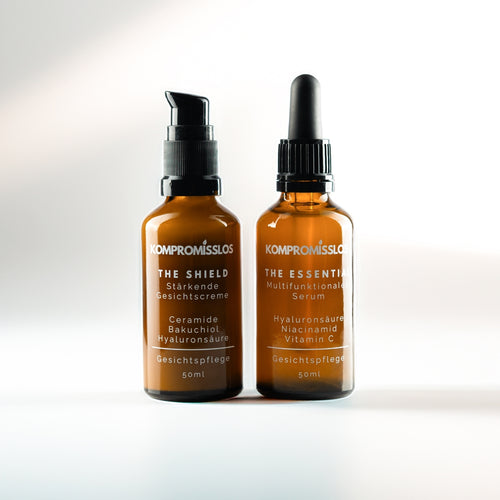
I deliberately designed The Essential and The Shield as facial skincare, not as all-purpose creams. 5% niacinamide, 2% vitamin C as 3-O-Ethyl Ascorbic Acid and 1% zinc PCA are figures that apply to The Duo as a whole and are intended for the face and neck, the areas where you see the results. Both products are fragrance-free, because fragrance has no job to do on the face. What the Duo cannot do is look after your whole body. Used twice a day on the face and neck, it lasts around two months; on the body it would run out quickly and would simply be overkill for your shins. For those, you do not need active-ingredient skincare, just a simple lotion. The active ingredients it contains, and what each one is for, are set out openly on our page about active ingredients in the Duo.
Frequently asked questions
Does body lotion cause spots on your face?
It can, but it does not have to. Rich, film-forming lotions can encourage blackheads and spots on blemish-prone skin. A case-control study in the journal Dermatology found that individual cosmetics can be associated with acne, while overall use of cosmetics was actually linked to less acne. Whether a particular ingredient is a problem is explained in the article on what comedogenic means. Persistent acne should be seen by a dermatologist.
Is baby cream suitable for your face?
That depends on which baby cream you mean. Nappy creams are very rich and form a dense protective film, often with zinc oxide, which stays visibly white. On dry patches in cold weather this can help locally, but it is usually too heavy as daily facial skincare. Light, fragrance-free baby lotions are less of a problem on the face, but they deliver hardly any active ingredients.
Can I use Nivea on my face?
That depends on the specific product, not the brand. Large high-street brands sell both body lotions and dedicated facial ranges, and some creams are expressly labelled for face and body. So check the packaging and the ingredient list: if it says ‘for face’, contains no parfum and the texture is not too heavy for your skin type, there is little reason not to.
Is there a cream for both face and body?
Yes, there are creams labelled for face and body, mostly simple, fragrance-free formulations for dry or sensitive skin. They cover the basics, meaning moisture and lipids. They rarely contain targeted active ingredients at a concentration suited to the face. For robust skin with no particular needs, that can be enough; for targeted facial skincare, it usually is not.
Can I use body lotion on my neck?
You can, but facial skincare is the better choice for your neck. According to a study in the Archives of Dermatological Research, the stratum corneum on the neck has on average only one more cell layer than on the face, and fewer than on the torso. So simply take your face cream down over your neck instead of switching to a perfumed body lotion there.
Is body oil bad for your face?
Not in principle; it depends on the oils and the fragrance. Many body oils contain added parfum or essential oils, which tend to cause trouble on the face. A pure, unscented plant oil can be a useful extra for dry facial skin in places. If your skin is prone to blemishes, it makes sense to hold back, because some oils are considered more problematic than others.
Can I use The Duo on my body too?
Your skin would tolerate it, but it does not make much sense. The Duo is formulated for the face and neck, and used twice a day it lasts around two months there. On the body it would be used up quickly, and arms or legs generally do not need active ingredients such as niacinamide or vitamin C. Use The Duo for your face and neck and a simple, fragrance-free lotion for your body.
Sources
- Ya-Xian Z, Suetake T, Tagami H. Number of cell layers of the stratum corneum in normal skin – relationship to the anatomical location on the body, age, sex and physical parameters. Archives of Dermatological Research, 1999. Source
- Misery L, Ständer S, Szepietowski JC, Reich A, Wallengren J, Evers AW, et al. Definition of Sensitive Skin: An Expert Position Paper from the Special Interest Group on Sensitive Skin of the International Forum for the Study of Itch. Acta Dermato-Venereologica, 2017. Source
- Diepgen TL, Ofenloch R, Bruze M, Cazzaniga S, Coenraads PJ, Elsner P, et al. Prevalence of fragrance contact allergy in the general population of five European countries: a cross-sectional study. British Journal of Dermatology, 2015. Source
- Singh S, Mann BK, Tiwary NK. Acne cosmetica revisited: a case-control study shows a dose-dependent inverse association between overall cosmetic use and post-adolescent acne. Dermatology, 2013. Source