Zinc oxide cream on your face: what it does and why zinc PCA is different
ACTIVE INGREDIENTS
You can use zinc oxide cream on your face, but only on individual spots and for a short time, not as an everyday face cream. Its active ingredient, zinc oxide, is a white, insoluble powder, usually in a greasy base. It sits on the skin as a layer, soothes irritated patches and dries out the surface a little. That can help with a single spot or a sore nose. Zinc PCA in serums is something different: a dissolved zinc salt that holds on to moisture and fits into your daily skincare without leaving a white layer.
Can you use zinc oxide cream on your face?
Yes, zinc oxide cream can go on your face, as long as you apply it to small, targeted areas rather than spreading it all over like a moisturiser. What people mean by it is almost always an ointment or paste containing zinc oxide in a base of petroleum jelly, paraffin or lanolin, depending on the product. It was originally designed for skin under strain from friction, moisture or soreness. A review in Dermatology Research and Practice describes how zinc oxide paste has long been used for nappy rash. In that setting, it is less effective than corticosteroid creams but is considered useful for soothing the skin and relieving itching. Translated to the face, that makes a sore patch under your nose after a cold, a single irritated spot or a small chafed area sensible places to use it. The eye area, deep or weeping wounds and patches of skin with an unexplained rash are off-limits.
Read the packaging before you use it for the first time. Some zinc creams are sold as medicines, others as cosmetics, and the directions for use vary accordingly. The fact that zinc oxide cream lives in your medicine cabinet does not make it an all-rounder for your whole face.
What does zinc oxide do on the skin?
Zinc oxide stays on the surface of the skin as a fine mineral film instead of being absorbed. Because the powder is practically insoluble in water, it forms a protective layer together with the greasy base, which keeps out friction and moisture from outside. Zinc oxide is also considered mildly drying, which is welcome on a weeping sore but not on normal facial skin. The same review in Dermatology Research and Practice lists topical zinc preparations such as zinc oxide as photoprotective and soothing agents, and notes that zinc oxide is widely used as a broad-spectrum physical sunscreen filter, at low cost and with an excellent safety profile.
That does not mean zinc oxide cream is a sunscreen. In a sunscreen, zinc oxide is finely dispersed and incorporated in a specific amount, and the sun protection factor is tested. A zinc oxide cream has no declared SPF, and you have no way of knowing how evenly it protects. A review in the International Journal of Cosmetic Science classifies the zinc compounds used in cosmetics by their function, for example as sunscreens, as antioxidants or for blemish-prone skin. So the word “zinc” on a pack tells you very little. What matters is which zinc compound is in it, and in what form.
Does zinc oxide cream work overnight on spots?
A thin dab of zinc oxide cream overnight can dry out a single, superficial spot a little and make it look calmer, but it will not make it disappear. That is practical experience, not a well-documented method. Most studies on zinc for blemish-prone skin have looked at other forms of zinc. According to the review in Dermatology Research and Practice, topical zinc sulphate was not effective and caused marked skin irritation, while preparations with zinc acetate or zinc octoate, some combined with the antibiotic erythromycin, performed as well as or better than single antibiotics. A literature review in Dermatologic Therapy calls zinc a promising alternative because it is inexpensive and has no systemic side effects, but it evaluates various preparations, not classic zinc oxide cream. A Cochrane review rates the clinical benefit of topical zinc for acne as unclear.
If you want to try it anyway, this is how:
- Cleanse your face in the evening and pat the area dry.
- Apply your usual skincare to the rest of your face and give it a moment to sink in.
- Finally, put a thin layer directly on the spot only, not on the skin around it.
- Wash it off thoroughly in the morning so that no greasy film stays on your skin all day.
- Leave the spot alone. Why squeezing spots leaves more marks than the spot itself is covered in a separate article.
If spots keep coming back in the same place, the cream will only ever help in the short term. With breakouts on your chin and jawline, for example, looking at the causes is worth more than any home remedy. Deep, painful lumps or spots that leave scars are a matter for a dermatologist.
Why is zinc oxide cream not an everyday face cream?
Zinc oxide cream is not a daily moisturiser because it covers and dries out the skin instead of giving it moisture and barrier building blocks. An everyday face cream should keep water in the skin, support the skin barrier with suitable lipids and feel unobtrusive on the skin. Zinc oxide cream does none of this in a targeted way. As a rule, it contains no humectants, its base is heavy and occlusive, and the zinc oxide leaves a white cast. Applied all over and every day, it can therefore make your skin feel greasy and tight at the same time. That is not a contradiction: the greasy base sits heavily on the surface while the zinc oxide dries it out. At best, the cream can hold back water that is already in the skin, but it cannot add any.
This is particularly unhelpful if your skin is dry and still prone to blemishes. Drying out your whole face then aggravates exactly what you are trying to calm. How to care for dry skin and breakouts at the same time without making either worse is explained in detail in a separate guide. Zinc oxide cream remains the tool for individual spots.
| Criterion | Zinc oxide cream | Zinc PCA | Panthenol |
|---|---|---|---|
| Form on the skin | Insoluble powder, stays on the skin as a white layer | Dissolved zinc salt, invisible | Dissolved provitamin, invisible |
| Main job | Covering, protecting, drying out the surface | Holding moisture, balancing the complexion | Binding moisture, supporting the barrier |
| Typical use | Targeted, on sore or irritated patches | Daily, in a serum or cream | Daily, all over on dry, irritated skin |
| Daily on the whole face | No | Yes | Yes |
What is the difference between zinc oxide cream and zinc PCA?
Zinc oxide cream contains zinc oxide, an insoluble mineral that stays on the skin; zinc PCA is zinc bound to pyrrolidone carboxylic acid, and it dissolves in water. Pyrrolidone carboxylic acid, or PCA for short, is one of the building blocks of your skin’s natural moisturising factor. Zinc PCA is therefore used in small amounts in light serums and creams, where it holds on to moisture and can contribute to a more balanced complexion if your skin tends to get shiny quickly. It covers nothing, leaves no white layer and is not a sunscreen either. Conversely, a serum with zinc PCA cannot do what zinc oxide cream is made for: shielding a sore patch under a protective layer.
The mix-up is understandable, because both products simply advertise “zinc” on the pack. What zinc PCA actually does, which skin it suits and how much of it makes sense is covered in its own guide. The Duo contains 1% zinc PCA, as part of your daily skincare rather than as an emergency fix.
Panthenol or zinc oxide cream: which one when?
Panthenol is the right choice when your skin is dry, tight or irritated all over, zinc oxide cream when a single patch is sore or needs protecting. Panthenol, also known as provitamin B5, binds water and comes in light textures that you can apply to your whole face every day. A review in the Journal of Dermatological Treatment sums up that various studies have confirmed the moisturising and barrier-strengthening effect of dexpanthenol, the biologically active form of panthenol. Zinc oxide cream, on the other hand, works from the outside: it covers and dries. You can read more about its effects and sensible concentrations in the guide to panthenol for skin.
You do not have to choose, either. If the skin around your nose is irritated after a cold, you can look after your face with a skincare product containing panthenol and additionally cover the sorest patch with a little zinc oxide cream. The order is simple: the light skincare first, the zinc cream last and only where it is needed. Do it the other way round and you end up spreading the zinc cream over half your face as you apply your moisturiser.
A tube of zinc oxide cream lasts a very long time on your face, because you only need a pea-sized amount for several spots at a time. Check the opening date and the PAO symbol on the packaging, and throw away old cream that is discoloured or smells rancid.
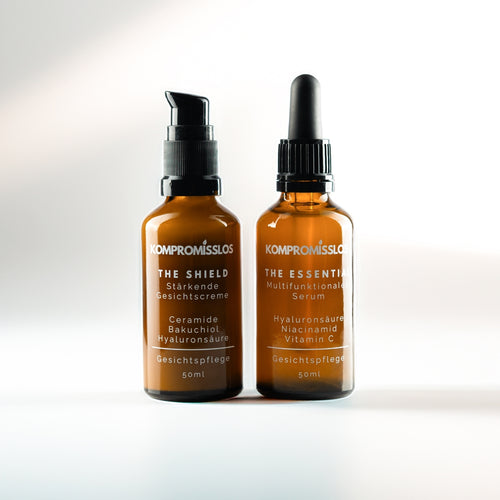
The Duo contains 1% zinc PCA, and that figure is published openly on our website. There is no zinc oxide in The Duo, and rightly so: a face cream you apply morning and evening should not leave a white layer or dry out your skin. Zinc PCA is therefore one component of your daily skincare, alongside niacinamide and the humectants, not a specialist remedy. What it cannot do is dry out an irritated spot overnight or shield a sore patch. That is what the zinc oxide cream in your medicine cabinet is for, and you do not need an extra product from me for it. You can look up which active ingredients The Duo contains and in what concentrations before deciding whether it suits your skin.
Frequently asked questions
Does zinc oxide cream dry out your skin?
Yes, zinc oxide dries out the surface of the skin a little, even though the base of the cream is greasy. On a single irritated patch, that is exactly what you want. Used every day all over your face, it can lead to tightness and flaky patches, because the cream supplies no humectants.
Does zinc oxide cream help with wrinkles?
No, there is no proven benefit of zinc oxide cream for wrinkles. It does not moisturise and contains no active ingredients that have been studied for wrinkles. In tested sunscreens, zinc oxide protects against UV light, which contributes to skin ageing. But a zinc oxide cream has no declared sun protection factor and is no substitute for sunscreen.
Is zinc oxide cream suitable for sensitive skin prone to redness?
Used on small areas, zinc oxide is usually well tolerated, but the base is not always as gentle. Some zinc creams contain lanolin, to which some people are allergic. Test a new cream on a small patch first. If you have rosacea, the question of suitable skincare belongs with a dermatologist, not in your medicine cabinet.
Does zinc oxide cream clog pores?
Zinc oxide itself is generally not considered pore-clogging, but the heavy, occlusive base can cause problems for blemish-prone skin if you apply it all over. There is hardly any reliable data on zinc oxide cream on the face specifically. Dabbed onto a single spot and washed off again in the morning, the risk is low.
Can I use zinc oxide cream with retinol?
Yes, there is no known interaction, but both can dry out the skin. So do not layer them on top of each other: leave out the individual spot when you apply retinol and put the zinc cream only there. What else works well with retinol is covered in the article on what to mix with retinol.
How long can zinc oxide cream stay on your face?
Leaving it on a small area overnight is common; wash it off thoroughly in the morning. Do not repeat this for more than a few days in a row. If the patch does not improve, gets bigger or starts to weep, have a doctor look at it instead of applying more cream. The instructions on the packaging take precedence.
Is the zinc in The Duo the same as in zinc oxide cream?
No. The Duo contains zinc PCA, a water-soluble zinc salt that is dissolved in the serum and leaves no white layer. Zinc oxide cream contains zinc oxide, an insoluble powder for covering the skin. For a single spot, you can use zinc oxide cream on that spot in addition to The Duo, ideally in the evening as the last step.
Sources
- Gupta M, Mahajan VK, Mehta KS, Chauhan PS. Zinc therapy in dermatology: a review. Dermatology Research and Practice, 2014. Source
- Abendrot M, Kalinowska-Lis U. Zinc-containing compounds for personal care applications. International Journal of Cosmetic Science, 2018. Source
- Cervantes J, Eber AE, Perper M, Nascimento VM, Nouri K, Keri JE. The role of zinc in the treatment of acne: a review of the literature. Dermatologic Therapy, 2018. Source
- Liu H, Yu H, Xia J, Liu L, Liu GJ, Sang H, et al. Topical azelaic acid, salicylic acid, nicotinamide, sulphur, zinc and fruit acid (alpha-hydroxy acid) for acne. Cochrane Database of Systematic Reviews, 2020. Source
- Proksch E, de Bony R, Trapp S, Boudon S. Topical use of dexpanthenol: a 70th anniversary article. Journal of Dermatological Treatment, 2017. Source