Vitamin C and AHA: same routine or keep them apart?
COMBINING ACTIVE INGREDIENTS
Yes, you can use vitamin C and AHA together in the same routine – just usually not at the same moment. Classic vitamin C (L-ascorbic acid) and AHAs are both formulated at an acidic pH, and when two acidic products go on straight after each other, the irritation adds up, especially on sensitive skin. The simplest solution is to separate them: vitamin C in the morning, the AHA on selected evenings. A stable form of vitamin C makes the combination less complicated, and because AHAs make your skin more sensitive to the sun, daily sun protection is a fixed part of the plan.
Can you use vitamin C and AHA in the same routine?
Yes, vitamin C and AHA can be used in the same routine – what matters is the gap between the two steps. The combination is not a problem in principle, but it does ask a lot of your skin. AHAs such as glycolic acid loosen the bonds between the cells in the outermost layer of the skin and make the surface smoother. Vitamin C is an antioxidant that helps the skin cope with oxidative stress during the day and is used for a more even-looking complexion. So the two have completely different jobs and are not competing for the same effect. The problem lies elsewhere: both are often formulated at an acidic pH, both can sting, and both often end up in routines that already include an exfoliant, an acid toner or a retinoid. The real question is therefore less whether the two ingredients get along and more whether your skin can handle the sum of them. Whether it should be an AHA at all depends on which acid suits which skin type – something best settled before you think about combinations.
Why does pH make combining vitamin C and AHA tricky?
pH makes the combination tricky because classic vitamin C and AHAs both work in a low pH range. A study in Dermatologic Surgery showed on pig skin that L-ascorbic acid has to be formulated at a pH below 3.5 in order to get into the skin. For AHA products, the US Food and Drug Administration (FDA) cites a safety threshold: the expert panel Cosmetic Ingredient Review considers them safe at a concentration of no more than 10% and when the final product has a pH of 3.5 or higher. Both product groups therefore sit firmly in the acidic range.
If you apply an L-ascorbic acid serum straight after an AHA product, your skin gets two acidic layers in quick succession. This typically shows up as stinging when you apply it, and later as redness or a feeling of tightness. The widespread worry that the two cancel each other out misses the point. What matters is the cumulative irritation, which rises with every additional acidic layer.
Which form of vitamin C works better with an AHA?
A stable form of vitamin C usually works better alongside an AHA than pure L-ascorbic acid, because it does not need a very low pH. L-ascorbic acid is the most thoroughly researched form, but it is unstable when exposed to air and relies on an acidic environment. Derivatives are chemically modified so that they stay more stable. One example is 3-O-Ethyl Ascorbic Acid, the stable form of vitamin C: a paper in the International Journal of Pharmaceutics: X describes it as a stable vitamin C derivative and measured its pKa at 7.72, considerably higher than that of ascorbic acid. For combining with an AHA, this means that a product containing this form does not have to be strongly acidic the way an L-ascorbic acid product does.
There is a caveat, though: not every derivative works equally well. In the Dermatologic Surgery study mentioned above, magnesium ascorbyl phosphate and ascorbyl palmitate did not increase the level of L-ascorbic acid in the skin. A derivative is therefore not a free pass; it comes down to the specific form and the formula.
Why is vitamin C in the morning and AHA in the evening usually the better option?
Using vitamin C in the morning and AHA in the evening is usually the better option, because each ingredient then works at its own time of day and your skin never has to deal with two acid layers at once. Vitamin C suits the morning because antioxidant protection is needed when UV light and environmental stressors hit the skin. AHAs suit the evening because the skin can rest afterwards and is not exposed to the sun. On top of that, using them at different times lets you see straight away which product is causing a reaction. Layering multiple serums in general is a topic of its own. For this particular pair, the sequence in the table is all you need.
| Option | How it works | Suits | What to watch out for |
|---|---|---|---|
| Split by time of day | Morning: vitamin C, skincare, sunscreen. On selected evenings: AHA, then skincare | Most skin types, including sensitive skin | Do not start with a daily AHA – begin with one or two evenings a week |
| Split by day | No vitamin C on AHA days, neither morning nor evening. On all other days, vitamin C as usual | Skin that quickly stings or feels tight | No additional exfoliant in the same week |
| One straight after the other | AHA first, wait until the skin is dry, then vitamin C, then skincare | Resilient skin, or vitamin C in a stable, less acidic form | With L-ascorbic acid only once your skin is well used to it; if it stings, go back to splitting them |
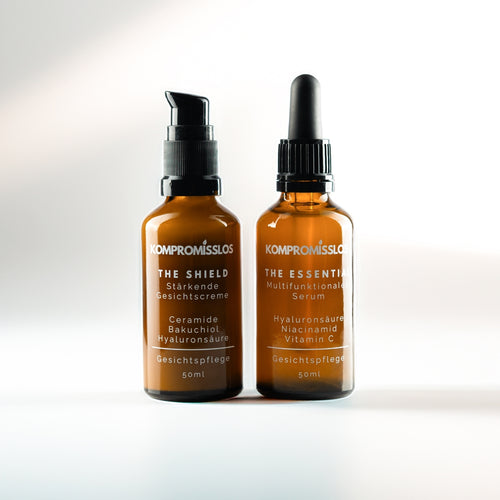
If you use The Duo of Essential serum and Shield cream, it stays your base morning and evening. The Duo contains no AHA, but 2% vitamin C as 3-O-Ethyl Ascorbic Acid, so it is not a strongly acidic L-ascorbic acid serum. On selected evenings, you therefore apply the acid first and follow with the serum once the acid has absorbed, choosing evenings without any other irritating steps. Then comes The Shield with ceramide NP and squalane, which support the skin barrier. During the day, add a separate sunscreen.
What does the combination mean for sun sensitivity and sun protection?
When it comes to sun sensitivity, the AHA is what matters most, and it makes daily sun protection non-negotiable for as long as you use it. A randomised, double-blind study in Photodermatology, Photoimmunology & Photomedicine applied 10% glycolic acid at pH 3.5 or a placebo to the backs of 29 participants for four weeks. The skin exposed to glycolic acid was more sensitive to UV light: more sunburn cells formed, and the minimum dose needed to cause redness fell. One week after stopping, no difference could be measured any more. The FDA sums up the research by stating that sensitivity to UV-induced redness increased by 18 per cent after four weeks of AHA use, and it recommends sun protection during use and for a week afterwards.
Vitamin C does not change this equation. It is an antioxidant, not a UV filter, so it does not replace SPF. If you use an AHA, protect your skin during the day with a product that contains SPF – even on cloudy days, and all the more so in the mountains.
When is vitamin C plus AHA too much for your skin?
The combination is too much for skin whose barrier is already irritated, and for skin with rosacea, perioral dermatitis or acute eczema. In these cases, stop the acid completely and have your skin assessed by a dermatologist rather than experimenting with cosmetics. Very dry or thinning skin, which becomes more common with age, often tolerates one of the two ingredients well, but not both together. Milder acids such as lactic or mandelic acid are often mentioned in this context, but they do not change the basic principle of cumulative irritation. And sometimes the most honest answer is that you do not need an acid at all. Whether that is true for you comes down to whether you need to exfoliate your face at all. These signs suggest the combination is too much for your skin right now:
- Burning or stinging as soon as you apply a cream you normally tolerate well
- Redness that lasts from the evening into the next day
- Shiny, tight skin that feels rough at the same time
- New flaking or dry patches around the nose and mouth
Do not start both ingredients in the same week. Introduce one product first, wait three to four weeks and then add the other. That way, if your skin reacts, you know where the reaction is coming from.
I deliberately chose vitamin C as 3-O-Ethyl Ascorbic Acid at a moderate concentration of 2%, rather than high-dose L-ascorbic acid. The reason ties in directly with this question: a stable form does not depend on a very low pH, and that is exactly what I wanted for a routine that runs morning and evening. There is no exfoliant in our range. If you want an AHA, you add it yourself where it makes sense – the base routine does not need one. Likewise, the cream has no sun protection factor, which is why a separate sunscreen belongs in your daytime routine, especially when an AHA is involved. We disclose which active ingredients are in the Duo and at what concentrations, so that you can judge combinations like this one for yourself.
Frequently asked questions
What comes first, AHA or vitamin C?
If you use both on the same evening, the AHA goes on first, then the vitamin C and finally your skincare. The acid should go directly onto cleansed skin. It is simpler, though, and gentler on most skin to keep vitamin C for the morning and the AHA for selected evenings.
How long should I wait between AHA and vitamin C?
There is no fixed waiting time backed by studies. The usual approach is to wait until the acid has fully absorbed and your skin is dry, which often takes a few minutes. If the vitamin C still stings, waiting longer rarely helps. In that case, splitting them by time of day is the better solution.
Can I use vitamin C the day after an AHA peel?
After an at-home AHA product, usually yes, as long as your skin is calm and not stinging. After an AHA peel at a beauty salon, follow the aftercare advice of the professional. Until your skin has settled, simple skincare plus sunscreen is a safer choice than an extra active ingredient.
Are products that combine vitamin C and AHA worth it?
They can be, if the formula as a whole is designed with tolerability and pH in mind, because the manufacturer then takes care of the balancing act. It becomes a problem if you also use an acid toner or an exfoliant on top. For sensitive skin, separate products are usually easier to manage, because you decide on your acid evenings yourself.
What should I do if my skin burns after vitamin C and AHA?
Rinse the products off with lukewarm water and leave out the acid for one to two weeks. During that time, a mild cleanser, simple skincare and sunscreen during the day are all you need. If redness or burning lasts for several days or blisters appear, see a dermatologist.
Can I combine vitamin C and AHA with niacinamide?
As a rule, yes: niacinamide is considered easy to combine, the concern about pairing it with vitamin C goes back to old laboratory experiments, and with an AHA, as always, what counts is the cumulative irritation from all your steps. The article on combining niacinamide and vitamin C explains why.
Can I use an AHA product with The Duo?
Yes, if you add the acid deliberately. The Duo contains no AHA, but vitamin C in the form of stable 3-O-Ethyl Ascorbic Acid. Use The Duo morning and evening as your base and apply the AHA before the serum on selected evenings. During the day, you need a separate sunscreen, because the cream contains no SPF.
Sources
- Pinnell SR, Yang H, Omar M, Monteiro-Riviere N, DeBuys HV, Walker LC, et al. Topical L-ascorbic acid: percutaneous absorption studies. Dermatologic Surgery, 2001. Source
- Kaidbey K, Sutherland B, Bennett P, Wamer WG, Barton C, Dennis D, et al. Topical glycolic acid enhances photodamage by ultraviolet light. Photodermatology, Photoimmunology & Photomedicine, 2003. Source
- Iliopoulos F, Sil BC, Moore DJ, Lucas RA, Lane ME. 3-O-ethyl-l-ascorbic acid: Characterisation and investigation of single solvent systems for delivery to the skin. International Journal of Pharmaceutics: X, 2019. Source
- U.S. Food and Drug Administration (FDA). Alpha Hydroxy Acids. Source