Skincare after Botox and fillers: what to do in the first few days
ROUTINE
Skincare after Botox and fillers is mostly about doing less in the first few days. On the day of treatment, leave the injection sites alone and ideally hold off on cream and make-up there until the next morning. After that, cleanse gently, apply a simple, fragrance-free moisturiser without pressure and pause retinol, exfoliating acids and peels until redness and swelling have settled. Exercise, saunas and strong sun come later. Whatever your clinic tells you always takes priority.
How should you care for your skin in the first few days after Botox and fillers?
In the first few days after Botox or fillers, keep your skincare as simple as possible: cleanse gently, apply products without pressure and do not try anything new. The reason is mundane. Every injection leaves tiny needle channels, and fillers in particular often bring mild swelling and sometimes a bruise as well. At this stage, every additional product is one more variable: if your skin stings or turns red, you can no longer tell whether it is the treatment or the new serum. The difference between the two procedures matters too. Botulinum toxin relaxes specific individual muscles, and the clinic’s main concern here is the product spreading in the first few hours. A hyaluronic acid filler, by contrast, is a gel that adds volume to the tissue, so swelling, bruising and pressure are the main issues. The same basic rule applies to both: during these days, skincare is a side issue and above all should not get in the way. Laser treatments and microneedling come with their own rules, which are not covered here.
| Phase | What you do | What you leave out |
|---|---|---|
| Day of treatment | Leave the injection sites alone, keep your hands clean, rinse gently with water only if needed | Cream, make-up, rubbing, massaging, exercise, heat |
| First few days | Gentle cleansing, fragrance-free skincare applied without pressure, sun protection | Retinol, exfoliating acids, peels, cleansing brushes, sauna |
| Once your clinic gives the go-ahead | Bring back your usual routine step by step | Reintroducing everything at once |
When can you wash your face and moisturise again after treatment?
Rinsing gently with plain water on the evening of the treatment is usually fine, but it is best to hold off on cream, cleansers and make-up on the injection sites until the next morning. That is also the view of a guideline from the UK’s Complications in Medical Aesthetics Collaborative, published in the Journal of Clinical and Aesthetic Dermatology: avoiding make-up and other over-the-counter products for at least 12 hours is described as prudent advice. The authors are candid about it: standard aftercare instructions apply for 4 to 12 hours, there is no solid evidence behind them, and the period probably corresponds roughly to the time it takes the needle channels to close. So this is about caution, not a proven limit.
For washing itself, that means lukewarm water and your fingertips rather than a flannel or brush, then patting dry instead of rubbing. Wash your hands first – the guideline recommends exactly that, so that no germs get from your fingers into fresh injection sites. From the next day, you can usually go back to your gentle cleanser, unless your clinic says otherwise.
Why should you avoid rubbing or massaging the treated areas?
You should avoid rubbing or massaging the injected areas because, after Botox, pressure could in theory push the product into neighbouring muscles, and fresh filler sites can respond with more swelling or bruising. With Botox, experts now take a more critical view of how big that risk really is. A retrospective study in the journal Toxins, covering 5,014 patients from six Italian centres, dropped the usual rules for the first 4 hours and gave instructions for the first 10 minutes only. No drooping of the upper eyelid occurred, and side effects were seen in 5.99 per cent of the 4,000 patients who were followed up, most commonly mild bruising. The authors themselves stress that there was no control group. For you, this means there is no need to panic, but rubbing will not do you any good during these days either. With fillers, it is up to the clinic in any case whether and how any reshaping is done. A facial massage, a facial roller or working your cream in firmly is no substitute for that and can wait until the areas have settled.
Which active ingredients should you pause after Botox and fillers, and for how long?
You should pause anything that deliberately irritates the skin or removes its outer layer: retinol and other retinoids, exfoliating acids, scrubs and cleansing brushes, plus products with fragrance or essential oils that your skin has reacted to in the past. There is no study that sets the right length for this break, and clinics give different time frames. A sensible guide is therefore not a date but a state: the injection sites have closed, redness and swelling have settled, and your clinic has no objections. If you regularly use AHAs, BHAs and other acids, the same rule applies to them as to retinol: they are the last to return to your routine.
Humectants and barrier lipids such as hyaluronic acid, glycerin, ceramides, squalane or panthenol usually need no break once skincare is allowed on the skin again. Incidentally, the hyaluronic acid in a serum has nothing to do with a hyaluronic acid filler: the filler is a cross-linked gel beneath the skin, while the serum binds moisture in the upper layers of the skin.
| Active ingredient or product | In the first few days | Why |
|---|---|---|
| Retinol, retinal, retinoids | Pause | Can irritate and cause flaking |
| AHA, BHA, PHA, peels | Pause | Remove the outermost layer of skin and sting on fresh injection sites |
| Fragrance, essential oils | Leave out | Unnecessary potential for irritation with no skincare benefit |
| Hyaluronic acid, ceramides, squalane | Fine once skincare is allowed again | Provide moisture and support the skin barrier |
| Sun protection | Daily, once products are allowed again | Freshly irritated skin does not cope well with UV exposure |
When can you go back to make-up, exercise, saunas and sun?
Make-up is usually fine again from the next day, strenuous exercise should wait at least 24 hours after fillers, and many clinics give even longer periods for saunas and strong sun. For make-up, the British guideline mentioned above gives at least 12 hours. When you start again, use clean brushes or a fresh sponge and dab rather than spread. How long to wait between skincare and make-up is covered in the article on skincare before make-up. For exercise after fillers, a Spanish-Portuguese expert panel writing in Aesthetic Plastic Surgery recommends avoiding strenuous exertion for 24 hours to reduce bruising and swelling. For Botox, the study in Toxins lists the usual instructions for the first 4 hours: stay upright, no physical activity, no direct sun and no sources of heat. However, these rules are based mainly on experience.
There is no robust study on the right break from saunas, steam rooms and sunbeds, so ask your clinic specifically. How to look after your face afterwards in general is covered in the article on sauna and your face. As for the sun: shade and a hat in the first few days, and once products are allowed again, your usual sunscreen for your face, applied without rubbing.
When does it make sense to go back to your normal routine?
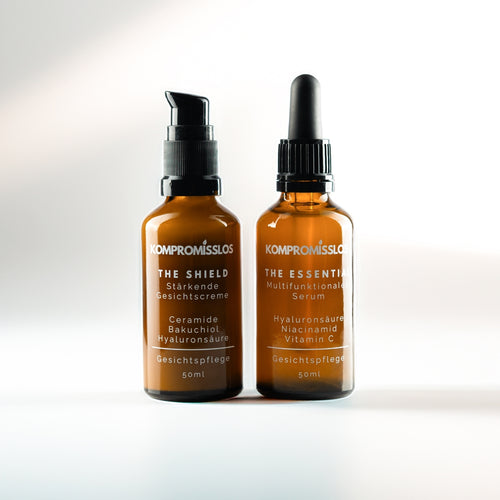
Your normal routine makes sense again once the injection sites look unremarkable and your clinic no longer mentions any restrictions – starting with the gentle steps and bringing back the irritating ones last. You do not need a special aftercare line for this. Once skincare is allowed again and your clinic has no objections, a calm, basic routine is enough: fragrance-free, without essential oils, without exfoliating acids and without retinol. The Duo of serum and cream fits into this window. The Essential contains hyaluronic acid in three molecular sizes and niacinamide – 5% niacinamide, calculated for The Duo as a whole. On top of that comes The Shield with ceramide NP, squalane and bakuchiol instead of retinol. During these days, apply both gently, without pressure on the injected areas. Skincare has no influence on how the treatment heals or on its result; during this time, its main job is simply not to get in the way.
- Gentle cleansing and a simple, fragrance-free moisturiser as soon as products are allowed again.
- Sunscreen every morning as the last step, even with The Duo, because the cream has no sun protection factor.
- Any additional serums and concentrated actives you normally use, once nothing stings or feels tight any more.
- Retinol, acids and peels last, and less often than usual at first.
If your skin still feels tight or stings with every product after several days, your barrier may already have been at its limit beforehand. In that case, it is worth looking at what a damaged skin barrier really needs rather than trying out more products.
When should redness, swelling or lumps send you back to your clinic?
Redness, swelling or lumps should send you back to your clinic as soon as they get worse rather than settling, and you should go to your clinic or an emergency department straight away if severe pain, whitish, blotchy or bluish skin, or problems with your vision come on as well. An expert consensus in Aesthetic Plastic Surgery names pain and changes in skin colour as the two main signs of a blocked blood vessel after fillers; eye symptoms such as blurred vision, loss of vision or eye pain require immediate assessment by an eye specialist. A review in Dermatologic Surgery compiled 98 cases of visual changes after fillers from the medical literature worldwide; the most common symptoms were immediate loss of vision and pain. This is rare, but that is exactly why you must not wait and see with signs like these.
You should also have redness, warmth and swelling checked if they get stronger rather than weaker after a few days, as well as lumps that do not go away or only appear later. According to the same consensus, delayed-onset lumps can appear from 4 weeks to 1 year or even longer after treatment and are usually inflammatory or caused by an infection. In all of these cases, the rule is the same: no self-treatment with creams, heat or massage – call your clinic instead.
A small bruise, slight redness or small raised bumps at the injection sites are common right after treatment and usually settle on their own. If you are unsure, take a photo and send it to your clinic – that is quicker than any amount of searching online.
I deliberately made The Shield without fragrance and with bakuchiol instead of retinol. After a treatment, that pays off in an unspectacular way: you do not have to swap out your routine, just pause it briefly and then carry on gently. What I cannot promise: no cream extends the effect of Botox or fillers. Because the cream contains no sun protection factor, you need separate sun protection during the day. And whatever your doctor tells you takes priority over anything I write here. Normally, I recommend massaging serum and cream in from the centre of your face outwards. In the days after an injection, apply both without pressure instead.
Frequently asked questions
Can I use hyaluronic acid after Botox?
Yes, a serum with hyaluronic acid is generally not a problem after Botox once skincare is allowed on the injection sites again – usually from the next morning. Apply it without pressure. It has nothing to do with a hyaluronic acid filler: the serum binds moisture in the upper layers of the skin, while the filler is a cross-linked gel beneath the skin.
Can I moisturise on the evening after treatment?
Better not on the injection sites. A guideline from the Complications in Medical Aesthetics Collaborative considers it prudent to avoid make-up and other over-the-counter products for at least 12 hours. In the evening, a gentle rinse with water is therefore enough, and you moisturise the next morning. If your skin feels very tight, ask your clinic what it recommends for the first night.
How long should I avoid retinol after fillers?
There is no fixed, evidence-based time frame. A sensible guide is to start using retinol again only when the injection sites have closed, swelling and redness have settled and your clinic has no objections. Then begin with a few evenings a week rather than going straight to daily use, so that you notice any irritation early.
Can I sleep on my face after Botox?
On the first night, it is better to sleep on your back, especially after fillers, where pressure on freshly injected areas serves no purpose. After Botox, staying upright for the first 4 hours is one of the usual instructions. A large retrospective study in Toxins questions whether rules lasting that long are necessary, but it had no control group.
Does a moisturiser help Botox last longer?
No, there is no evidence for that. How long Botox works depends on the preparation, the dose and the muscle treated, not on the cream on top. Good skincare can make your skin look smoother, but it does not prolong the muscle relaxation. A separate article explains what so-called Botox creams can really do and where they stop.
Do I need a special aftercare cream after Botox?
Usually not. After Botox or fillers, a simple, fragrance-free moisturiser without retinol and without exfoliating acids, applied without pressure, is enough. Special aftercare products are not a must. If your clinic gives you a particular product, use it the way they explain and leave out anything extra during that time.
Can I use The Duo after Botox or fillers?
Yes, as soon as your clinic allows skincare on the skin again, usually from the next day. The Duo is fragrance-free and contains no essential oils, no retinol and no exfoliating acids. For the first few days, apply serum and cream without pressure rather than massaging them in, and add sunscreen during the day. The Duo has no influence on how the treatment heals or how long it lasts.
Sources
- Santorelli A, Salti G, Cavallini M, Fundarò SP, Basso M, Ponzo M et al. Are Post-Care Recommendations Following Upper-Face Botulinum Toxin Treatment Scientifically Necessary? A Retrospective Study Based on 5000 Patients. Toxins, 2025. Source
- Davies E, Vaghela D, Convery C, Walker L, Murray G. Guideline for the Prevention, Diagnosis, and Management of Acute Bacterial Soft Tissue Infections Following Nonsurgical Cosmetic Procedures. Journal of Clinical and Aesthetic Dermatology, 2021. Source
- Urdiales-Gálvez F, Delgado NE, Figueiredo V, Lajo-Plaza JV, Mira M, Moreno A et al. Treatment of Soft Tissue Filler Complications: Expert Consensus Recommendations. Aesthetic Plastic Surgery, 2018. Source
- Beleznay K, Carruthers JD, Humphrey S, Jones D. Avoiding and Treating Blindness From Fillers: A Review of the World Literature. Dermatologic Surgery, 2015. Source