Pillowcase breakouts: which everyday habits really matter and what’s a myth
SKIN CONCERNS
A pillowcase alone does not cause breakouts, but it can contribute to them: sebum, skin flakes and traces of skincare and hair products collect on the fabric, and your face spends hours pressed against it every night. The same principle applies to your phone, your hands, your towel and your make-up sponge. What is well documented is mainly that repeated pressure and friction encourage blemishes where the contact happens. Fixed rules for how often to change your pillowcase, and silk as the answer, are more rule of thumb than research finding.
Can a pillowcase cause breakouts?
A pillowcase cannot cause spots out of nowhere, but if your skin is already prone to blemishes, it can encourage them. Two things come together here. The first is residue: night after night, sebum, dead skin cells and traces of cream, sunscreen and hair styling products end up on the fabric and from there back on your skin. The second is mechanics: your face spends the whole night on the same spot under the weight of your head, often warm and slightly damp. That pressure and friction can trigger blemishes has been known for a long time. In 1975, the dermatologists Mills and Kligman summed this up in the Archives of Dermatology under the term acne mechanica: local flare-ups caused by pressure, friction, rubbing, squeezing or stretching. Their examples come from clothing, sports equipment and working life, but the principle applies just as well to sleeping on your side. One possible clue is therefore a pattern: the spots appear on the cheek you sleep on and hardly at all on the other one.
It is important to keep this in perspective. Whether your skin is prone to blemishes in the first place depends on predisposition, sebum production and hormones. The pillowcase is an amplifier, not a cause. The basics are covered in the article on blemish-prone skin, its causes and what actually helps.
How often should you change your pillowcase if you’re prone to breakouts?
If you are prone to breakouts, changing your pillowcase once a week is a sensible starting point, or every two to three nights if the spots appear on the side you sleep on. That said, no fixed schedule has been backed by controlled studies. The closest thing is a retrospective analysis in the Journal of Cosmetic Dermatology: among 218 acne patients, acne came back after treatment in 105 cases, and changing the pillowcase weekly emerged in the analysis as a protective factor. That is an association, not proof. People who change their pillowcase every week may well take more care of their skin in other ways too. For everyday purposes, the finding is still enough: the effort is small, there is no risk, and it is one of the few everyday factors that are entirely within your control. Wash the pillowcase as hot as the care label allows, and don’t forget the pillow underneath altogether. Its filling also absorbs moisture and residue over time.
If changing it three times a week means too much laundry, turn the pillow over after one night so that you sleep on the unused side of the pillowcase, or lay a freshly washed cotton cloth over it. That way your face rests on a clean surface even without a fresh pillowcase.
Does a silk pillowcase help with breakouts?
A silk pillowcase creates less friction than coarse cotton, but there is no evidence that it reduces breakouts. The idea behind it makes sense: if friction encourages blemishes, a smoother surface ought to help. You will also often read that silk draws less moisture from the skin than cotton, but there is no solid data for that either. So far, there are no studies showing that silk leads to fewer spots in people with blemish-prone skin. What a silk pillowcase definitely does have is a practical drawback: it usually only tolerates low temperatures and delicate cycles, which makes it tempting to wash it less often. A silk pillowcase left on the bed for two weeks is probably worse for your skin than a cotton one that goes in the machine every week. If you like silk and wash it just as often, there is nothing against it. If your main concern is spots, a smooth cotton pillowcase that you can wash hot is the more practical choice. How often you change your pillowcase probably matters more than what it is made of.
How much do your phone and hands contribute to breakouts?
Your phone and hands mainly encourage breakouts where they regularly rest on your skin with pressure, warmth and friction – not through a single touch. During a call, the screen presses against your cheek and jaw for minutes at a time, it warms up, and sebum and traces of make-up stick to the glass. An experiment from the same paper by Mills and Kligman shows how much occlusion and pressure can do: when acne-affected skin was sealed under an adhesive dressing for two weeks, new inflamed spots appeared consistently, developing from tiny blackhead precursors, invisible to the naked eye, that had ruptured. With your hands, what matters most is how often they end up on your face. In its tips for people with acne, the American Academy of Dermatology states that touching your face throughout the day can make acne flare. In everyday life, that mainly means resting your chin on your hand, rubbing your cheek and fiddling with particular spots.
Two related topics are covered elsewhere. If your spots appear almost exclusively on your chin and jawline, you will find the links with hormones and habits in the article on what’s behind spots on your chin and jawline. And if touching turns into squeezing, read why you should leave spots alone rather than squeeze them.
Which other everyday objects touch your face, and which ones really matter?
Besides your pillow and phone, the main things that touch your face are your towel, make-up brushes and sponges, glasses, and headphones or a helmet – and the ones that matter most are those that sit on the same spot every day for long periods. The evidence is clearest for make-up tools. A study in the Journal of Applied Microbiology analysed used cosmetics from the UK: make-up sponges were the most heavily contaminated with microbes, and 93 per cent of them had not been cleaned. The study did not look at spots, but it does show how much builds up on a damp sponge. With glasses and headphones, it is again a matter of pressure and friction on the same points, such as the bridge of the nose or just in front of the ear. Hair, hair products and a fringe resting on your forehead are a separate topic with rules of their own. Sweat left on your skin under a headband or cap after exercise is another of the factors that are easiest to get rid of, simply by rinsing your face after training.
| Object | How often it touches your face | What is realistically enough |
|---|---|---|
| Pillowcase | Every night, for several hours under pressure | Change it weekly, or every two to three nights if you get spots on the side you sleep on |
| Phone | With every call, often for minutes against the same cheek | Wipe the screen regularly; use headphones or speaker mode for longer calls |
| Towel | Once or twice a day | A separate face towel, changed often; pat dry instead of rubbing |
| Make-up brushes and sponges | Every time you apply make-up | Rinse sponges after use and let them dry; clean brushes regularly with mild soap |
| Glasses and sunglasses | All day on your nose and cheekbones | Clean the nose pads and arms now and then with water and a little soap |
| Headphones and helmet | For hours at a time, often with warmth and sweat | Wipe the pads and straps; rinse your skin briefly with water afterwards |
One question often comes up alongside this: is it the object, or what you put on your skin? If a product itself is under suspicion, it helps to look at what comedogenic means and which ingredients count as pore-clogging, and why the lists are less reliable than they seem.
How can you tell whether a habit is causing your breakouts?
The most reliable way to tell whether a habit is triggering your breakouts is a simple elimination test: change one thing, keep everything else the same and observe for three to four weeks. The most important clue is location. Spots encouraged by mechanical factors follow the contact area, so they appear on one side only, along a strap or exactly where your phone or glasses rest. If, on the other hand, the blemishes are spread evenly, habits tend to play a minor role. In that case, it is more worthwhile to look at your skincare, your cycle and your predisposition than at your pillowcase. The waiting period is necessary because new spots develop over days to weeks, and a single calm morning does not prove anything yet. Just as important: don’t introduce any new products during this time, or you won’t know in the end what made the difference. Periods of heavy pressure at work can also distort the picture – more on that in the article on what chronic stress does to your skin barrier and complexion.
- Make a note: where exactly are the spots, and which objects regularly rest there? A photo once a week in the same light helps.
- Change one habit: for example, change your pillowcase every two to three nights, or only take calls with headphones.
- Keep your skincare the same: the same cleanser, the same products and no new active ingredients during these weeks.
- Compare after three to four weeks: if the affected area calms down, the habit played a part. If not, the main cause lies elsewhere.
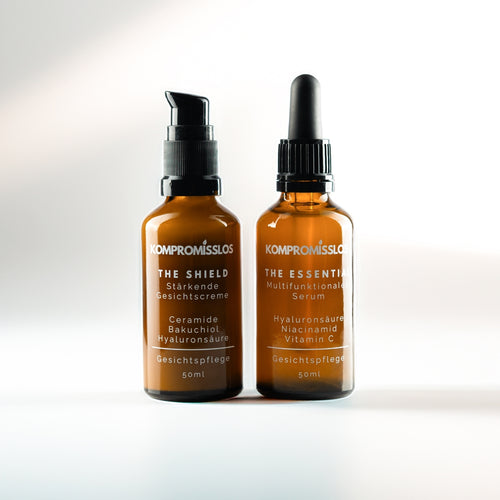
The shorter your routine, the fewer variables this test has. With The Duo of serum and cream, your skincare stays manageable: The Essential serum contains niacinamide and zinc PCA for a more even-looking complexion, while The Shield cream uses ceramide NP and squalane to support the skin barrier, which constant rubbing and cleansing can put under strain. The Duo as a whole contains 5% niacinamide and 1% zinc PCA. If you have painful lumps, lasting scars or spots that are spreading, this test is not the right approach. In that case, see a dermatologist.
I deliberately pared Kompromisslos down to two products, and this topic shows a side effect of that decision: the fewer jars, brushes and bottles there are in your bathroom, the less there is to come into contact with your fingers and face in the first place. You apply the serum drop by drop and pump out the cream, then spread both from the centre of your face outwards, as described on the page on how to apply the serum and cream. Wash your hands beforehand – no further hygiene ritual is needed. Both products are fragrance-free, so no added fragrance comes into play when your skin is already irritated. To be honest, though, no cream can make up for a pillowcase that has been on the bed for three weeks, or for a phone pressed against your cheek for an hour every day. And if it looks like acne, it should be assessed by a dermatologist.
Frequently asked questions
Should I use a separate towel for my face if I get spots?
Yes, a separate face towel is a simple and sensible habit if you get spots. Your body towel picks up residue from shower gel, body lotion and hair products that you don’t need on your face. Change your face towel every few days, let it dry thoroughly in between and pat your skin dry rather than rubbing it.
How often should I clean make-up brushes and sponges?
Rinse out sponges after every use and let them dry completely, and clean brushes used for liquid products at least once a week. That is a guideline, not a figure from a study. What is clear is that damp sponges collect a particularly large number of microbes. Mild shampoo or soap and lukewarm water are all you need.
Is it bad to sleep in your make-up once?
Sleeping in your make-up once is no disaster, but it is not a good habit. The residue stays on your skin all night and also ends up on your pillowcase, which you will lie on again over the next few nights. If it does happen, cleanse thoroughly in the morning and change the pillowcase. How to take off your make-up in the evening without stressing your skin is covered in the article on what kind of cleanser your skin really needs.
Do I need to disinfect my phone?
You don’t need to disinfect your phone for the sake of your skin; cleaning it regularly is enough. What mainly sticks to the screen is sebum and traces of make-up, which you press back against your cheek on your next call. A soft, slightly damp cloth every few days will do, and for cleaning products, follow the manufacturer’s instructions. More effective than any cloth is using headphones or speaker mode for longer calls.
Does the detergent I wash my pillowcases with matter?
When it comes to breakouts, your detergent matters less than how often you change the pillowcase. Fragrances in detergent and fabric conditioner can irritate sensitive skin, though, and that tends to show up as redness, burning or itching rather than as spots. If your skin is prone to both, a fragrance-free detergent without fabric conditioner is an easy thing to try that costs nothing but a switch.
Can changing your habits help with acne too?
Habits can reduce contributing factors in acne, but they do not replace treatment. Acne is a skin condition whose course depends mainly on sebum production, keratinisation, skin flora and inflammation. A fresh pillowcase or keeping your phone away from your cheek removes pressure and residue, nothing more. With inflamed lumps, scars or a lot of distress, a dermatologist is the right person to see – and early on.
Does The Duo suit skin that reacts to friction and contact with breakouts?
Yes, The Duo can be a good fit: it is a fragrance-free routine with just two steps, designed with sensitive skin in mind, including skin that is prone to blemishes and quickly looks irritated by friction. Niacinamide and zinc PCA in the serum support a more even-looking complexion, while ceramide NP and squalane in the cream support the skin barrier. It does not replace the habits in this article; it complements them. You can find out more about what goes into it on the page for The Duo.
Sources
- Mills OH, Kligman A. Acne mechanica. Archives of Dermatology, 1975. Source
- Guo K, Lu Z, Deng H, Shao Y. Risk Factors of Acne Recurrence After Treatment and Establishment of an Early Warning Model. Journal of Cosmetic Dermatology, 2025. Source
- Bashir A, Lambert P. Microbiological study of used cosmetic products: highlighting possible impact on consumer health. Journal of Applied Microbiology, 2020. Source
- American Academy of Dermatology. Acne: Tips for managing. AAD, accessed 2026. Source