Junglück alternative from Switzerland: what to look for when you switch
BUYING AND BRAND
If you’re looking for a Junglück alternative in Switzerland, three criteria matter most: clear percentages for the active ingredients, a range size that suits your routine, and an offer where ordering, pricing and returns all run entirely in Swiss francs. The brand name alone tells you little about any of this.
What sets Junglück apart?
Junglück is a German cosmetics brand, founded in 2018, that sells its products mainly direct to consumers. You can recognise it by its brown glass bottles, by the absence of fragrance, silicones, parabens and mineral oil, and by an aloe vera base that takes the place of water in many of its formulas. The brand deliberately works without an official natural cosmetics seal and is open about this. Its range is broad, extending from face and body care to hair care and sets for specific skin needs. For Switzerland, the brand runs its own shop with prices in francs and duty-paid delivery; production itself takes place in Germany. So anyone looking for an alternative is usually not looking for something completely different, but for the same basic approach in a different shape: fewer bottles in the bathroom, a company based in Switzerland, or clearer information on how much of an active ingredient is actually in the bottle.
These three wishes vary in how hard they are to meet. You can get fewer bottles from any brand that deliberately cuts back. Location is a matter of research, and there are now quite a few brands based in Switzerland. Stating concentrations, on the other hand, is an active decision – and it is the best way to tell brands apart.
Which criteria really count when you compare?
When you compare two skincare brands, five criteria count more than anything else: the stated concentrations of the active ingredients, the number of products you need to get a result, the buying process including currency and returns, the payment methods available, and how traceable the reviews are. Everything else is a matter of taste. Packaging design, being fragrance-free and sustainability promises hardly differ any more between serious brands, because they have long been standard and are therefore no longer a deciding factor. What does differ is a brand’s willingness to give concrete figures and to keep its range deliberately small. So don’t ask which brand seems more likeable or is better photographed, but which gives you more verifiable information – and which of that information you can actually look up in everyday life. The overview below shows how to recognise each of the five criteria without needing specialist knowledge or having to decode an INCI list.
| Criterion | Why it matters | How to recognise it |
|---|---|---|
| Stated concentrations | Without a percentage, it remains unclear whether an active ingredient is dosed to be effective or is only there for decoration. | A percentage right next to the active ingredient, not just the word “high-strength”. |
| Number of products | The more individual products, the more of the combining work falls to you. | The number of steps a brand recommends to get a result. |
| Buying and returns | Currency, delivery route and returns address determine how much effort a complaint involves. | Prices in francs, information on customs duties and a clear return period. |
| Payment methods | A lack of local payment options is a common reason for abandoning a purchase from abroad. | Twint, credit card, Apple Pay or Klarna at checkout. |
| Reviews | Only reviews you can filter show whether the positive voices are recent. | Number, average and date of the individual reviews. |
What changes when you buy in Switzerland?
Buying in Switzerland changes four things compared with ordering from abroad: the currency, customs clearance, the delivery time and the route a return takes. As long as a foreign company runs its own Swiss shop with prices in francs and duty-paid delivery, the difference at the point of purchase is small. You only notice the difference when something isn’t right or a delivery fails to arrive. At that point, what matters is where the parcel goes back to, how long that takes and who pays for the return. With us, both stay within Switzerland: delivery costs CHF 3.70 and is free on orders over CHF 60, it takes 1 to 3 working days, and you have a 100-day right of return. You can pay with Twint, credit card, Apple Pay or Klarna. Check these four points before every order, whichever brand you choose in the end.
Before her first order, one customer wrote to tell us she had previously bought from a German brand and had been happy with it. She wanted to change two things: fewer bottles in the bathroom, and a company where ordering and returns stay entirely within Switzerland. Her real question wasn’t whether our serum was better, but whether two products would be enough when she had previously combined several. Our answer was honest: you only find out if your previous routine doesn’t carry on in parallel, but The Duo is used on its own and your skin is given time.
What should you look for in stated concentrations?
When it comes to stated concentrations, look for three things: whether a percentage is given at all, what that figure refers to, and whether it fits the ingredient’s position in the INCI list. The term “high-strength” is not protected and means nothing on its own. A number, by contrast, can be put into context and compared with other products. At Junglück, some products state percentages directly in the product name and others don’t – and most brands handle it in a similar way. The frame of reference also matters: a percentage can apply to a single product or to an entire routine. We always give our figures for The Duo of serum and cream together, never for a single product, because the two steps are designed to work together. You’ll find what each figure stands for in our ingredients overview.
Specifically, The Duo contains 5% niacinamide, 2% hyaluronic acid, 2% vitamin C as 3-O-Ethyl Ascorbic Acid, 2% gentian root extract, 2% edelweiss extract, 1% zinc and 0.3% bakuchiol, plus ceramides, squalane, panthenol, jojoba oil, aloe vera, vitamin E and tamarind seed extract, without a stated percentage. When comparing, it helps to know which vitamin C percentage makes sense and at what point niacinamide counts as high-strength.
How does our Duo differ from a broad range?
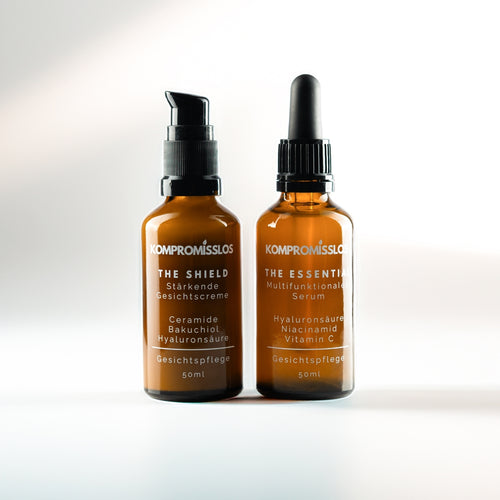
The difference lies in how many decisions you have to make yourself. A broad range of individual products gives you freedom: you combine active ingredients as needed, swap individual steps and put your routine together yourself. That assumes you know which active ingredients complement each other and which you’d be better off not applying on the same evening. Our range consists of two products, The Essential serum and The Shield cream, which are sold together as The Duo for CHF 109.90. The combining work is done before you order, and you don’t have to learn an order of application or waiting times between steps. The price is higher than two individual products from the chemist and lower than the combined cost of a multi-step routine made up of many individual serums. Which option suits you better depends solely on whether you like combining products yourself or would rather not.
To be fair, there is also a case against: if your current skincare works, your skin is calm and you feel good with it, you don’t need to switch. Changing brands just because another one seems more likeable costs money and involves a period of adjustment. You can read how others experienced the switch in our customer reviews, and we’ve written separately about what to look out for when reading reviews.
At Kompromisslos, I deliberately built two products rather than a range, and it was an uncomfortable decision. A broad range is easier to sell, because every additional bottle is another reason to buy. I decided against it because I didn’t want to outsource the work of combining products to you. Anyone who sells seven individual serums also sells, with each one, the task of fitting it in correctly. For the same reason, we always give the percentages for The Duo as a whole and never for the serum or cream alone: separate figures would suggest a precision that doesn’t exist with two steps designed to work together. Dominic Bertschin
Frequently asked questions
Is there a Swiss alternative to Junglück?
Yes, there are several vegan skincare brands in Switzerland with a similar basic approach, including Kompromisslos with The Duo of The Essential serum and The Shield cream for CHF 109.90. The difference lies less in the philosophy than in the size of the range and in how specifically the concentrations of active ingredients are stated.
Is Junglück available in Switzerland?
Yes, the brand runs its own shop for Switzerland with prices in francs and duty-paid delivery; production takes place in Germany. Before you order, check how long delivery takes, where a return goes and which payment methods are available at checkout.
What should you look for when switching skincare brands?
Look for concentrations stated as percentages, the number of products needed for a result, and the buying process, including currency, delivery time and return period. Also, don’t change everything at once – give your skin time to adjust to the new skincare.
Are two products enough instead of a whole range?
For most skin conditions, two coordinated steps – serum and cream – are enough. A larger range is worthwhile if you want to fine-tune individual active ingredients or tackle several concerns separately. If you don’t want to combine products yourself, a fixed pair is simpler.
What does high-strength mean for a serum?
High-strength is not a protected term and, without a percentage, says nothing about the actual amount. Only a specific figure with a frame of reference is meaningful. In The Duo, it’s 5% niacinamide, 2% hyaluronic acid, 2% vitamin C as 3-O-Ethyl Ascorbic Acid and 0.3% bakuchiol, each based on the serum and cream together.
Is it worth switching if my skincare works?
No – in that case, you don’t need to switch. Swapping a routine that works costs money and involves a period of adjustment. A switch only makes sense once something specific bothers you, such as too many steps, missing concentration details or a cumbersome returns process.